

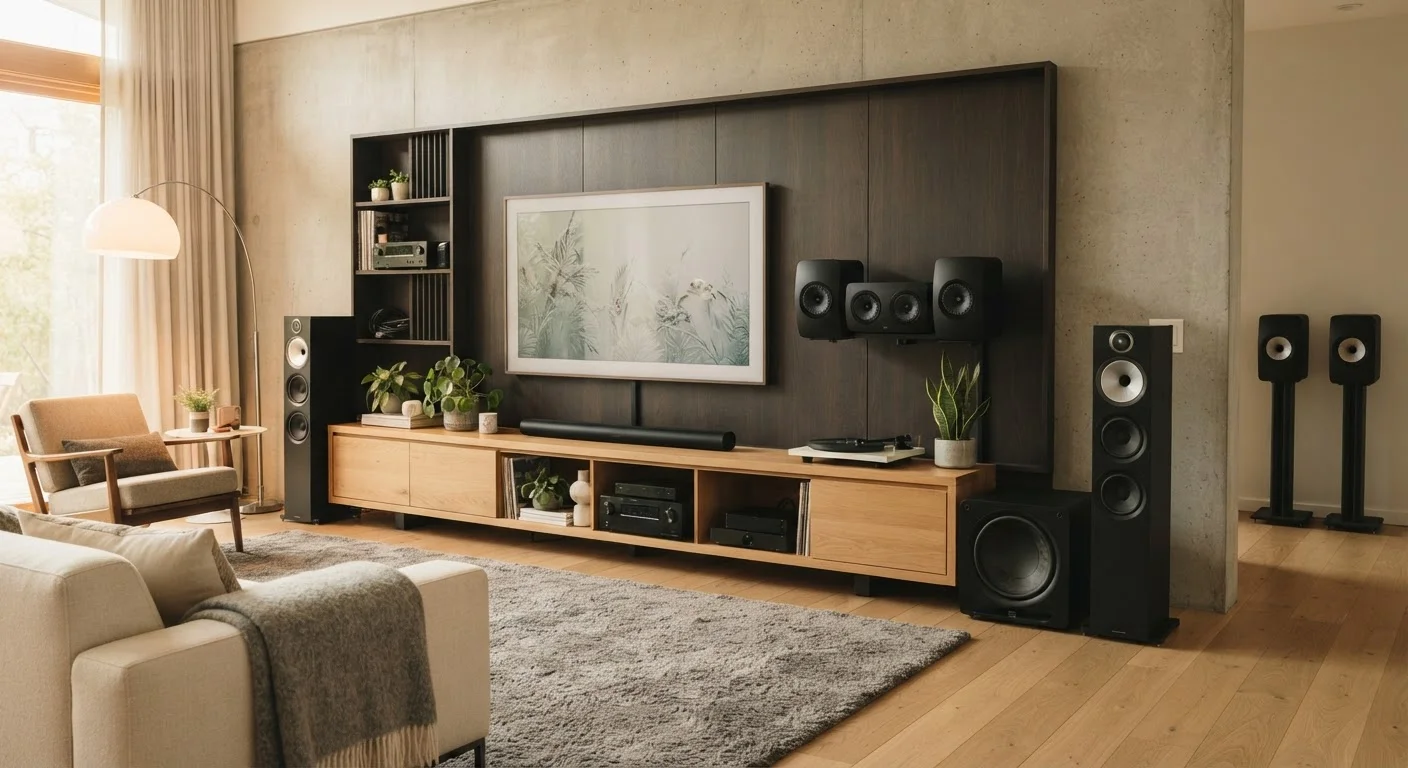
Our Verdict
Soundbars, bookshelf speakers, and home theater systems each occupy a distinct place on the complexity-versus-performance spectrum. None is objectively superior - what matters is matching the format to your actual room, habits, and priorities. Most listeners benefit from starting with one clear goal, whether that's cleaner TV dialogue or full cinematic surround sound, and choosing the format built around that goal.
| Best for | Recommended |
|---|---|
| Renters, small spaces, or casual TV listeners | Soundbar |
| Music-first listeners wanting stereo depth without clutter | Bookshelf Speakers |
| Dedicated home theater rooms and immersive movie watching | Home Theater System |
| Those working within strict time or cost constraints | Soundbar |
Why the Format You Choose Matters More Than the Price Tag
Most people shopping for home audio focus on price first and format second. That's an easy way to end up with a system that sounds technically fine but doesn't fit the room or how you actually use it. Understanding what each audio format is designed to do - and what it's not - is the more useful starting point.
Before diving into the three formats, it helps to know what you're upgrading from. If you're currently relying on a flatscreen TV's built-in speakers, almost any of these options will feel like a significant improvement. The question is how much improvement you need, and at what cost in terms of space, setup time, and budget. For a deeper foundation, see our Home Audio for Beginners guide before committing to any format.
Soundbars: The One-Cable Upgrade
A soundbar is a single elongated speaker enclosure designed to sit below or above a television. It houses multiple drivers - small speaker units - arranged to spread sound horizontally and sometimes simulate surround effects using acoustic reflections or signal processing.
What soundbars do well: They are easy to install, require one or two cables, and take up almost no space. Many connect via HDMI ARC (Audio Return Channel), meaning your TV remote controls the volume. Some include a wireless subwoofer for added bass. Soundbars are particularly effective at improving dialogue clarity, which is the most common complaint about flat TV speakers.
Where they fall short: Soundbars rely heavily on processing to simulate effects that dedicated speakers produce physically. Virtual surround sound is a real phenomenon, but it is not the same as having speakers positioned around the room. Dynamic range - the difference between the quietest and loudest moments - is also more limited compared to larger speaker systems.
If your main goal is better TV audio without rewiring a room, getting the most out of a soundbar without adding extra equipment is a practical place to start.
Start With What Bothers You Most
If muffled TV dialogue is your main frustration, a soundbar with a dedicated center channel is likely your fastest fix. If you feel like your music sounds flat and dimensionless, a stereo speaker pair will make a more immediate difference. Diagnosing the specific problem first narrows your options quickly and avoids overspending on capability you won't use.
Bookshelf Speakers: Serious Stereo in a Compact Form
Bookshelf speakers are compact, two-channel speakers designed for stereo listening. Unlike soundbars, they are separate units - one for the left channel, one for the right - and they reproduce music and dialogue with a level of spatial accuracy that a single-enclosure soundbar generally cannot match.
The stereo advantage: Placing two speakers apart from each other creates a soundstage - the perception that instruments or voices occupy specific positions in space. This is most noticeable with music, where a well-placed pair of bookshelf speakers can make a recording feel three-dimensional.
What you need to run them: Most bookshelf speakers are passive, meaning they require an external amplifier or stereo receiver to power them. This adds complexity and cost, but also flexibility - you can upgrade the amplifier independently of the speakers. Powered (or active) bookshelf speakers have a built-in amplifier and plug directly into the wall, reducing the component count. See our breakdown of passive vs. powered speakers for a full comparison.
Limitations: Bookshelf speakers are a stereo format. They are not designed for surround sound without additional speakers and a multichannel receiver. Bass output also depends heavily on driver size and cabinet volume - many compact models benefit significantly from a dedicated subwoofer. Our article on why a subwoofer can make or break your audio system explains when that addition is worth it.
| Soundbar | Bookshelf Speakers | Home Theater System | |
|---|---|---|---|
| Setup complexity | Low - one or two cables | Moderate - needs amplifier | High - multiple speakers, receiver, cables |
| Space required | Minimal - below the TV | Small - two speaker positions | Significant - speakers throughout room |
| Surround sound | Simulated via processing | Stereo only (no surround) | True multichannel, physical speakers |
| Music performance | Functional, limited imaging | Strong stereo soundstage | Varies by configuration |
| Movie performance | Good dialogue, limited depth | Solid stereo, no surround | Best immersion when calibrated |
| Additional components needed | Usually none | Amplifier or receiver | AV receiver required |
| Expandability | Limited | Can add subwoofer | Highly modular |
Home Theater Systems: Full Surround, Full Commitment
A home theater audio system - commonly configured as 5.1, 7.1, or Dolby Atmos-capable - places individual speakers throughout the room to create directional, immersive sound. The numbers refer to speaker count: a 5.1 system has five speakers plus one subwoofer; a 7.1 adds two more surround speakers; Atmos configurations add height channels above the listener.
What sets them apart: Unlike soundbars simulating surround sound, a true multichannel system produces it physically. Sound effects pan across real speaker positions, which is particularly effective for film and gaming. The result, when set up correctly in an appropriate space, is a noticeably different listening experience - effects come from behind, above, or beside the listener rather than from a single horizontal bar.
The setup reality: Home theater systems require an AV receiver to decode and distribute audio signals to each speaker. Running speaker cables to rear and side positions in a living room is a real logistical challenge. Room dimensions and surface materials affect the result significantly - our guide on how room size and shape affect speaker placement covers this in detail.
For readers ready to commit, The Complete Guide to Building a Home Theater Audio System walks through every decision from receiver selection to final calibration. And if Atmos is on your radar, what Dolby Atmos actually means for your living room clarifies when it makes a real difference versus a marketing one.
Don't Underestimate Room Requirements
A full home theater system in a room that isn't acoustically suited for it - due to hard surfaces, irregular shape, or open-plan layout - can actually sound worse than a well-placed soundbar in the same space. Before committing to a multichannel build, consider how your room's dimensions and materials will interact with speaker placement. Acoustic treatment and speaker positioning are not afterthoughts.
Choosing the Right Format for Your Situation
The most useful question isn't which format sounds the most impressive in isolation - it's which one fits how you actually live. Consider these factors:
- Room size and layout: Larger rooms benefit from distributed speaker systems. Small apartments or open-concept spaces can be tricky for surround setups due to acoustic challenges and cable routing.
- Primary use case: If you watch TV casually and occasionally listen to music, a soundbar or a powered bookshelf speaker pair is likely sufficient. If movies are your priority and you have a dedicated space, a home theater system may reward the investment.
- Setup tolerance: Soundbars are plug-and-play. Bookshelf speakers with a passive amplifier involve more configuration. Home theater systems require the most planning - speaker placement, receiver calibration, and wire management all take time.
- Wired vs. wireless preferences: Each format has wired and wireless variants. Our overview of wired vs. wireless home audio trade-offs helps clarify what you gain and give up with each approach.
If you're still unsure where to begin, working through the questions to answer before building any home audio setup can sharpen your thinking before any money changes hands.
5.1
Most common home theater speaker configuration
A 5.1 system - five speakers plus one subwoofer - remains the standard entry point for multichannel home theater audio, as defined by the ITU-R BS.775 standard for multichannel audio.
~3 meters
Recommended listening distance for bookshelf speakers
Acoustic engineers generally suggest a roughly equilateral triangle between listener and each speaker, often placing ideal listening distance at approximately 3 meters for a typical residential setup.
The content on this site is for informational purposes only and is not a substitute for professional advice. Always consult a qualified professional for guidance specific to your situation.