

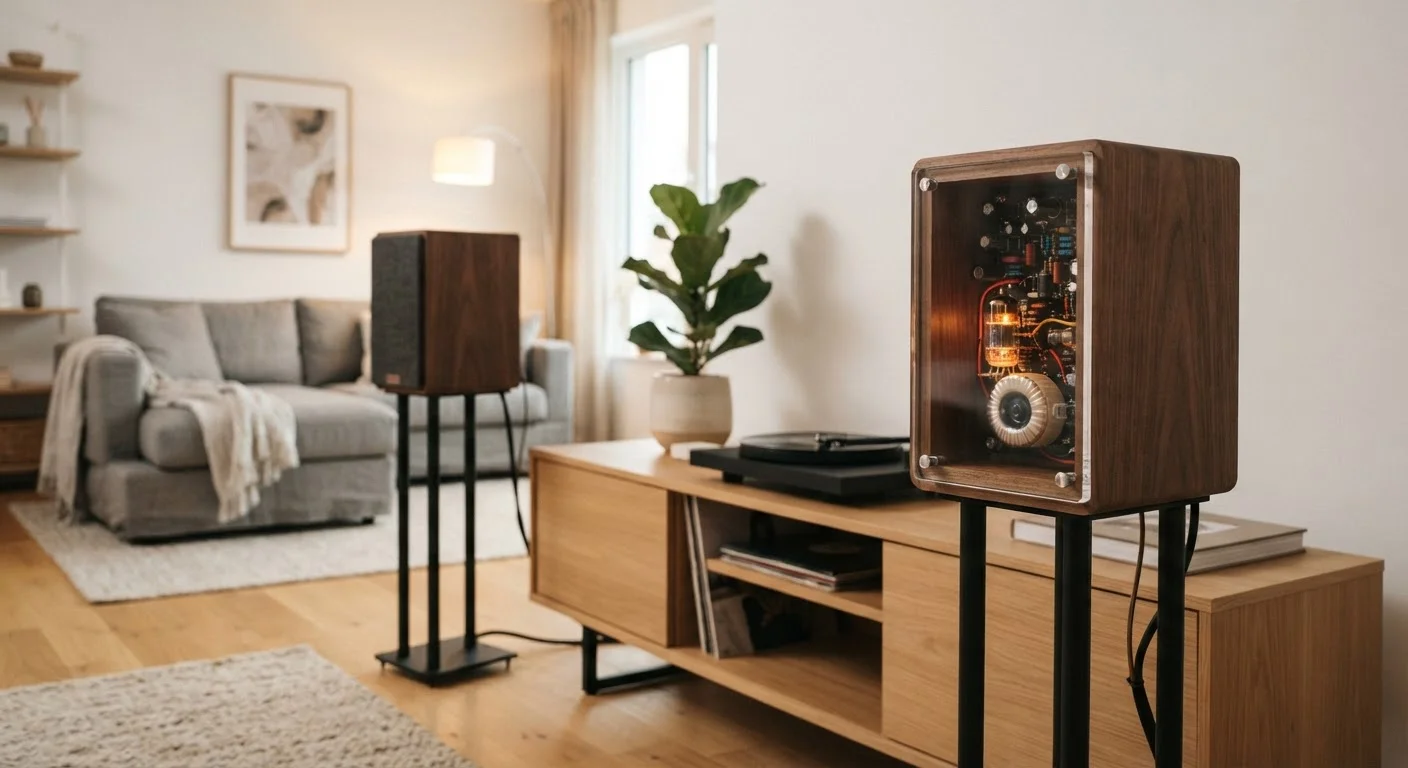
Option A
Passive Speakers
The traditional, component-based approach to home audio.
Best for: Listeners who want a customizable system and already own - or plan to buy - a separate amplifier or receiver.
Option B
Powered Speakers
The self-contained, plug-and-play audio solution.
Best for: Anyone who wants quality sound without managing multiple components or complex wiring.
What Makes These Two Speaker Types Fundamentally Different
Every speaker needs an amplifier to work - a component that takes the low-level audio signal from your phone, TV, or streaming device and boosts it to a level that can physically move the speaker's driver. The difference between passive and powered speakers comes down to where that amplifier lives.
Passive speakers have no built-in amplification. They rely entirely on an external amplifier or AV receiver connected by speaker wire. This is the traditional model used in hi-fi stereo systems and home theaters for decades.
Powered speakers (sometimes called active speakers) house the amplifier inside the cabinet. You connect them directly to an audio source - a turntable with a phono preamp, a computer, a TV - and they're ready to go. No separate amp required.
This single distinction creates a cascade of practical differences in cost, setup complexity, upgrade potential, and physical footprint. See our overview of home audio formats for context on how both types fit into the broader speaker landscape.
Head-to-Head: Key Trade-Offs at a Glance
The table below summarizes the most practical differences between passive and powered speakers across the criteria that tend to matter most to everyday buyers.
| Criterion | Passive Speakers | Powered Speakers |
|---|---|---|
| Built-in amplifier | No - requires external amp | Yes - amp is inside cabinet |
| Setup complexity | Higher - more components | Lower - plug into source |
| Upfront cost (no existing gear) | Higher - amp adds expense | Lower - all-in-one cost |
| Upgrade flexibility | High - swap components independently | Limited - replace whole unit |
| Best room scale | Medium to large rooms | Small to medium rooms |
| Home theater compatibility | Excellent - multi-channel support | Limited - typically stereo only |
| Cable management | More cables required | Fewer cables overall |
One point worth clarifying: powered and active are often used interchangeably, but strictly speaking, active speakers have separate amplifier circuits for different frequency drivers (like a dedicated amp for the tweeter and another for the woofer). Most consumer powered speakers use a single internal amp. The distinction rarely matters for home use, but you may see both terms in product listings.
When Passive Speakers Make More Sense
Passive speakers are worth considering if you already own a stereo receiver or AV receiver - in that case, the amplification cost is already sunk. You can direct your budget toward the speakers themselves rather than splitting it between speakers and a built-in amp you may not need.
They also suit listeners who expect their system to evolve over time. Because each component is separate, you can upgrade the amplifier without replacing the speakers, or swap in better speakers when your budget allows. This modularity is why passive setups remain the foundation of high-end two-channel audio.
For home theaters specifically, a passive multi-speaker configuration paired with an AV receiver gives you centralized control over multiple channels - something powered speakers aren't designed to handle cleanly. Room placement strategy also becomes more flexible when you're working with speakers that don't carry their own power supplies.
A Note on Impedance and Amplifier Matching
Passive speakers have an impedance rating - typically 4, 6, or 8 ohms - that must be compatible with your amplifier's output. Mismatches can reduce sound quality or, in extreme cases, strain the amplifier. Before pairing passive speakers with an existing amp, check both components' specifications. Most modern AV receivers handle a wide impedance range without issue, but it's worth confirming.
When Powered Speakers Are the Smarter Call
Powered speakers shine in situations where simplicity matters. A desktop audio setup, a bedroom listening station, or a compact living room system can all be served well by a single pair of powered bookshelf speakers connected directly to a source. No receiver, no speaker wire runs, no impedance matching to worry about.
They're also a practical choice if you're starting from zero. Buying a separate amplifier alongside passive speakers increases both cost and complexity. A quality pair of powered speakers can deliver genuinely good sound without that overhead.
If you're exploring wireless options as part of your setup, the wired vs. wireless trade-offs guide is a useful next read - many powered speakers are available with Bluetooth or Wi-Fi built in, adding another layer of convenience.
2-5
Components in a typical passive stereo setup
A standard passive configuration includes at minimum a source device, a stereo amplifier or receiver, and the speakers themselves - plus cabling.
1
Components needed with powered speakers
A powered speaker pair connected to a single source device represents the minimum viable audio setup, reducing both cost and cable clutter.
Before committing to either type, it's worth thinking through your source devices, room size, and listening habits. The pre-purchase checklist can help you map those factors before you spend anything.
The content on this site is for informational purposes only and is not a substitute for professional advice. Always consult a qualified professional for guidance specific to your situation.