

Our Verdict
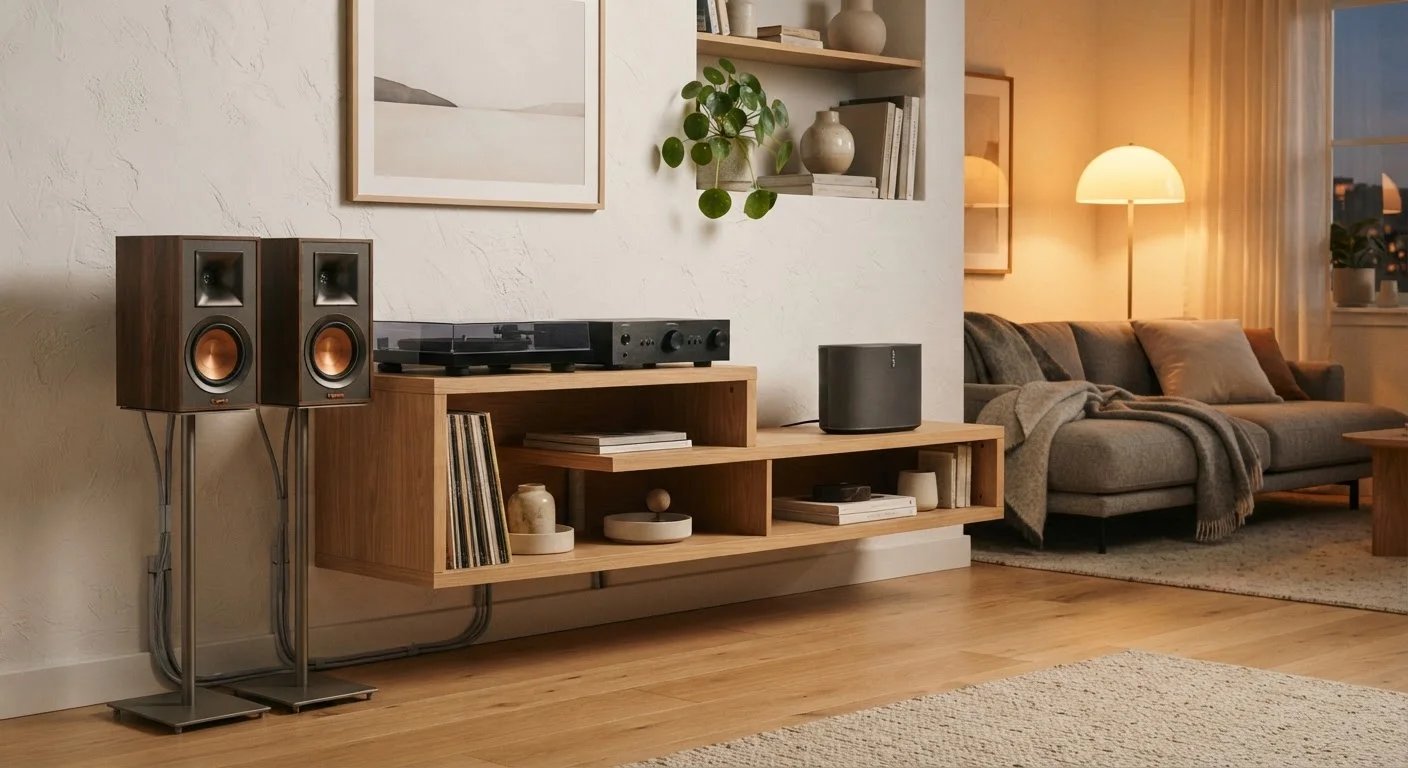
Wired audio remains the more technically consistent choice for dedicated listening rooms, home theater setups, or anyone who values uncompromised signal quality. Wireless systems win on flexibility, convenience, and multi-room scalability, making them the practical choice for most everyday listeners. Many households ultimately use both - wired where it counts most, wireless where convenience takes priority.
Wired setups suit audio enthusiasts and home theater builders; wireless suits renters, casual listeners, and anyone building a multi-room system without major installation.
What Actually Separates Wired and Wireless Audio
At its core, the difference is how audio signal travels from source to speaker. In a wired setup, that signal moves through a physical cable - typically speaker wire, RCA, or digital optical - with no conversion step in between. In a wireless system, the audio is encoded, transmitted over Bluetooth or Wi-Fi, and decoded at the speaker end. That process introduces variables that simply don't exist in the wired world.
This isn't a debate about old versus new. Both approaches have matured significantly, and modern wireless audio - particularly over Wi-Fi using protocols like AirPlay 2 or WiSA - has narrowed the quality gap considerably. What remains are real, structural trade-offs worth understanding before you invest in either direction. For a broader look at how different speaker types fit into each approach, see our breakdown of soundbars, bookshelf speakers, and home theater systems.
The Case for Wired Audio
Wired connections have one fundamental advantage: they don't compete for bandwidth, don't suffer from interference, and don't introduce compression artifacts. The signal that leaves your amplifier is the signal that reaches your speaker - no translation required.
Uninterrupted, interference-free signal delivery
Physical cables aren't affected by Wi-Fi congestion, neighboring networks, or Bluetooth interference - audio quality stays consistent regardless of wireless traffic in your home.
Full support for lossless and high-res audio
Wired connections carry uncompressed audio formats without codec limitations, which matters for listeners who want to hear exactly what's on high-quality recordings.
Near-zero latency for video and gaming
There is no encoding or decoding step in a wired audio signal, which eliminates the lip-sync delays that can appear with Bluetooth in home theater use.
No batteries or charging dependencies
Wired speakers draw power directly from an amplifier or powered speaker circuit, removing battery life and charging cycles from the equation entirely.
Long-term reliability with minimal failure points
A well-installed wired system has very few components that can fail or become obsolete - cables and connectors typically outlast the electronics they connect.
Wired setups also support high-resolution audio formats - such as lossless FLAC files or Dolby TrueHD - without the compression that most Bluetooth codecs apply. If you're building a dedicated home theater or a serious two-channel listening room, wired remains the cleaner path. It's also worth noting that passive speakers - which require a separate amplifier - are inherently wired, so your speaker choice can naturally steer the conversation.
The Case for Wireless Audio
Wireless systems removed the biggest practical barrier to home audio: installation complexity. Placing a speaker across a room without running cable through walls is genuinely transformative, particularly in rental apartments or homes where physical modification isn't an option.
Installation requires planning and physical effort
Running speaker wire through walls, floors, or ceilings is a significant undertaking that often requires professional installation in finished spaces.
Difficult to expand or reconfigure later
Adding speakers to a new room or rearranging a layout typically means rerouting cables, which can be disruptive and costly after initial installation.
Signal quality depends on network reliability
Wi-Fi-based wireless speakers are vulnerable to router congestion, network dropouts, and interference - issues that don't affect wired audio at all.
Bluetooth compression can reduce audio fidelity
Most Bluetooth connections apply some level of audio compression; the degree varies by codec, but some data loss is inherent to the technology.
Battery-powered speakers require regular charging
Portable wireless speakers and some battery-backed models need recharging, which interrupts use and introduces a component that degrades over years of charge cycles.
Firmware and app dependencies can cause issues
Wireless audio systems often rely on companion apps and manufacturer servers; discontinued support or app changes can meaningfully affect functionality over time.
Multi-room audio is where wireless genuinely excels. Streaming synchronized audio to speakers in different rooms - kitchen, living room, patio - is straightforward over Wi-Fi-based systems and nearly impossible to replicate cleanly with a wired approach without major infrastructure work. For renters or households that rearrange frequently, wireless flexibility is hard to argue against. Before committing to either path, it helps to work through a few key questions about your room and listening habits first.
Wi-Fi vs. Bluetooth: Not the Same Wireless
Wireless audio covers two distinct technologies that perform very differently. Bluetooth is a direct device-to-device connection with limited bandwidth, typically used for portable speakers and headphones. Wi-Fi-based systems - used by many multi-room audio platforms - operate on your home network and can transmit significantly more audio data with lower compression. If audio quality is a concern with wireless, Wi-Fi-based systems generally outperform Bluetooth by a meaningful margin.
Latency, Compression, and Signal Quality: What the Numbers Mean
Latency - the delay between signal and sound - matters more for video than for music. Bluetooth audio can introduce delays ranging from roughly 30 milliseconds to over 200 milliseconds depending on the codec used. For watching video, even modest delay creates visible lip-sync issues. Wired connections produce latency that is effectively zero in practical terms.
~220ms
Worst-case Bluetooth SBC codec latency
Standard Bluetooth SBC codec latency can reach approximately 220 milliseconds, enough to create noticeable lip-sync issues in video playback contexts.
~32ms
Low-latency Bluetooth aptX LL codec delay
Qualcomm's aptX Low Latency codec targets delays around 32 milliseconds, which significantly reduces but does not eliminate perceivable sync issues in video use.
24-bit/96kHz
Maximum resolution of LDAC Bluetooth codec
Sony's LDAC codec supports up to 24-bit/96kHz audio at 990 kbps, approaching the quality of wired connections for listeners using compatible devices.
Compression is the other factor. Standard Bluetooth uses codecs like SBC, which reduces audio data to fit within bandwidth constraints. Higher-quality codecs such as aptX HD or LDAC transmit more data and produce noticeably better results, but they require both the source and the speaker to support the same codec. Wired connections carry the full, unmodified signal - there's no codec negotiation involved. That said, most listeners in typical rooms may find the difference between a good wireless codec and a wired connection difficult to detect. The truth is that many audio quality claims don't hold up under honest scrutiny.
Which Setup Fits Your Home?
The honest answer is that many households end up using both. A wired system anchors a living room or home theater; wireless speakers handle the kitchen, bedroom, or outdoor patio. Thinking of the two as mutually exclusive misses how most people actually listen to audio across a home.
If you're building from scratch, start with where you listen most critically. A dedicated listening room or home theater rewards the investment in wired infrastructure. Everywhere else, wireless offers real advantages in flexibility without meaningful real-world cost to audio quality for most content and most listeners. For those exploring the broader connected home picture, our guide to smart home devices covers how wireless speakers fit into larger ecosystems.
The content on this site is for informational purposes only and is not a substitute for professional advice. Always consult a qualified professional for guidance specific to your situation.