

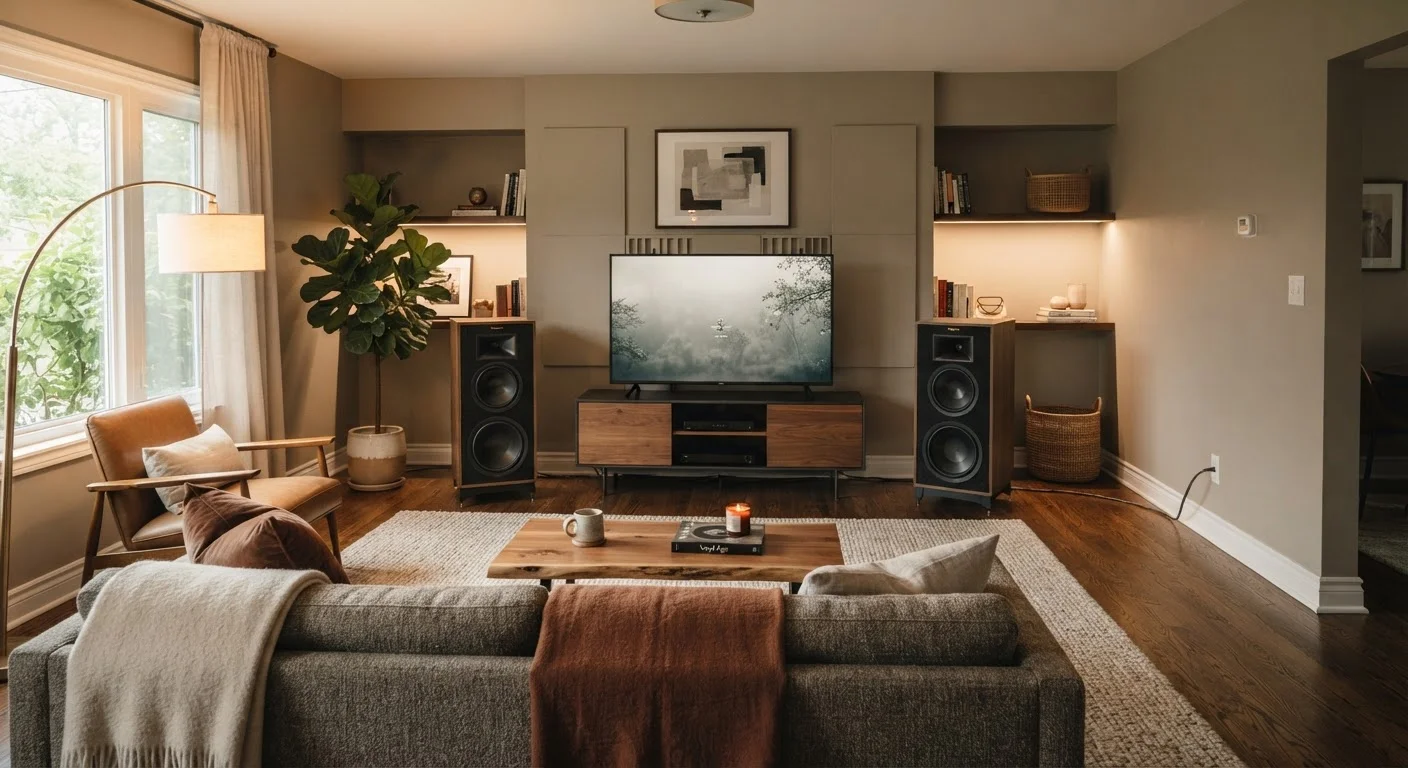
Your Room Is Part of Your Audio System
Most people evaluate speakers as standalone products - how they measure in a lab, how they review on paper. But once a speaker enters a real room, the room itself becomes an active participant in what you hear. Walls, floors, ceilings, and furniture all interact with sound waves in ways that can improve or seriously undermine even a well-designed speaker.
Understanding this isn't about becoming an acoustics engineer. It's about making smarter decisions when you place your speakers - and knowing why a small adjustment can produce a surprisingly large change in sound quality. See our common speaker placement mistakes to understand what to avoid from the start.
±20 dB
Bass variation room modes can cause
Acoustic research consistently shows that untreated rooms can produce bass frequency swings of 20 decibels or more depending on listening position - a difference far larger than most audio components introduce.
2-3 ft
Recommended minimum wall clearance for most speakers
Audio engineers generally recommend keeping speakers at least 1-3 feet from rear walls to prevent bass reinforcement from wall proximity from obscuring low-frequency accuracy.
38%
Of U.S. homes built with open floor plans
According to data from the National Association of Home Builders, a significant share of newly constructed American homes feature open-concept layouts, which present distinct acoustic challenges for audio setups.
How Room Dimensions Shape Sound
Every room has a set of natural resonant frequencies determined by its length, width, and height. When a sound wave at one of those frequencies travels the length of a room, it bounces back and overlaps with the next wave coming from the speaker. The result is called a standing wave or room mode - a frequency that gets disproportionately loud or quiet depending on where you sit.
In practical terms, this means that sitting in the wrong spot can make bass nearly disappear, while sitting two feet forward might make it overwhelming. Room modes are most pronounced in bass frequencies because low-frequency sound waves are long enough to interact with typical room dimensions.
Square rooms are especially problematic. Because the length and width are the same, the same resonant frequencies are reinforced on multiple axes simultaneously, creating more severe peaks and nulls. Rectangular rooms spread these problems across different frequency points, making them easier to manage.
Room Modes Affect All Speakers Equally
Room modes are a property of the room's dimensions, not the speaker's quality. A high-end speaker placed in an acoustically problematic position will exhibit the same resonance problems as an entry-level model. This is why speaker placement adjustments can deliver improvements that no hardware upgrade can replicate.
Hard Surfaces, Soft Surfaces, and What They Do to Sound
Sound bounces off hard surfaces - glass, bare wood floors, plaster walls, concrete - with very little energy loss. When these reflections reach your ears milliseconds after the direct sound from the speaker, they blur the stereo image and add a harsh brightness that wasn't in the original recording. This effect is called flutter echo, and it's a common reason rooms with minimal furnishings sound unpleasant even with quality speakers.
Soft, irregular surfaces do the opposite. A thick rug absorbs mid and high frequencies. A bookshelf packed with books of different sizes scatters reflections in multiple directions rather than bouncing them back cleanly. Heavy curtains over windows reduce glass reflections. None of these substitutes for proper acoustic treatment, but in a typical living room, thoughtful furniture arrangement makes a meaningful difference.
The goal isn't a dead, anechoic room - that would sound unnatural. It's a balance between too much reflection and too much absorption. Most untreated rooms lean toward over-reflective, especially in the high frequencies.
Walls, Corners, and the Placement Rules That Follow
Placing a speaker close to a wall reinforces its bass output - sound from the rear of the speaker combines with reflections off the wall, adding low-frequency energy. This might sound appealing, but it usually produces an uncontrolled, boomy result rather than accurate, deep bass. Corners amplify this effect even more dramatically because two or three surfaces converge, stacking reflections from multiple directions.
The general approach is to give speakers some breathing room from rear and side walls. How much depends on the speaker's design and port configuration - rear-ported speakers are more sensitive to wall proximity than front-ported or sealed designs. This is also why subwoofer placement deserves its own consideration. Learn more in our guide on how subwoofer positioning affects your whole system.
Your listening position is equally important. Sitting directly against a back wall places you at a bass pressure maximum - a spot where certain frequencies stack up to unnatural levels. Moving your seating forward by even two feet can noticeably clarify bass response.
Use the Rule of Thirds as a Starting Point
A simple acoustic guideline is to place speakers one-third of the room's length from the front wall and position your listening seat one-third from the rear wall. This starting point doesn't guarantee perfect results, but it tends to avoid the worst placement problems in most rectangular rooms and gives you a reliable baseline to adjust from.
Open Floor Plans and Irregular Shapes
Open-concept spaces - rooms that flow into kitchens, hallways, or dining areas without defined walls - present a different challenge. Without boundaries, sound dissipates quickly and bass response becomes thin. Speakers that sounded full in an enclosed room may seem lean and lightweight in an open plan.
Irregular room shapes, like L-shaped rooms or spaces with alcoves, create uneven acoustic fields where one listening position sounds very different from another just a few feet away. This complicates stereo imaging - the sense that instruments and voices occupy specific locations in space - because the left and right sides of the room behave differently.
If your space has these characteristics, it's worth exploring how your speaker type interacts with the layout before making any purchase. Our breakdown of soundbars versus bookshelf speakers versus home theater systems covers how different formats handle these spatial challenges differently.
Practical Starting Points for Any Room
You don't need measurement equipment or acoustic panels to meaningfully improve how your room sounds. A few foundational adjustments make a consistent difference across most spaces:
- Pull speakers away from rear walls - start at 1-2 feet and experiment from there.
- Toe speakers inward toward your primary listening seat to improve stereo focus.
- Add a rug between the speakers and your seating position to reduce floor reflections.
- Avoid placing speakers symmetrically in corners, which produces unmanageable bass buildup.
- Move your listening seat forward from the back wall by at least a couple of feet.
For readers building a setup from scratch, our pre-purchase checklist includes room-specific questions that help you match a system to your actual space before spending anything. Room awareness, built in early, saves a lot of frustration later.
Frequently Asked Questions
Most bookshelf and floor-standing speakers benefit from being pulled at least 1-3 feet away from the rear wall. Proximity to a wall reinforces bass frequencies, which can cause a boomy, indistinct low end. The exact distance depends on the speaker's design and your room's dimensions - experimenting in small increments is usually the most effective approach.
Different rooms have different surface materials, dimensions, and furniture arrangements that all shape how sound behaves. A room with hard floors and bare walls will reflect sound aggressively, creating a live, bright - sometimes harsh - character. A room with carpet, upholstered furniture, and curtains will absorb more sound, producing a warmer, more controlled result.
Square rooms are acoustically problematic because all four walls are equidistant, meaning the same resonant frequencies are reinforced simultaneously from multiple directions. This creates pronounced peaks and dips in bass response. If you have a square room, asymmetric speaker placement and acoustic treatment can help manage the problem.
Yes. Ceiling height influences both room volume and vertical reflections. Low ceilings can make sound feel compressed and amplify early ceiling reflections that smear imaging. Higher ceilings generally give sound more space but can introduce their own flutter echoes if surfaces are hard and untreated.
Generally, yes - toeing speakers inward so they point toward the primary listening position improves stereo imaging and helps the high-frequency response reach your ears more directly. The ideal angle varies by speaker design, but a moderate toe-in (roughly 15-30 degrees) is a reliable starting point for most setups.
Significantly. Upholstered sofas, bookshelves filled with objects, thick rugs, and curtains all scatter and absorb sound energy in ways that reduce harsh reflections and even out frequency response. Conversely, a room stripped of furniture will sound noticeably more reflective, often uncomfortably so.
The content on this site is for informational purposes only and is not a substitute for professional advice. Always consult a qualified professional for guidance specific to your situation.