

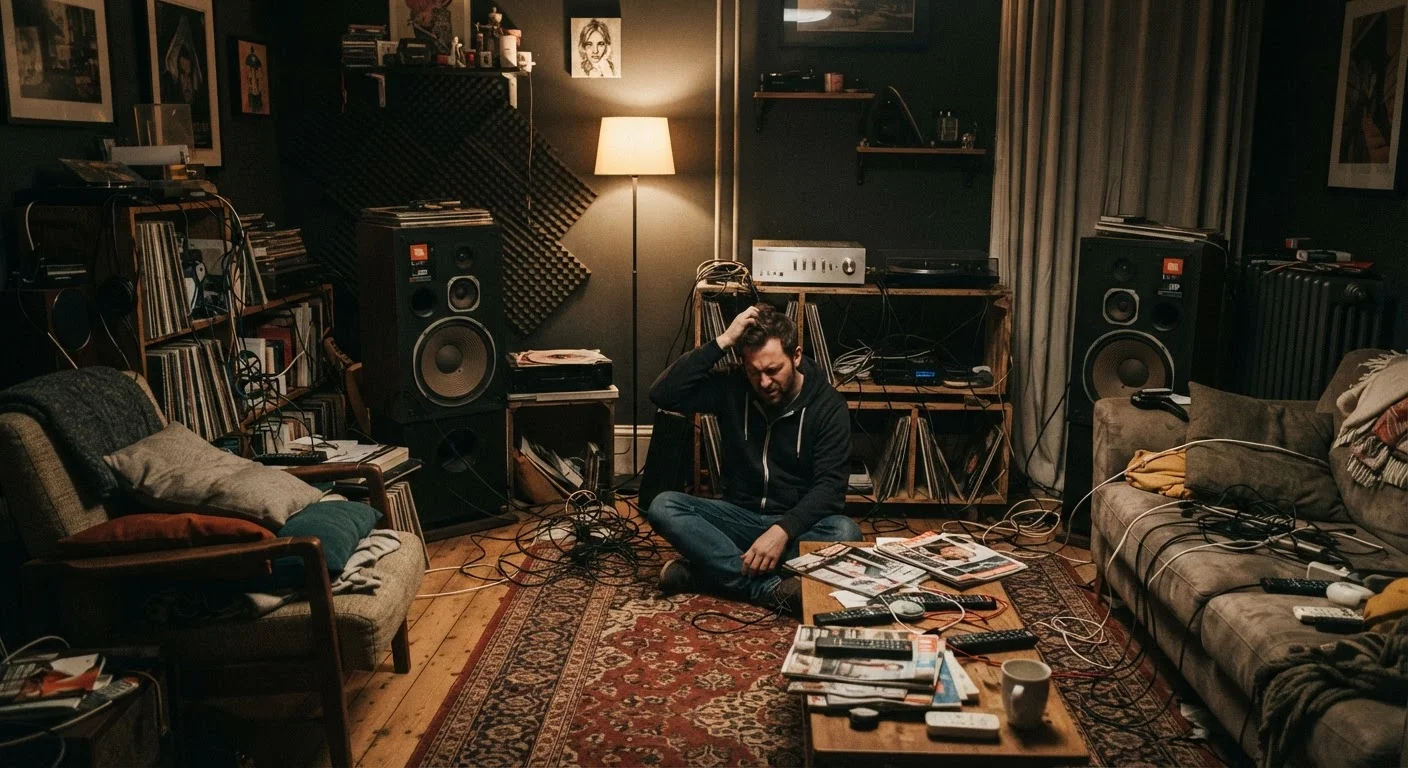
Why Your Expensive Speakers Still Sound Disappointing
Spending more on speakers doesn't guarantee better sound. In fact, some of the most common audio problems have nothing to do with the hardware - they stem from how a system is set up, positioned, and used. Whether you've invested in a stereo pair, a surround system, or a standalone soundbar, the same pitfalls tend to show up repeatedly.
If you're just starting to build a home audio setup, it's worth reviewing the fundamentals of how sound systems work before diagnosing what's going wrong. But for those who already have gear and aren't happy with the results, the mistakes below are the most likely culprits.
Pushing speakers flush against the wall to save space.
Why it happens: It feels tidy and out of the way, and most people don't realize the wall is acting as an acoustic mirror, artificially amplifying bass and muddying the midrange.
Placing speakers at different heights or distances from the listening position.
Why it happens: Furniture layout and convenience often dictate speaker placement rather than acoustic logic, leading to an off-center soundstage where one channel arrives slightly before the other.
Using compressed, low-quality streaming audio as the default source.
Why it happens: Convenient streaming services default to lower bitrate settings, and most listeners never change them - even when higher-quality options are available at no extra cost.
Applying heavy EQ boosts to compensate for bad placement or room problems.
Why it happens: EQ is immediately accessible and feels like a direct fix, but boosting frequencies that are suffering due to room acoustics typically introduces distortion at higher volumes rather than solving the underlying issue.
Mismatching amplifier power to speaker sensitivity ratings.
Why it happens: Power (watts) is a commonly marketed spec, but speaker sensitivity - how efficiently a speaker converts power into volume - is less visible and rarely explained at the point of purchase.
Ignoring the toe-in angle of speakers entirely.
Why it happens: Most speaker setup instructions are skipped, and speakers are simply placed on whatever surface is convenient, aimed straight ahead rather than toward the listener.
How Your Room Is Working Against You
The single biggest variable in home audio is the room itself - and most people treat it as fixed when it's actually highly adjustable. Hard parallel walls create flutter echo (a rapid, fluttery repetition of sound). Large open spaces sap bass energy. Low ceilings can cause a congested, boxy midrange. None of these problems are solved by swapping out speakers.
~50%
Of audible sound variation attributed to room acoustics
Acoustic researchers and audio engineers generally estimate that the listening room accounts for roughly half of what a speaker system sounds like at the listening position.
12-18 in
Minimum recommended wall clearance for rear speaker ports
Most speaker manufacturers recommend at least 12 to 18 inches of clearance from the rear wall to reduce boundary bass buildup, particularly for rear-ported designs.
Acoustic treatment doesn't require an expensive renovation. A large area rug on a bare floor, bookshelves filled with irregularly sized objects, and heavy curtains over windows can each absorb or diffuse sound in meaningful ways. For a deeper look at how dimensions and layout change what you hear, see how room size and shape affect speaker performance.
Don't Treat Acoustic Panels as a Cure-All
Adding foam panels or acoustic tiles is helpful for controlling reflections, but over-damping a room creates a 'dead' sound that feels unnatural. Aim for a balance between absorption and diffusion - a room that's too dry will strip the life out of music just as much as one that's too reverberant. When in doubt, start with soft furnishings before committing to dedicated acoustic products.
Bass, in particular, is highly susceptible to room behavior. Subwoofers can pile up low frequencies in corners or cancel them out at certain seating positions. If your bass sounds boomy in one spot and thin in another, the issue is almost certainly room interaction rather than the subwoofer itself. Understanding how a subwoofer integrates with your room and speakers can help you resolve this.
Separating Audio Fact From Fiction
Several persistent myths lead people to make changes that don't actually help - and sometimes hurt. Believing that more wattage always means better sound, for instance, can lead to mismatched gear that clips or distorts at normal volumes. Assuming expensive cables produce noticeably better audio has caused many listeners to spend money on accessories while neglecting placement and EQ.
For a clear breakdown of what actually matters versus what's marketing noise, home audio myths that keep people from getting better sound covers the most common misconceptions in detail. Correcting your assumptions before making changes is often more valuable than any hardware purchase.
Upgrading Gear Won't Fix a Setup Problem
Swapping out speakers or an amplifier when the real issue is placement, room acoustics, or source quality is one of the most expensive mistakes in home audio. Before purchasing new equipment, methodically rule out each setup variable. The improvement you're chasing may be entirely free.
Before upgrading anything, work through these key questions about your room, source, and listening needs. Many people discover that free setup changes - repositioning speakers, adjusting EQ, improving source quality - deliver the improvement they were planning to buy.
The content on this site is for informational purposes only and is not a substitute for professional advice. Always consult a qualified professional for guidance specific to your situation.