

Start here
How Sound Actually Travels in a Room
Build your foundation
The Core Components of Any Audio Setup
Apply to your space
Matching Your Setup to Your Space
Plan before you buy
What to Decide Before You Spend Anything
Avoid early pitfalls
Common Beginner Mistakes to Avoid
How Sound Actually Travels in a Room
Before thinking about components, it helps to understand what you're working with: sound is physical. It travels as pressure waves through air, bounces off walls, floors, and ceilings, and arrives at your ears as a combination of direct sound (straight from the speaker) and reflected sound (from every surface in between).
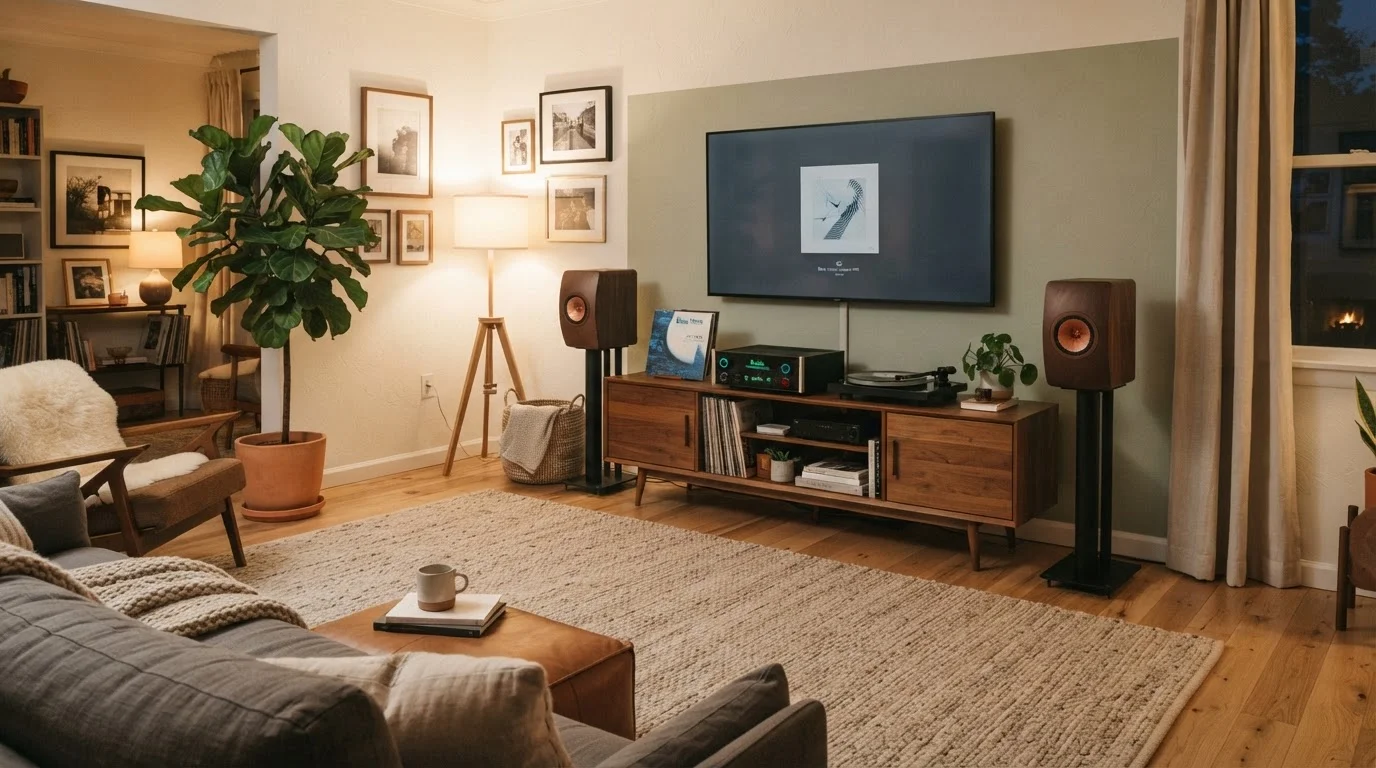
This means your room is part of your audio system whether you want it to be or not. Hard surfaces like tile, glass, and bare walls reflect sound aggressively, creating echo and muddiness. Soft surfaces - rugs, curtains, sofas, bookshelves full of books - absorb and scatter those reflections, producing a cleaner, more controlled sound.
You don't need acoustic treatment panels to get good sound at home, but being aware of your room's surfaces helps you interpret what you hear and make smarter setup decisions. For a deeper look at the qualities that separate mediocre audio from genuinely satisfying sound, see what makes home audio sound great.
Passive speaker
A speaker with no built-in amplifier - it requires a separate amplifier or receiver to power it.
Active (powered) speaker
A speaker with a built-in amplifier, allowing it to connect directly to a source without external amplification.
Impedance
Measured in ohms, impedance describes a speaker's electrical resistance. Amplifiers must be rated to handle the speaker's impedance to avoid damage.
Sensitivity
A measure of how loudly a speaker plays per watt of power, expressed in decibels (dB). Higher sensitivity means less amplifier power is needed.
AV receiver
A central component that amplifies audio, routes video signals, and connects multiple sources (TV, streaming devices, game consoles) to speakers.
Phono preamp
A small amplifier that boosts and equalizes the low-level signal from a turntable so it can be processed by a standard amplifier or receiver.
The Core Components of Any Audio Setup
Every home audio system - from a single soundbar to a full home theater - is built from the same basic building blocks:
- Source: Where the audio signal comes from. This could be a streaming device, smartphone, turntable, CD player, or TV.
- Amplifier: The component that takes a weak audio signal and boosts it enough to drive speakers. In many setups, the amplifier is built into a receiver or the speakers themselves.
- Speakers: Convert the electrical signal from the amplifier into the pressure waves you hear. Passive speakers require an external amplifier; active (powered) speakers have one built in.
- Cables and connections: The physical or wireless pathway between components. Analog cables, optical audio, HDMI ARC, and Bluetooth each carry audio differently, with varying quality trade-offs.
For setups that include a television, an AV receiver typically sits at the center, routing video and audio to the right outputs. For pure music listening, a stereo integrated amplifier paired with two speakers is often all that's needed. See how soundbars, bookshelf speakers, and home theater systems compare to understand which configuration fits different use cases.
Matching Your Setup to Your Space
Room size has a direct relationship to speaker size and amplifier power. Large speakers in a small room can overwhelm the space with bass; small speakers in a large room may struggle to fill it with sound. As a general principle:
- Small rooms (under 150 sq ft): Compact bookshelf speakers or a quality soundbar typically provide more than enough volume and detail.
- Medium rooms (150-300 sq ft): Bookshelf or mid-size floorstanding speakers paired with a stereo amplifier or AV receiver perform well.
- Large or open-plan spaces: Larger floorstanding speakers, higher-powered amplification, and possibly subwoofer support help maintain even coverage.
Speaker sensitivity - measured in decibels (dB) at one watt - tells you how loud a speaker gets per unit of amplifier power. A high-sensitivity speaker (around 90 dB or above) needs less power to reach a given volume. Pairing a low-sensitivity speaker with an underpowered amplifier leads to distortion at higher volumes, which can damage both components over time.
Test at Listening Volume Before You Commit
When auditioning speakers, listen at the volume levels you'd actually use at home - not showroom-loud. Speakers can sound flattering at high volumes and thin or harsh at conversational levels. Bringing a playlist of familiar music helps you hear differences more accurately than unfamiliar demo tracks.
What to Decide Before You Spend Anything
The single most useful thing you can do before buying any equipment is answer a short set of questions about how you actually plan to use your system. Your answers shape every other decision:
- What will you listen to most? Music, TV audio, movies, or games each favor different configurations.
- How do you want to stream audio? Wired connections offer reliability; Bluetooth and Wi-Fi streaming add convenience. Some AV receivers include built-in streaming; others require a separate device.
- How many listening zones do you need? A single room is straightforward. Multi-room audio requires a networking layer - either a dedicated platform or smart speakers - which adds complexity and cost.
- What sources do you already own? A turntable requires a phono preamp (either standalone or built into an amplifier). A TV as a source needs an HDMI ARC or optical output.
Working through these questions before stepping into a store - or an online cart - saves significant time and money. The pre-purchase checklist for audio setups covers this process in structured detail.
Common Beginner Mistakes to Avoid
A few patterns reliably trip up first-time buyers. Being aware of them in advance makes the whole process smoother:
- Chasing wattage instead of sensitivity. More watts doesn't automatically mean better or louder sound. A high-sensitivity speaker driven by a modest amplifier can outperform a low-sensitivity speaker with a powerful one. For a full breakdown of audio myths like this one, see common home audio myths.
- Skipping the room assessment. Buying speakers before measuring your space and understanding its acoustics leads to setups that sound worse than they should.
- Overspending on cables. Standard, well-made cables perform identically to expensive ones in typical home audio applications. Cable quality matters at the extremes of cable length or in electrically noisy environments - not in most living rooms.
- Buying components that don't communicate with each other. Always verify that your amplifier supports your speaker's impedance, that your source's output format matches your receiver's input, and that any smart home integrations are compatible before purchasing.
If unfamiliar terminology came up while reading this guide, the home audio terminology reference defines the most common terms in plain language. When you're ready to go deeper, setting up a 5.1 surround sound system walks through a full installation from speaker placement to final calibration.
Impedance Mismatch Can Damage Equipment
Connecting a 4-ohm speaker to an amplifier rated only for 8-ohm loads can cause the amplifier to overheat or fail over time. Always check the impedance specifications on both your speakers and your amplifier before connecting them. When in doubt, consult the manufacturer's documentation for compatible load ranges.
Frequently Asked Questions
Passive bookshelf speakers require a separate amplifier or AV receiver to power them. Active (powered) bookshelf speakers have a built-in amplifier, so they connect directly to your source. Always check whether a speaker is passive or active before buying.
There's no single right answer - it depends on room size, intended use, and source quality. A functional stereo setup for a small room can come together at a modest budget. Spending more on a few well-matched components generally yields better results than buying many cheaper pieces.
Stereo uses two channels (left and right) to create a soundstage in front of the listener. Surround sound uses additional speakers placed around the room to simulate audio coming from multiple directions, which is more immersive for movies and games.
Yes - placement has a significant impact on sound quality. Speakers placed too close to walls can produce boomy, exaggerated bass, while poor lateral positioning can flatten the stereo image. Even small adjustments in angle and distance can meaningfully improve what you hear.
Impedance, measured in ohms, describes the electrical resistance a speaker presents to an amplifier. Mismatching impedance can strain or damage an amplifier. Most home speakers are rated at 4, 6, or 8 ohms - always verify that your amplifier supports your speaker's impedance rating.
Technically yes, but tonal consistency suffers when speakers from different manufacturers are combined in a surround setup. For stereo listening, using a matched pair from the same product line is strongly recommended. For home theater, using the same brand across the front three channels matters most.
The content on this site is for informational purposes only and is not a substitute for professional advice. Always consult a qualified professional for guidance specific to your situation.