

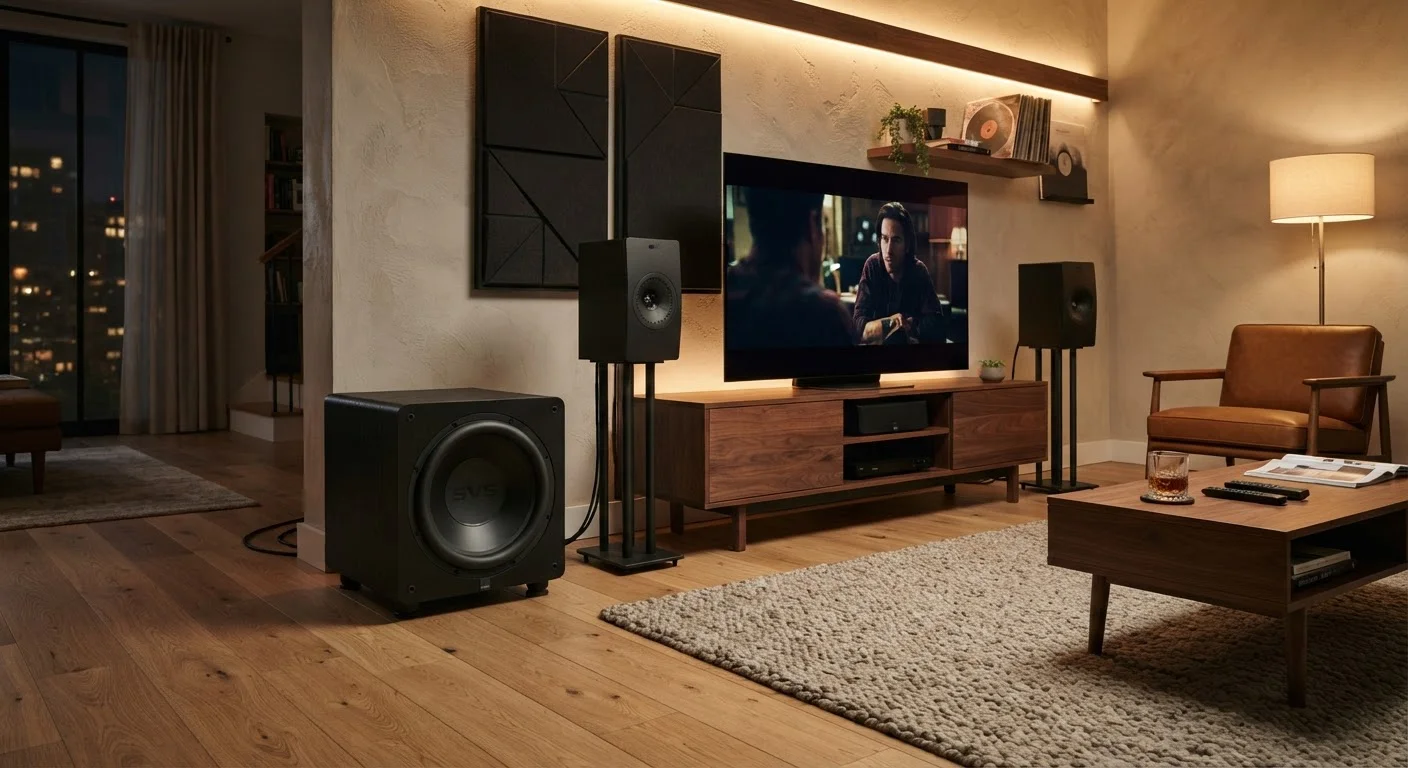
What a Subwoofer Actually Does to Your Sound
Most bookshelf speakers, soundbars, and even mid-sized floor-standers roll off below roughly 80-100 Hz. That's not a flaw - it's physics. Producing deep bass requires a large driver moving a significant volume of air, which compact enclosures simply can't do effectively. A subwoofer fills that gap, handling the frequencies associated with the lowest notes of a bass guitar, the rumble of an explosion in a film, or the kick drum in a live recording.
What this means in practice: without a subwoofer, your audio system isn't hearing the full picture. That missing low-end isn't just about "feeling" the bass - removing those frequencies affects the perceived warmth, fullness, and weight of everything you listen to. Dialogue in films can sound thinner. Music loses its rhythmic anchor. The difference becomes most obvious when you temporarily disconnect a subwoofer from a well-calibrated system.
If you're still learning the broader vocabulary of home audio, the home audio terminology guide covers foundational terms like frequency response, crossover, and impedance that come up throughout this topic.
20-80 Hz
Frequency range a subwoofer primarily covers
The LFE (Low Frequency Effects) channel in Dolby and DTS movie formats contains content specifically engineered for this range, which most main speakers cannot reproduce.
80 Hz
THX-recommended crossover point for home theater
THX, the audio certification standard developed for cinema and home theater, specifies 80 Hz as the standard crossover frequency for satellite and bookshelf speaker systems.
~6 dB
Bass boost from corner placement
Placing a subwoofer in a room corner can increase output by approximately 6 dB due to boundary reinforcement, but this often results in uneven, exaggerated bass response.
Integration: The Part Most People Get Wrong
Adding a subwoofer to your system only improves the sound if it integrates correctly with your main speakers. Two settings control this: the crossover frequency and the gain (volume) level. Set the crossover too high and bass sounds disconnected from your speakers - you can physically locate where the low end is coming from, which the ear finds distracting. Set it too low and your main speakers strain to reproduce frequencies they can't handle cleanly.
Similarly, gain that's too high produces "one-note bass" - a boomy, indistinct low end that overwhelms rather than supports the rest of the sound. The goal is a subwoofer you don't notice as a separate component. If someone walks into the room and immediately identifies the subwoofer by ear, the integration needs work.
Most modern AV receivers include auto-calibration systems (such as Audyssey or MCACC) that measure your room and set crossover and level automatically. These are worth using as a starting point, though manual fine-tuning is often needed afterward. Common speaker setup mistakes - including subwoofer misconfiguration - are more widespread than most people realize.
Use Your Receiver's Auto-Calibration First
If your AV receiver includes an automatic room correction system, run it before making any manual adjustments to your subwoofer. These systems use a calibration microphone to measure your room acoustics and set crossover, distance, and level automatically. It won't be perfect, but it gives you an informed baseline to refine from rather than guessing.
Room Placement and Why It Changes Everything
Bass frequencies are omnidirectional - your ears can't pinpoint where low-end sound originates the way they can with midrange or treble. This gives you flexibility in where you place a subwoofer, but it doesn't mean placement is irrelevant. Low frequencies interact with room dimensions to create standing waves: areas where bass builds up or cancels out. A subwoofer that sounds excellent in one corner of a room may sound muddy or thin just eight feet away.
A practical starting method is the "subwoofer crawl": place the subwoofer at your main listening position, play a bass-heavy track on repeat, then move around the room listening. Where the bass sounds most even and controlled is generally where the subwoofer will perform best when moved there. Corner placement amplifies output but almost always introduces uneven, exaggerated bass. Along the front wall, closer to one of your main speakers, tends to produce more coherent results in typical rectangular rooms.
Room size and shape affect this significantly. How room dimensions affect speaker placement explores this further for all speaker types, not just subwoofers.
Bass Traps Can Help in Problem Rooms
If your room produces persistent boomy bass regardless of subwoofer placement, the issue may be room acoustics rather than the subwoofer itself. Acoustic treatment panels called bass traps - typically placed in corners - absorb low-frequency energy and can significantly improve bass clarity. This is especially relevant in rooms with parallel walls and hard surfaces.
When You Actually Need One - and When You Don't
Not every setup needs a subwoofer. If you listen primarily to acoustic music at moderate volumes in a small room, well-designed bookshelf speakers may serve you well without additional bass reinforcement. The same applies to nearfield desktop listening, where a subwoofer can easily overwhelm a small space.
Where subwoofers earn their place:
- Home theater: Movie soundtracks are mixed with a dedicated LFE (Low Frequency Effects) channel specifically for subwoofers. Without one, you're missing content the director intentionally encoded.
- Electronic and hip-hop music: Synthesized bass and sub-bass in these genres often falls below 60 Hz, where most speakers contribute little.
- Live music recordings: Acoustic bass instruments and kick drums have fundamentals that benefit from full-range reproduction.
- Large rooms: Bigger spaces absorb bass more readily, making dedicated bass reinforcement more valuable.
For a broader view of how subwoofers fit within different system types - from soundbars to full home theater builds - see the comparison of soundbars, bookshelf speakers, and home theater systems. And if you're building a system from scratch, the beginner's guide to home audio is a useful foundation before adding any single component.
Frequently Asked Questions
Large floor-standing speakers can often reproduce bass down to around 40-50 Hz on their own, which covers most music. However, for home theater use with movie soundtracks that contain content below 40 Hz, a dedicated subwoofer still adds meaningful impact. Whether you need one depends on how low your speakers measure and the content you watch or listen to.
Corners amplify bass output but can make it boomy and uneven. Along the front wall near your main speakers is often a good starting point. A useful technique is placing the subwoofer at your listening position, playing bass-heavy content, and walking around the room to find where bass sounds most even - that spot is where to put the subwoofer.
For bookshelf or satellite speakers, 80 Hz is a widely used starting point and is THX-recommended for home theater. If your main speakers go lower, you can try 60 Hz. The goal is a smooth handoff where you can't localize the bass to the subwoofer's physical location.
A subwoofer won't damage properly matched components when used within its design parameters. However, running it at consistently high gain levels can stress the subwoofer's amplifier and voice coil over time. Always set gain levels to match your room size and main speaker sensitivity rather than maxing it out.
One subwoofer is sufficient for most rooms and listening scenarios. Two subwoofers can distribute bass more evenly throughout the room and reduce the "hot spots" where bass peaks, which is useful in larger or acoustically challenging spaces. It's a meaningful upgrade but rarely a necessity for average-sized rooms.
The content on this site is for informational purposes only and is not a substitute for professional advice. Always consult a qualified professional for guidance specific to your situation.