

Our Verdict
Strict budget limits work best when you need firm guardrails to stop overspending in high-risk categories. Flexible ranges shine when your income or costs vary month to month and you have the discipline to stay within a band. For most households, a blended model - fixed caps on essentials, ranges on discretionary categories - offers the most durable framework.
Strict limits suit those new to budgeting or rebuilding financial discipline; flexible ranges suit experienced budgeters with variable income or irregular expenses.
What Each Approach Actually Means
A strict budget limit sets a single, non-negotiable ceiling on a spending category. Groceries get $400 - not $401. When the money is gone, you stop spending. It's binary by design.
A flexible spending range defines a lower and upper bound - say, $350 to $500 for groceries. You aim for the low end but permit yourself to reach the top when circumstances justify it. The range acknowledges that real spending is rarely perfectly flat from month to month.
Both methods are legitimate frameworks within the broader world of budgeting fundamentals. The question is which structure matches how your income arrives and how your costs actually behave.
This Is General Financial Education
The frameworks discussed here are general budgeting concepts, not personalized financial advice. Everyone's income, obligations, and financial goals differ. For decisions specific to your circumstances, consult a licensed financial professional.
The Case for Strict Budget Limits
Hard caps remove negotiation from the equation. When there's no wiggle room, decision fatigue drops - you either have budget left or you don't.
Eliminates decision fatigue with a clear ceiling
When a category is capped, there's nothing to debate mid-month. You either have money in the category or you don't, which simplifies spending decisions significantly.
Supports pre-commitment and reduced impulse spending
Hard limits set in advance act as a pre-commitment device, making it harder to rationalize in-the-moment overruns that you'd regret at month's end.
Easier to track against a single fixed number
One target per category means a glance at your running total tells you exactly where you stand - no mental math about acceptable ranges required.
Creates a clear record of spending discipline over time
Consistent adherence to fixed caps builds a documented spending history that can inform future budgets and inform conversations with financial advisers.
Research on self-control consistently shows that pre-commitment strategies - deciding in advance and removing in-the-moment choices - reduce impulsive spending. A strict limit acts as exactly that kind of pre-commitment device. This is also the logic behind cash envelope systems, explored in depth in our look at cash envelope budgeting.
Strict limits also make tracking simpler. You're measuring actual spend against one fixed number, which works well with basic tools. See how different tracking methods compare in our guide to tracking your spending.
The Drawbacks of Rigid Caps
Strict limits struggle with variable costs. A car repair, a medical copay, or a seasonal utility spike doesn't care about your fixed cap. When real life exceeds the number, you either break the budget or go without - neither outcome is ideal.
Fails to account for predictable cost variability
Utility bills, grocery prices, and medical costs all fluctuate naturally. A single fixed number will be too high some months and impossible in others.
Increases risk of budget abandonment after one overage
When a strict limit is exceeded even once, some budgeters interpret it as total failure and abandon the system rather than adjusting the cap.
Poorly suited for irregular or variable income earners
Freelancers or commission earners whose monthly revenue isn't predictable can find fixed caps become unworkable during lean income months.
Can lead to artificial underspending in some categories
Strict caps on categories like preventive healthcare or home maintenance may discourage necessary spending, creating larger costs later.
Inflexibility can also lead to abandonment. Budgeters who blow a strict limit even once sometimes treat it as a signal that budgeting doesn't work for them, when the issue is actually the structure, not the habit. This is especially common for households with irregular income, where zero-based or envelope methods may need modification to remain realistic.
The Case for Flexible Spending Ranges
Ranges introduce realism. A grocery budget of $350-$500 acknowledges that some months you'll host guests or stock up on pantry staples; others you'll coast. You're not failing the budget - you're operating within it.
~60%
Americans living paycheck to paycheck
Multiple annual surveys from financial research organizations consistently find that roughly six in ten U.S. adults report little to no monthly spending buffer, underscoring why budget flexibility often matters.
30-50%
Typical monthly grocery cost variation per household
Consumer expenditure data from the U.S. Bureau of Labor Statistics shows significant month-to-month variation in food-at-home spending, illustrating why a rigid cap can misfire in a naturally variable category.
Flexible ranges also pair well with variable income. Freelancers, gig workers, and anyone with commission-based pay can align their upper bound with higher-income months and target the lower end during lean periods. This adaptability is why ranges often feel more sustainable long-term, particularly when paired with strategies from our guide on stretching a tight budget.
Where Flexible Ranges Fall Short
The obvious risk: ranges can become a permission slip for chronic overspending. If you routinely hit the upper bound - or nudge past it with small justifications - the range has effectively become a meaningless ceiling. Without honest monthly review, drift goes unnoticed until it shows up as a savings shortfall.
Ranges also add cognitive complexity. Tracking whether you're trending toward the low or high end of multiple categories takes more attention than comparing a single number. For people who prefer low-maintenance systems, this overhead can erode consistency. Our breakdown of envelope budgeting versus spending tracker apps covers how system complexity affects long-term adherence.
Building a Hybrid That Works
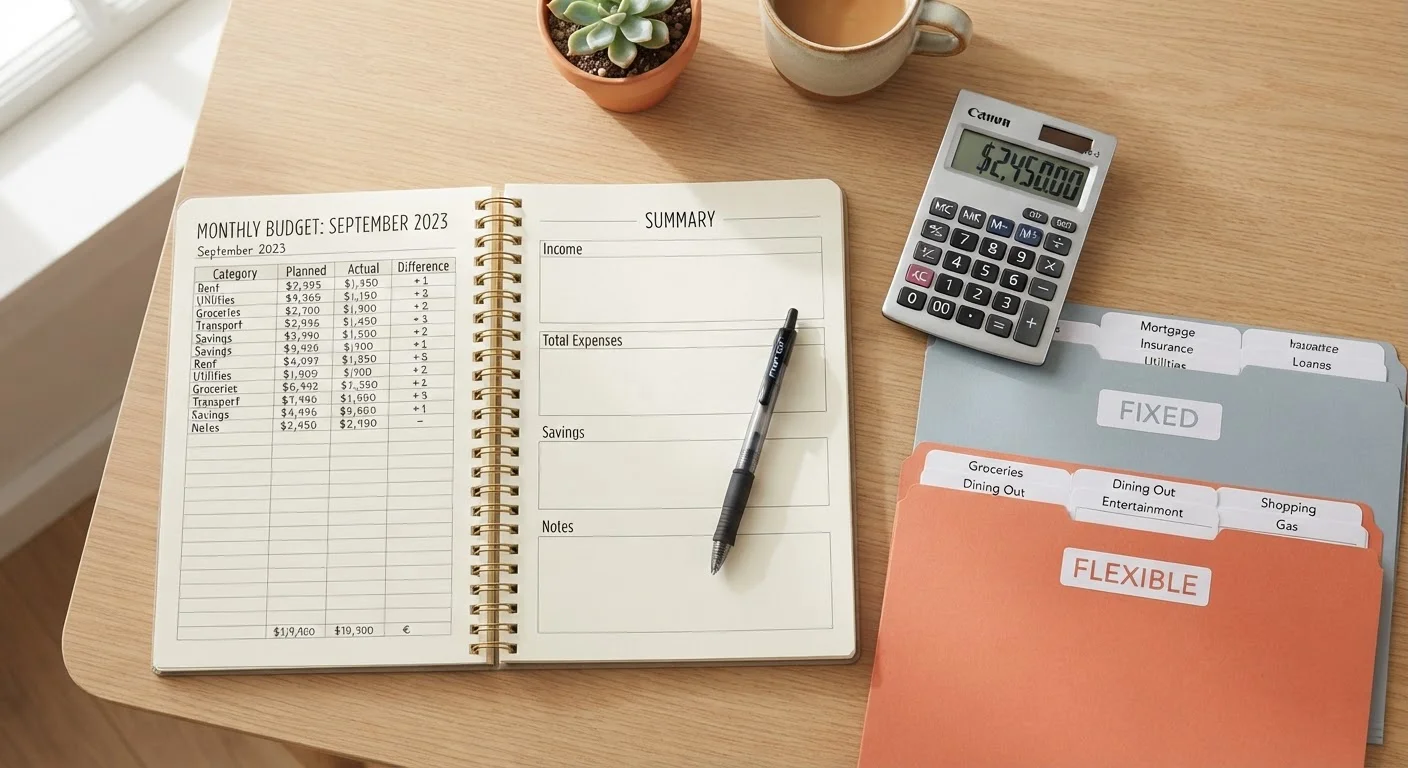
Most durable household budgets don't choose one philosophy wholesale. A practical hybrid applies strict caps where overspending causes real harm - credit card interest, rent, loan payments - and ranges where spending legitimately varies month to month, like food, utilities, or clothing.
The key is an honest audit of your categories: which ones are predictable, and which genuinely fluctuate? Apply caps to the former and ranges to the latter. Review both monthly. If a range's upper bound is consistently hit, treat that as a signal to either adjust the range or examine what's driving it - not a reason to abandon the budget entirely. For broader frameworks on managing money responsibly, the Saving & Debt hub offers additional context.
This article is for general informational and educational purposes only and does not constitute personalized financial advice. Consult a qualified financial professional for guidance specific to your situation.
The content on this site is for informational purposes only and is not a substitute for professional advice. Always consult a qualified professional for guidance specific to your situation.