

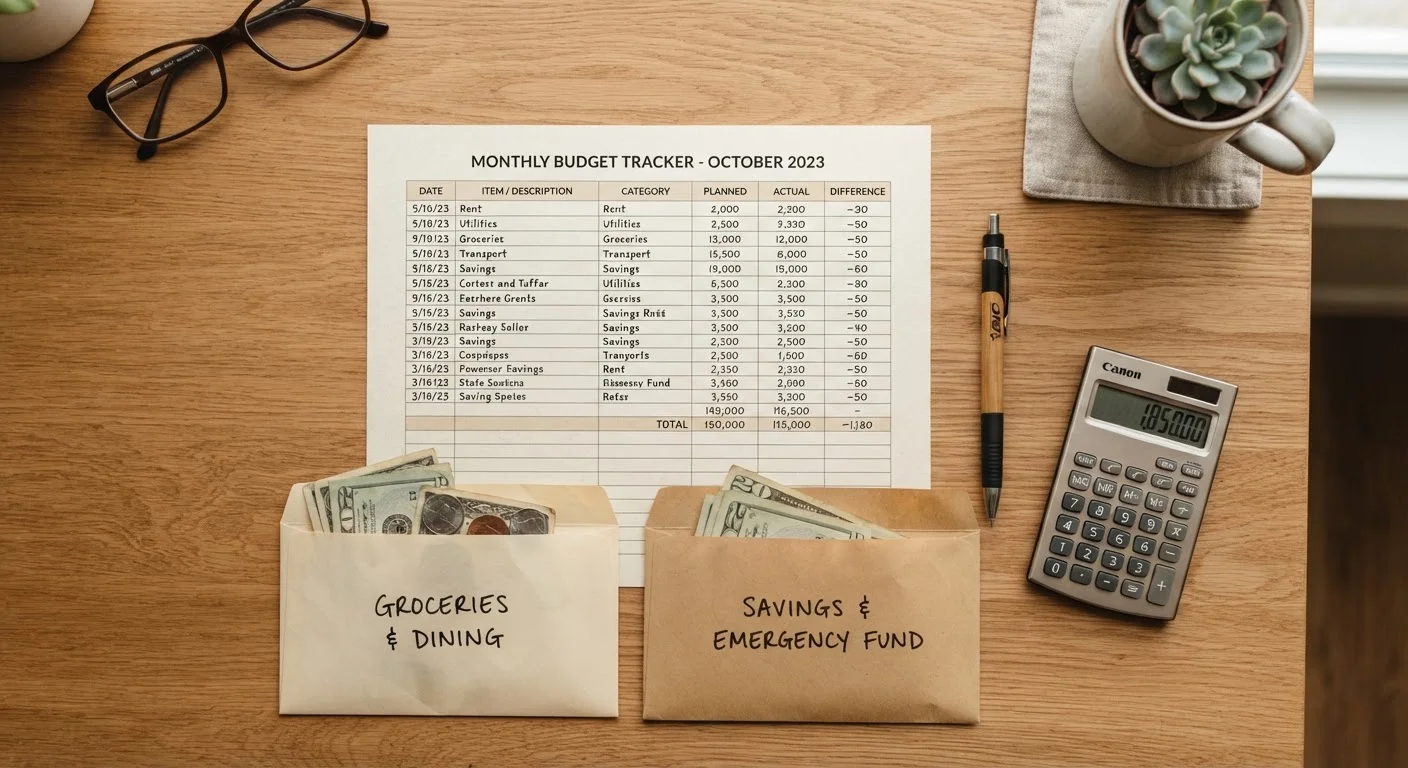
Option A
Zero-Based Budgeting
The intentional, every-dollar-has-a-job approach.
Best for: People who want full visibility into their spending and are comfortable planning on paper or in a spreadsheet each month.
Option B
The Envelope Method
The tangible, cash-in-hand spending guardrail.
Best for: People who overspend in specific categories and want a physical, hard-stop mechanism to break the habit.
How Each System Actually Works
Zero-based budgeting (ZBB) starts from scratch every month. You take your total expected income and assign every dollar a job - housing, groceries, utilities, savings, debt repayment - until the math reaches zero. Income minus expenses equals zero, meaning nothing is left unaccounted for. For a deeper look at the mechanics, see how zero-based budgeting assigns every dollar a purpose.
The envelope method works differently. You divide your cash into labeled envelopes - one per spending category - and when an envelope is empty, spending in that category stops for the month. Some people use physical envelopes with actual bills; others replicate the concept in budgeting apps using virtual envelopes. Either way, the core mechanic is the same: a pre-loaded, finite pool of money per category.
Both systems demand intentionality. Neither will work if you set them up once and walk away. The meaningful difference lies in where that effort gets applied - at the planning stage (ZBB) or at the point of purchase (envelope).
| Criterion | Zero-Based Budgeting | The Envelope Method |
|---|---|---|
| Core mechanic | Assign every dollar a category before spending | Pre-load cash into labeled spending envelopes |
| Time investment | High - rebuilt from scratch monthly | Low to moderate - refill envelopes each pay period |
| Works for irregular income | Yes - plan adjusts month to month | Partially - requires envelope amounts to vary |
| Handles bills and autopay | Yes - any expense can be categorized | Awkward - designed around cash transactions |
| Behavioral spending check | Indirect - relies on reviewing your plan | Direct - empty envelope stops spending immediately |
| Tools required | Spreadsheet, app, or paper ledger | Cash and envelopes (or an envelope-style app) |
| Best for savings goals | Yes - savings assigned as a budget line | Possible but requires a dedicated savings envelope |
Strengths, Weaknesses, and Real-World Trade-Offs
Zero-based budgeting excels at giving you a holistic monthly view. Because you're allocating every dollar - including irregular expenses and savings goals - you're less likely to forget a car insurance payment or leave retirement contributions as an afterthought. Its weakness is the time cost: rebuilding a detailed budget from scratch each month takes discipline, and skipping even one month can unravel the system.
The envelope method's strength is behavioral. Research in behavioral economics consistently shows that paying with cash creates more psychological friction than swiping a card, which tends to reduce impulsive spending in the moment. Its limitation is practical: it's cumbersome for bills paid by check or autopay, and carrying cash isn't always safe or convenient. A closer look at envelope budgeting's real advantages and drawbacks outlines both sides honestly.
~33%
Americans with a detailed household budget
Gallup polling has consistently found that fewer than one in three U.S. adults maintains a detailed monthly budget, suggesting most households operate without a formal system.
12-18%
Typical reduction in discretionary spending with cash
Multiple consumer behavior studies have found that people tend to spend less when using cash versus cards, though exact figures vary by study design and category.
If rigidity is a concern for you, it's worth reading about the trade-offs between strict budget limits and flexible spending ranges - both approaches live on that spectrum.
Choosing the Right Fit - or Blending Both
The honest answer is that neither system is universally superior. Zero-based budgeting tends to suit people who are analytical, motivated by planning, and comfortable revisiting a spreadsheet monthly. The envelope method tends to suit people who need a blunt, in-the-moment guardrail - especially for discretionary categories where willpower alone hasn't worked.
A hybrid approach is entirely valid. You can use ZBB to build your monthly plan in full, then fund physical or digital envelopes only for the two or three categories where you historically overspend. This gives you big-picture clarity without requiring you to carry envelopes to every gas station.
Digital Envelope Apps Change the Equation
If carrying physical cash feels impractical, several budgeting apps replicate the envelope method digitally - letting you allocate funds into virtual categories tied to your bank account. This removes the cash-management friction while preserving the psychological effect of a hard category limit. If you're comparing that approach to pure tracking tools, envelope budgeting vs. spending tracker apps breaks down the difference.
Before committing to either method, it helps to clear up some common misconceptions. Common budgeting myths that keep people from starting addresses the idea that budgets are only for people in financial trouble - they're not. Both systems work best as ongoing habits, not crisis tools. For more strategies across both spending and saving, the Smart Budgeting hub and Saving & Debt hub offer practical, no-jargon guidance.
This article is for general informational and educational purposes only and does not constitute personalized financial advice. Consult a qualified financial professional for guidance tailored to your individual circumstances.
The content on this site is for informational purposes only and is not a substitute for professional advice. Always consult a qualified professional for guidance specific to your situation.