

Our Verdict
Cash envelope budgeting is a genuinely effective tool for people who struggle to feel the weight of digital spending. The tactile friction it creates - watching cash leave your hand - can produce real behavioral change that apps alone often don't. That said, it introduces security risks, ignores online spending, and demands consistent manual discipline. It is not a universal solution, but it remains one of the most accessible budgeting systems available.
Best suited to households with persistent overspending in specific cash-friendly categories, or anyone who has tried digital tracking and found it too easy to ignore.
What Cash Envelope Budgeting Actually Is
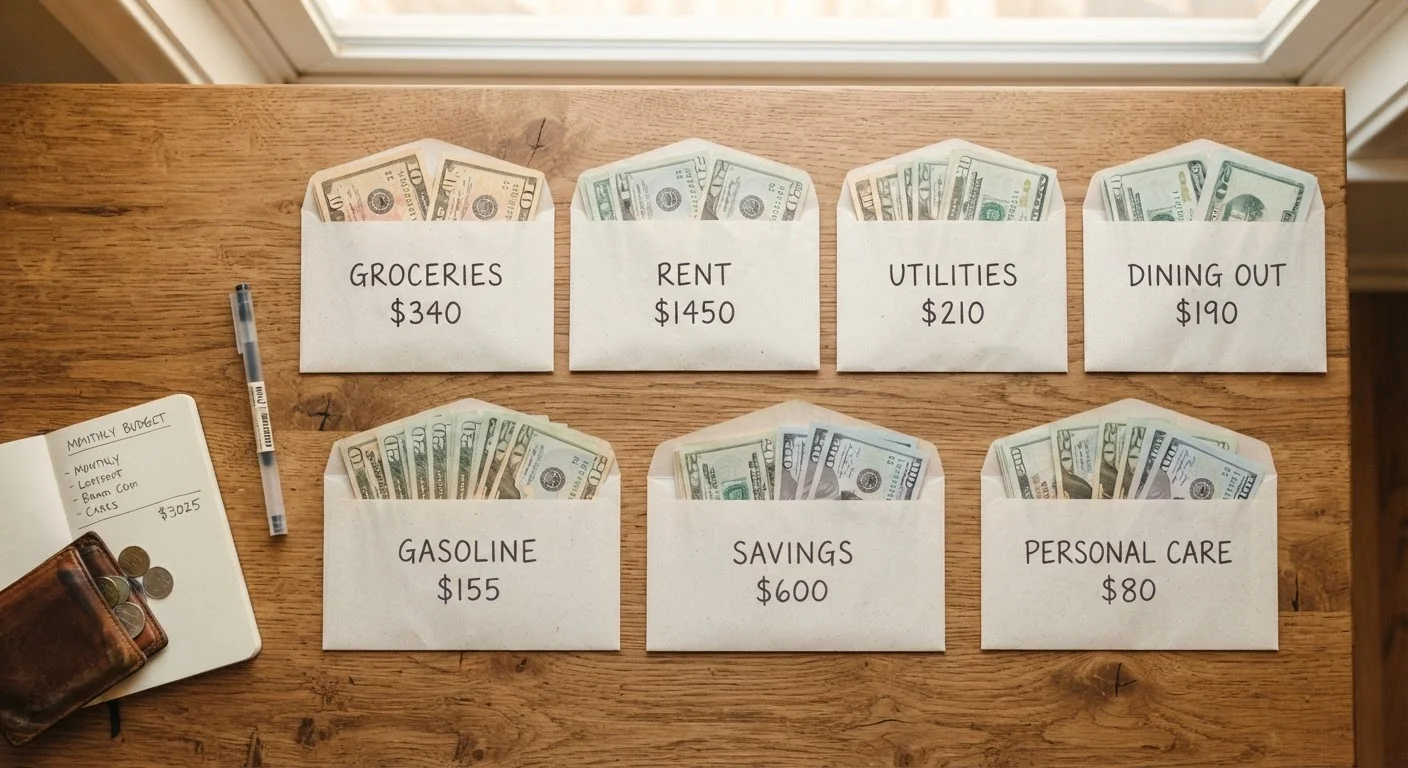
The cash envelope method is straightforward: at the start of a pay period, you withdraw physical cash and divide it into labeled envelopes - one per spending category. Groceries, dining out, gas, entertainment. When an envelope is empty, spending in that category stops until the next cycle.
The mechanics haven't changed much since the approach was popularized in personal finance circles decades ago, but the underlying psychology is durable. Physical cash activates a different kind of spending awareness than swiping a card. Research in behavioral economics consistently finds that people spend more when payment feels abstract - a real cost of digital-first financial lives.
This article takes an honest look at where the method delivers and where it falls short. For a direct comparison with digital tools, see Envelope Budgeting vs. Spending Tracker Apps.
The Real Advantages
The envelope method's strengths are concrete, not theoretical.
Creates an absolute, physical spending limit
When cash is gone, it's gone - no overdraft buffer, no mental accounting tricks. This hard stop is something digital tracking can't replicate without deliberate friction settings.
Makes overspending viscerally tangible
Behavioral finance research consistently shows people spend less with cash than with cards, attributing this to the "pain of paying" being more immediate with physical money.
No app, subscription, or technology required
The method costs nothing to implement and works independently of smartphones, internet access, or software updates - making it accessible to nearly any household.
Focuses attention on problem spending categories
Rather than overhauling your entire financial life, you can apply envelopes only to the two or three categories where overspending consistently occurs.
Builds a concrete budgeting habit quickly
The physical ritual of dividing cash each pay period reinforces budget awareness in a way that passive transaction syncing rarely does for new budgeters.
The tactile element is its defining advantage. Handing over a $20 bill and receiving change registers differently than a contactless tap. That friction is precisely the point - it slows down impulse decisions. For people who consistently overdraft or carry revolving credit card balances tied to everyday spending, this single feature can shift outcomes meaningfully.
It also eliminates the gap between tracking and limiting. A spending app tells you what happened; an empty envelope tells you to stop. That distinction matters for households where awareness alone hasn't been enough.
The Honest Drawbacks
No budgeting system is without friction, and the envelope method has specific limitations that make it a poor fit for some households.
Doesn't cover online or subscription spending
A large and growing share of household expenses - utilities, rent, streaming, online shopping - simply can't be paid in cash, leaving a parallel tracking system necessary.
Lost or stolen cash is unrecoverable
Unlike a debit or credit card, physical cash carries no fraud protection. Losing an envelope of grocery money has no remedy, which is a genuine financial risk.
Inconvenient for shared finances or frequent travel
Coordinating physical envelopes between two earners or managing cash across different cities adds logistical complexity that can undermine the system entirely.
Requires consistent manual discipline each pay period
The method demands a deliberate cash-withdrawal ritual every cycle. Skip it once or twice and the system collapses, unlike automated digital tracking that continues passively.
Carries no rewards, protections, or purchase records
Spending in cash forgoes credit card purchase protections, reward points, and automatic transaction histories that can be useful for tracking or disputes.
The biggest structural gap is online and subscription spending. Rent, utilities, streaming services, insurance premiums - none of these work with physical cash. Practically speaking, most households will need a parallel digital system running alongside the envelopes, which adds complexity rather than reducing it.
Security is a real concern too. Lost or stolen cash is unrecoverable in a way that a debit card is not. Carrying meaningful amounts of cash on grocery runs or errands is a legitimate trade-off to acknowledge. For a broader look at how rigid limits compare to more flexible systems, see strict budgeting limits vs. flexible spending ranges.
Who Benefits Most - and Who Probably Won't
The Envelope Method Doesn't Have to Be All-or-Nothing
Many people find that applying cash envelopes to just two or three high-friction categories - groceries, dining, entertainment - delivers most of the behavioral benefit without the logistical burden of going fully cash-based. You don't have to abandon your checking account or digital tools entirely. A hybrid approach lets you use each method where it performs best. See common budgeting myths for more on why all-or-nothing thinking keeps many people from starting.
The envelope method is not inherently superior to digital tracking - it's a different tool suited to different behavioral patterns. Tracking methods each carry real trade-offs, and the best system is the one you'll actually use consistently.
~18%
Less spent when paying with cash vs. cards
Multiple behavioral economics studies, including research cited by the Federal Reserve, have found consumers tend to spend less when using cash compared to card payments.
~1 in 3
Americans with no formal budget
Surveys conducted by the National Foundation for Credit Counseling have found a significant share of U.S. adults do not follow any structured budget.
Most likely to benefit: People who consistently overspend in specific categories like groceries or dining, those who find digital account balances abstract, younger adults building their first budgeting habit, or anyone who has tried apps and abandoned them within weeks.
Less likely to benefit: Households with high online spend, frequent travelers, people in shared finances where cash coordination is complicated, or anyone for whom carrying cash creates safety concerns.
A hybrid approach often threads this needle well: use physical envelopes for two or three problem categories, and track the rest digitally. Zero-based budgeting paired with the envelope method is one structured way to combine both philosophies.
This article is for general informational purposes only and does not constitute personalized financial advice. Consult a qualified financial professional for guidance specific to your situation.
The content on this site is for informational purposes only and is not a substitute for professional advice. Always consult a qualified professional for guidance specific to your situation.