

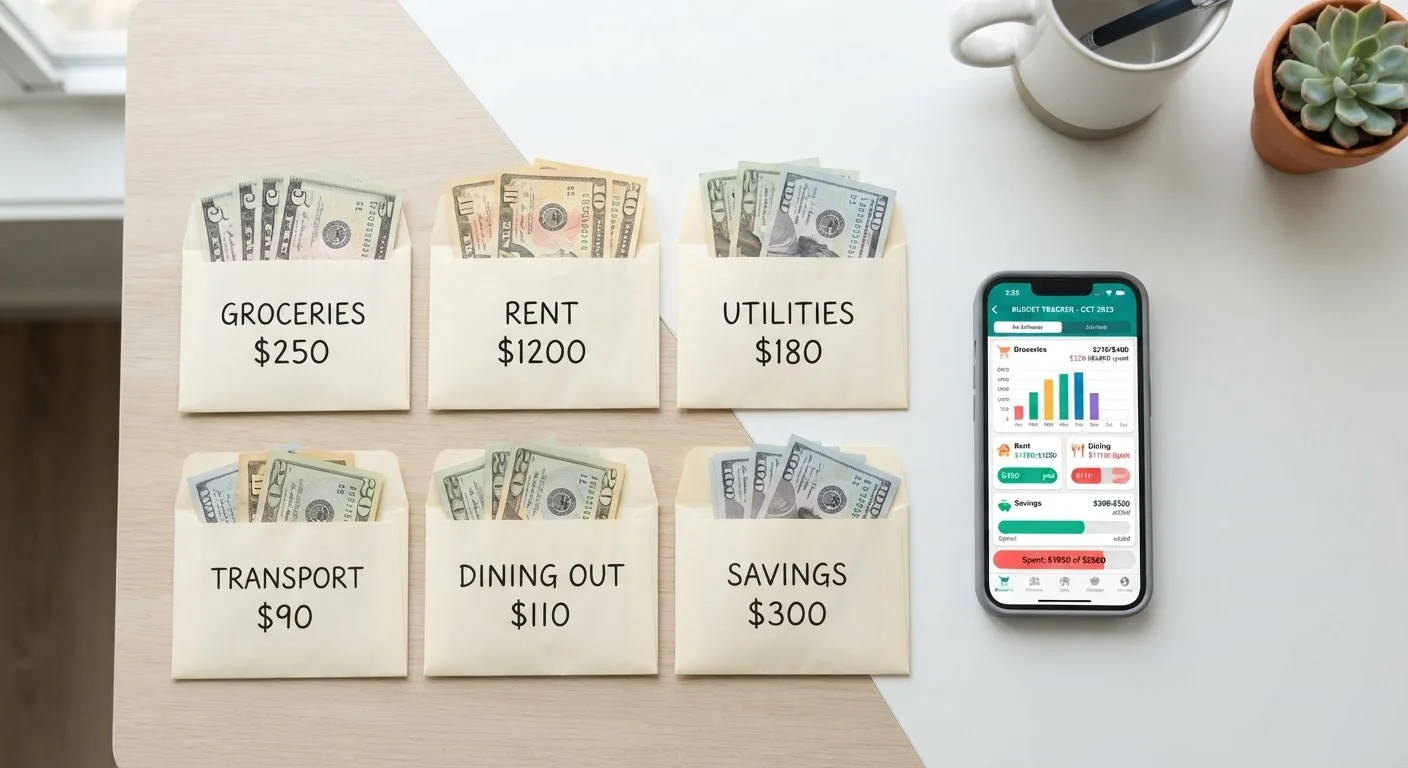
Option A
Envelope Budgeting
The tangible, friction-based method that makes overspending feel immediate.
Best for: People who overspend with cards and need a physical boundary to make limits feel real.
Option B
Spending Tracker Apps
The data-driven, automated approach that fits a mostly cashless lifestyle.
Best for: People who rarely use cash and want automatic transaction logging with spending insights.
How Each Method Actually Works
Envelope budgeting is straightforward: at the start of each pay period, you withdraw cash and physically divide it into labeled envelopes - one for groceries, one for gas, one for dining out, and so on. When an envelope is empty, spending in that category stops. No negotiation, no overdraft buffer. The constraint is built in.
Spending tracker apps work differently. You connect your bank accounts and cards, and the app automatically categorizes transactions as they post. Some apps let you set category limits and send alerts when you approach them. The record is always accurate, but acting on it is entirely up to you.
Both systems start from the same premise: you need to know what you planned to spend versus what you actually spent. The difference is when the feedback arrives. Envelopes deliver it before you hand over money. Apps deliver it after. That timing gap is where most budgets either hold or fall apart. For a deeper look at how structure affects outcomes, see zero-based budgeting vs. the envelope method.
| Criterion | Envelope Budgeting | Spending Tracker Apps |
|---|---|---|
| Feedback timing | Before you spend | After you spend |
| Works for cashless spending | Limited - cash only | Yes - cards and accounts |
| Setup effort | Moderate (cash withdrawal, labeling) | Low (account linking) |
| Ongoing maintenance | Weekly cash handling | Regular review sessions |
| Hard spending stop | Yes - empty envelope | No - alerts only |
| Shared household use | Requires coordination | Easier with shared views |
| Spending data history | Manual tracking required | Automatic and searchable |
| Privacy considerations | No data sharing required | Requires account access |
The Psychology Behind Each Approach
Research in behavioral economics consistently shows that people experience the pain of payment more acutely with cash than with cards or digital payments - a phenomenon sometimes called the "coupling" of spending and payment. Envelope budgeting exploits this directly: the physical act of emptying an envelope is visceral in a way that a declined push notification is not.
Spending tracker apps rely on a different cognitive mechanism: awareness and reflection. The assumption is that seeing your spending data clearly will prompt better decisions. This works well for people who are motivated by information and review their dashboards regularly. It works less well for people who log in once, feel a vague sense of guilt, and close the app.
83%
Of budgeters who quit within 3 months
A Lending Club survey found the majority of Americans who attempt a budget abandon it within the first quarter, often citing inconvenience as the primary reason.
~18%
Lower spending with cash vs. cards
Studies in consumer behavior, including work published in the Journal of Consumer Research, have found that cash payments tend to reduce discretionary spending compared to card payments.
1 in 3
App users who check budgets weekly
Industry usage data from personal finance app providers suggests only a minority of users engage with their spending data on a consistent weekly basis.
The honest question to ask yourself: do you tend to change behavior when you see data, or only when you feel an immediate consequence? Your answer points fairly directly to which system is better suited to how your brain operates. For a broader look at patterns that quietly undermine even well-structured budgets, the article on spending habits that erode budgets is worth reading alongside this comparison.
Practical Limitations You Should Know About
Envelope budgeting has real friction points. Withdrawing cash regularly takes time. Many merchants - especially online retailers - don't accept cash at all. And carrying envelopes of money raises legitimate safety concerns for some households. It also does nothing to help you track spending you've already done; it's purely a forward-looking constraint.
Spending tracker apps come with their own drawbacks. Account-linking can break when banks update their security systems, leaving gaps in your data. Automatic categorization is imperfect - a charge at a warehouse store might land in "groceries" one month and "household" the next. And the sheer volume of data some apps provide can feel overwhelming rather than clarifying.
A Hybrid Approach Is a Legitimate Option
You don't have to choose one system exclusively. Some households use a spending tracker app to monitor overall cash flow and fixed expenses, while reserving the envelope method for two or three categories where they chronically overspend - such as dining out or personal shopping. This hybrid captures the data advantages of apps while applying the psychological friction of cash exactly where it's needed most.
There's also a privacy dimension worth noting. Most tracker apps require access to your banking credentials or use third-party data aggregators to pull transaction data. That's a reasonable trade-off for many people, but it's worth understanding before you connect accounts. See how different tracking methods compare on privacy and usability for a fuller breakdown of your options.
If you're just getting started and haven't built any tracking habit yet, the Shopping Budget Starter Kit covers the foundational steps before you commit to either system.
This article is for general informational purposes only and does not constitute personalized financial advice. For guidance tailored to your specific situation, consult a qualified financial professional.
The content on this site is for informational purposes only and is not a substitute for professional advice. Always consult a qualified professional for guidance specific to your situation.