

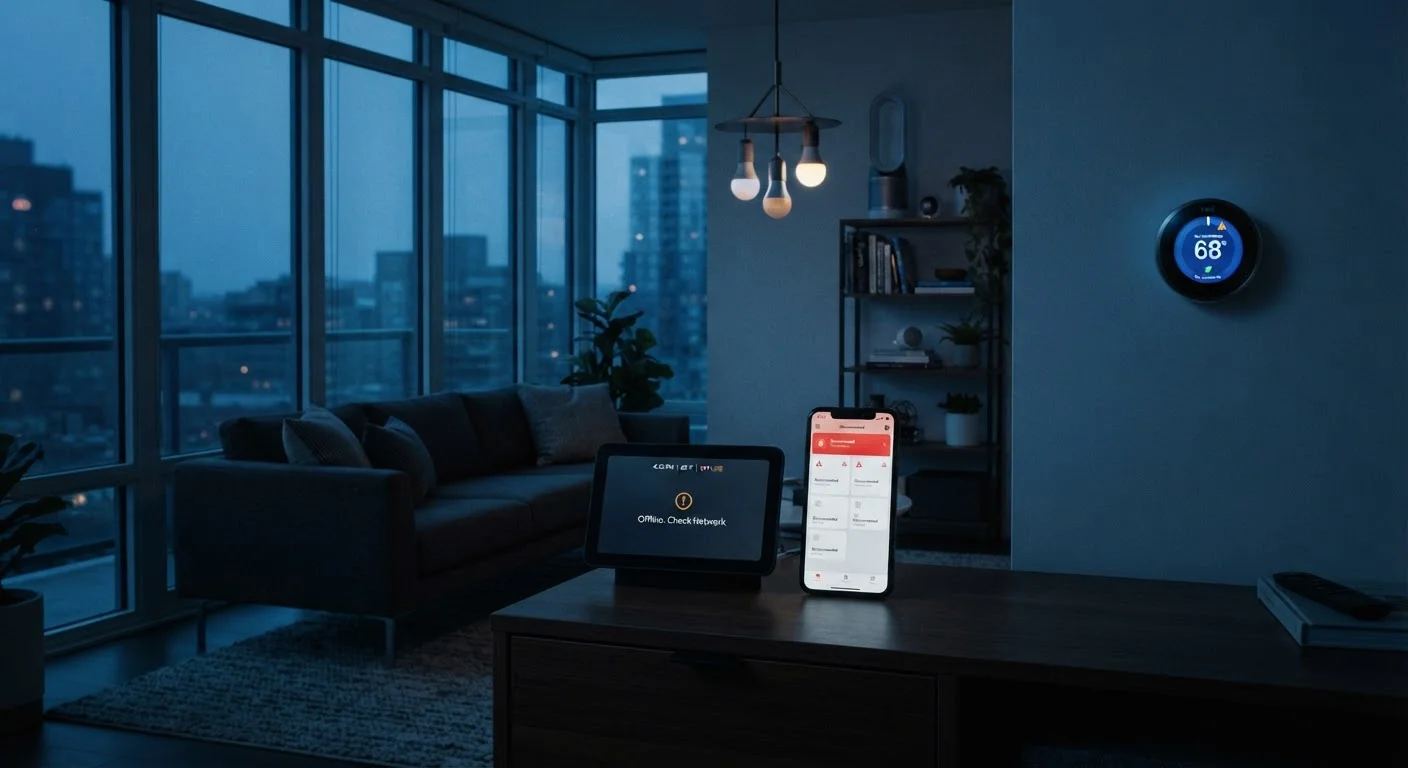
The Real Source of Your Connectivity Headaches
Smart home devices promise seamless convenience - lights that respond on command, thermostats that learn your schedule, locks you can control from anywhere. But when those devices keep falling off your network, the frustration quickly outweighs the benefit. The good news: most dropouts trace back to a short list of fixable causes, and understanding them puts you back in control.
Network problems in smart homes tend to compound. A router handling 30 or more connected devices behaves differently than one managing a laptop and a phone. Interference, outdated firmware, and poor placement all contribute. The sections below walk through the most common mistakes - and what to do about each one.
Placing devices too far from the router or access point.
Why it happens: Consumers often underestimate how much walls, floors, and appliances degrade Wi-Fi signal strength over distance.
Overloading the router's device limit or DHCP address pool.
Why it happens: Consumer routers are often configured with a limited pool of IP addresses by default. When that pool is exhausted, new or rejoining devices can't obtain an address and drop off.
Mixing 2.4 GHz and 5 GHz bands without understanding which devices belong on which.
Why it happens: Many routers broadcast both frequencies under the same network name, and devices connect automatically - often to the wrong band for their needs.
Neglecting firmware updates on both the router and the smart devices.
Why it happens: Firmware updates feel optional until something breaks - but outdated software introduces compatibility issues, security gaps, and connectivity bugs that manufacturers quietly fix in updates.
Ignoring Wi-Fi channel congestion from neighboring networks.
Why it happens: In apartments or dense neighborhoods, dozens of networks compete on the same Wi-Fi channels, causing interference that manifests as dropped connections.
Network Architecture Matters More Than You Think
A single router was designed for a simpler era. Spreading smart devices across a large home - especially one with thick walls, multiple floors, or concrete construction - creates dead zones where devices repeatedly try and fail to maintain a stable connection. A mesh network system, which uses multiple access points to create overlapping coverage, can dramatically reduce signal-related dropouts.
30+
Connected devices in an average smart home
Industry analysts estimate that many connected households now manage more than 30 devices simultaneously, placing significant demand on consumer-grade routers.
2.4 GHz
Band used by most smart home devices
The 2.4 GHz frequency offers broader range and better wall penetration than 5 GHz, making it the default choice for the majority of low-bandwidth smart home hardware.
It's also worth understanding the difference between devices that process commands locally and those that depend entirely on remote servers. As explained in our guide to local vs. cloud-dependent smart devices, a cloud-reliant device goes dark even when your home network is perfectly fine - if the manufacturer's servers go down, so does your device. For critical functions like door locks or security cameras, this distinction is worth factoring into your setup decisions.
For a deeper look at why router dependency affects so many smart gadgets, see why smart devices stop working when the router goes down. And if reliability is the top priority, wired vs. wireless smart home trade-offs covers when a physical connection makes more sense than Wi-Fi.
Cloud Outages Are Outside Your Control
Even a perfectly configured home network can't prevent a cloud-dependent device from going offline during a manufacturer server outage. Before relying on any smart device for a critical function - such as home access or security monitoring - confirm whether it can operate locally without an active internet connection. Devices that support local processing offer meaningfully more resilience.
Finally, network security and network stability are more connected than most people realize. An unsecured network is more likely to be congested by unauthorized users. Locking down your smart home network and reviewing this practical security checklist are worthwhile steps that serve both goals at once.
The content on this site is for informational purposes only and is not a substitute for professional advice. Always consult a qualified professional for guidance specific to your situation.