

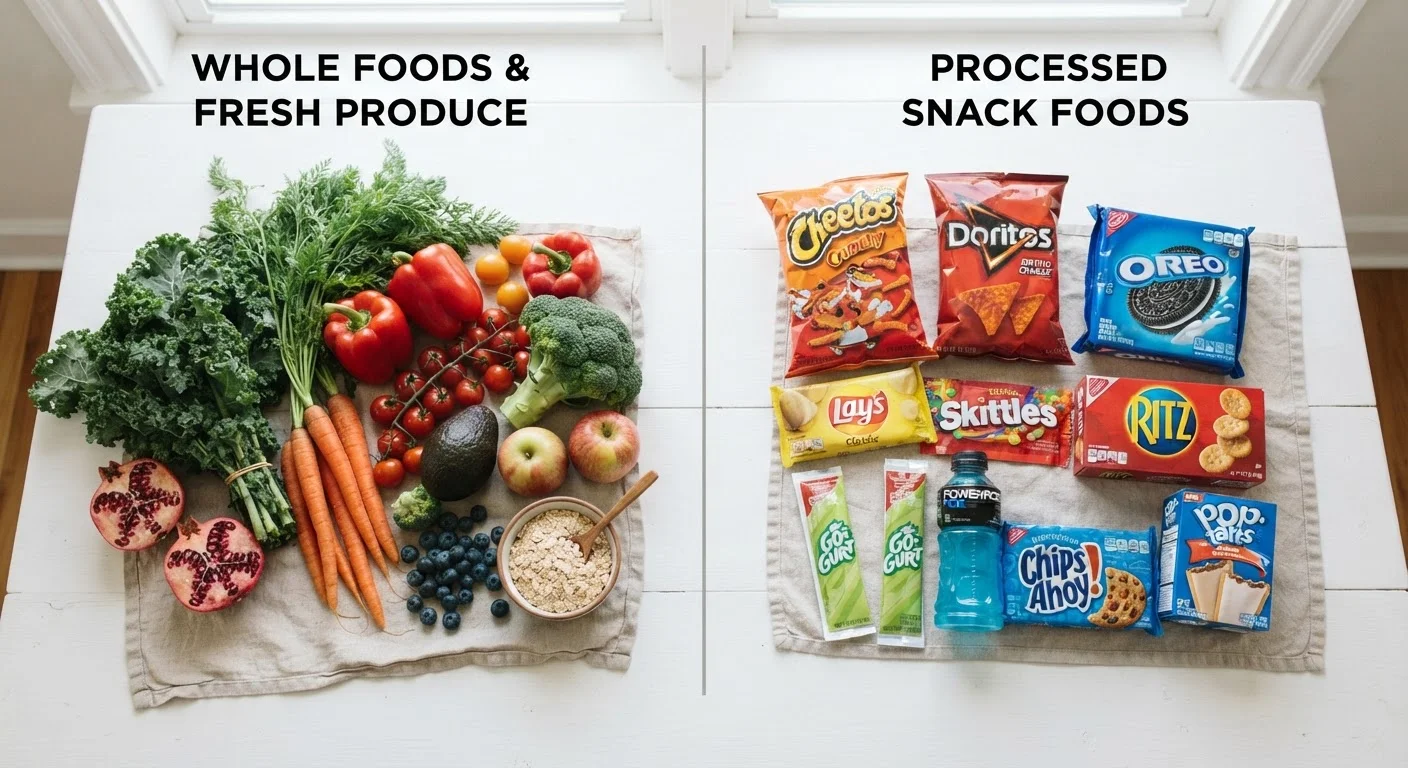
Option A
Whole Foods
Foods close to their natural, unaltered state.
Best for: Maximizing nutrient density, fiber intake, and minimizing additives across daily meals.
Option B
Processed Foods
Foods altered from their original form - ranging from minimally to heavily modified.
Best for: Convenience, shelf stability, and affordability, depending on the degree of processing involved.
The Spectrum: What 'Processed' Actually Means
The word processed is one of the most overloaded terms in nutrition. Technically, any food that has been washed, chopped, cooked, frozen, or packaged has undergone some form of processing. That means frozen peas and cheese crackers are both processed - yet they bear almost no meaningful resemblance to each other nutritionally.
A more useful framework comes from the NOVA classification, developed by researchers at the University of São Paulo, which groups foods into four categories based on the extent and purpose of processing:
- Group 1 - Unprocessed or minimally processed: Fresh fruits, vegetables, plain meats, eggs, plain nuts, and dry legumes.
- Group 2 - Processed culinary ingredients: Oils, butter, flour, sugar, and salt - used to prepare meals, not eaten alone.
- Group 3 - Processed foods: Foods made by adding Group 2 ingredients to Group 1 foods - canned fish, cheese, cured meats, simple bread.
- Group 4 - Ultra-processed foods (UPF): Industrial formulations using ingredients rarely found in home kitchens - emulsifiers, artificial flavors, colorants, and modified starches. Think packaged snacks, sodas, and fast-food products.
This distinction matters because the health research targeting "processed food" almost always focuses on ultra-processed foods specifically. Understanding where on the spectrum a food sits is more informative than a blanket label.
| Criterion | Whole Foods | Processed Foods |
|---|---|---|
| Nutrient retention | High - intact vitamins, minerals, fiber | Varies widely by processing degree |
| Added sugars & sodium | None added | Often significant in ultra-processed |
| Fiber content | Naturally present | Often reduced or absent in UPFs |
| Shelf life | Generally shorter | Extended by design |
| Convenience | Requires more preparation | Often ready to eat or quick to prepare |
| Cost variability | Ranges from low (legumes) to high (fresh fish) | Often affordable; varies by product |
| Additive exposure | None | High in ultra-processed category |
What Whole Foods Offer - and Where the Label Gets Complicated
Whole foods are broadly understood as foods that are eaten close to their natural state with little or no modification. Think an apple, a handful of walnuts, a sweet potato, or a piece of unprocessed fish. These foods tend to retain their full matrix of nutrients - fiber, vitamins, minerals, and phytocompounds - because processing hasn't stripped them away.
That intact food matrix matters. Research suggests that nutrients consumed within their whole-food context are often absorbed and utilized differently than isolated nutrients in supplements or fortified products. Fiber in a whole apple, for example, slows sugar absorption in a way that apple juice - even "100% juice" - cannot replicate.
However, the whole-food category isn't automatically perfect. Some whole foods are high in saturated fat, natural sugars, or calorie density. The goal isn't to treat whole foods as inherently virtuous and everything else as harmful - it's to understand what a food actually delivers nutritionally. For a deeper look at how to evaluate food value beyond calories, see our piece on nutrient density - a concept that reframes how you think about food quality.
57%
Share of calories from ultra-processed foods in average U.S. diet
Research published in BMJ Open estimated that ultra-processed foods account for more than half of daily caloric intake among U.S. adults.
4x
Fiber gap between whole and ultra-processed diets
Studies comparing dietary patterns suggest people eating predominantly whole foods consume roughly four times the dietary fiber of those relying heavily on ultra-processed products.
10%+
Higher all-cause mortality risk linked to UPF-heavy diets
A large cohort study in JAMA Internal Medicine found a statistically significant association between high ultra-processed food intake and elevated mortality risk, though causality is not established.
Ultra-Processed Foods and the Evidence Worth Knowing
When health researchers raise concerns about processed foods, their focus is almost exclusively on the ultra-processed category. Multiple large observational studies - including research published in The BMJ and JAMA Internal Medicine - have found associations between high ultra-processed food consumption and elevated risks of cardiovascular disease, type 2 diabetes, and certain cancers. These are associations, not proven causal relationships, and diet research carries inherent methodological challenges. Still, the consistency of findings across populations is notable.
Why might ultra-processed foods contribute to these patterns? Proposed mechanisms include:
- High levels of added sugars and refined carbohydrates that spike blood glucose
- Excess sodium contributing to elevated blood pressure
- Low fiber content disrupting gut microbiome diversity
- Industrial additives whose long-term effects are not fully established
- Hyper-palatability engineering that may encourage overconsumption
It's worth noting that not all processing is harmful. Pasteurization eliminates dangerous pathogens from milk. Fortification of staple foods has reduced deficiency diseases. Fermentation creates yogurt and kimchi - both minimally processed and health-associated. The problem is specifically the ultra-processed end of the spectrum, not processing as a concept.
Understanding what's actually in a food requires reading labels carefully. Our guide on reading a nutrition label walks through how to decode ingredient lists and daily values without getting lost in the fine print.
A Note on Observational Research
Most studies linking ultra-processed foods to health outcomes are observational - they identify associations, not causes. People who eat more ultra-processed foods may also differ in other lifestyle factors (stress, sleep, income) that independently affect health. This doesn't mean the findings are unimportant, but it does mean interpreting them with appropriate nuance matters. Dietary science is complex, and no single study settles a question definitively.
How to Apply This in Practice
Knowing the theory is one thing; applying it at a grocery store or kitchen is another. Here are grounded, practical principles rather than rigid rules:
- Prioritize whole foods as a foundation. Building meals around vegetables, legumes, whole grains, fruit, eggs, and plain proteins sets a nutritional baseline that's hard to undermine.
- Use minimally processed foods as allies. Canned chickpeas, plain frozen broccoli, full-fat plain yogurt, and rolled oats are processed but nutritionally strong. Plant-based proteins like lentils and tofu often fall into this accessible, minimally processed category.
- Treat the ingredient list as your guide. A short, recognizable ingredient list generally signals less industrial processing. A long list featuring additives, modified starches, or multiple forms of sugar typically signals ultra-processed territory.
- Watch for sugar in disguise. Whether labeled as high-fructose corn syrup, dextrose, maltose, or evaporated cane juice, added sugars in ultra-processed foods accumulate quickly. Our article on natural vs. added sugar explains why the source and context of sugar matters nutritionally.
- Aim for dietary patterns, not perfection. No single food makes or breaks health. What matters over time is the overall balance of what you eat consistently.
This article is for general informational and educational purposes only and does not constitute medical or nutritional advice. Consult a qualified healthcare professional or registered dietitian for guidance tailored to your individual health needs.
The content on this site is for informational purposes only and is not a substitute for professional advice. Always consult a qualified professional for guidance specific to your situation.