

Why Calories Alone Don't Tell the Whole Story
For decades, public health messaging focused heavily on calorie counts - eat less, move more. That framework captures something real: energy balance does matter for weight. But it leaves out a critical question: what comes with those calories?
Two foods can contain identical calories and deliver radically different nutritional value. A 200-calorie serving of cooked lentils provides protein, iron, folate, potassium, and fiber. A 200-calorie portion of certain packaged snack crackers may deliver primarily refined starch and sodium. The calorie count is the same. The nutritional return is not.
This is exactly what the concept of nutrient density is designed to address. It reframes the question from "how much energy does this food provide?" to "how much nutritional value does this food provide per calorie?" That shift in framing changes what a smart eating pattern looks like in practice.
Nutrient Density Is a Pattern, Not a Score
No universally agreed-upon scoring system for nutrient density is used in clinical practice or on food labels. The concept is most useful as a mental framework - a way of thinking about food value - rather than a precise metric. When evaluating your own diet, overall patterns matter far more than any single food choice.
What Counts as a Nutrient-Dense Food
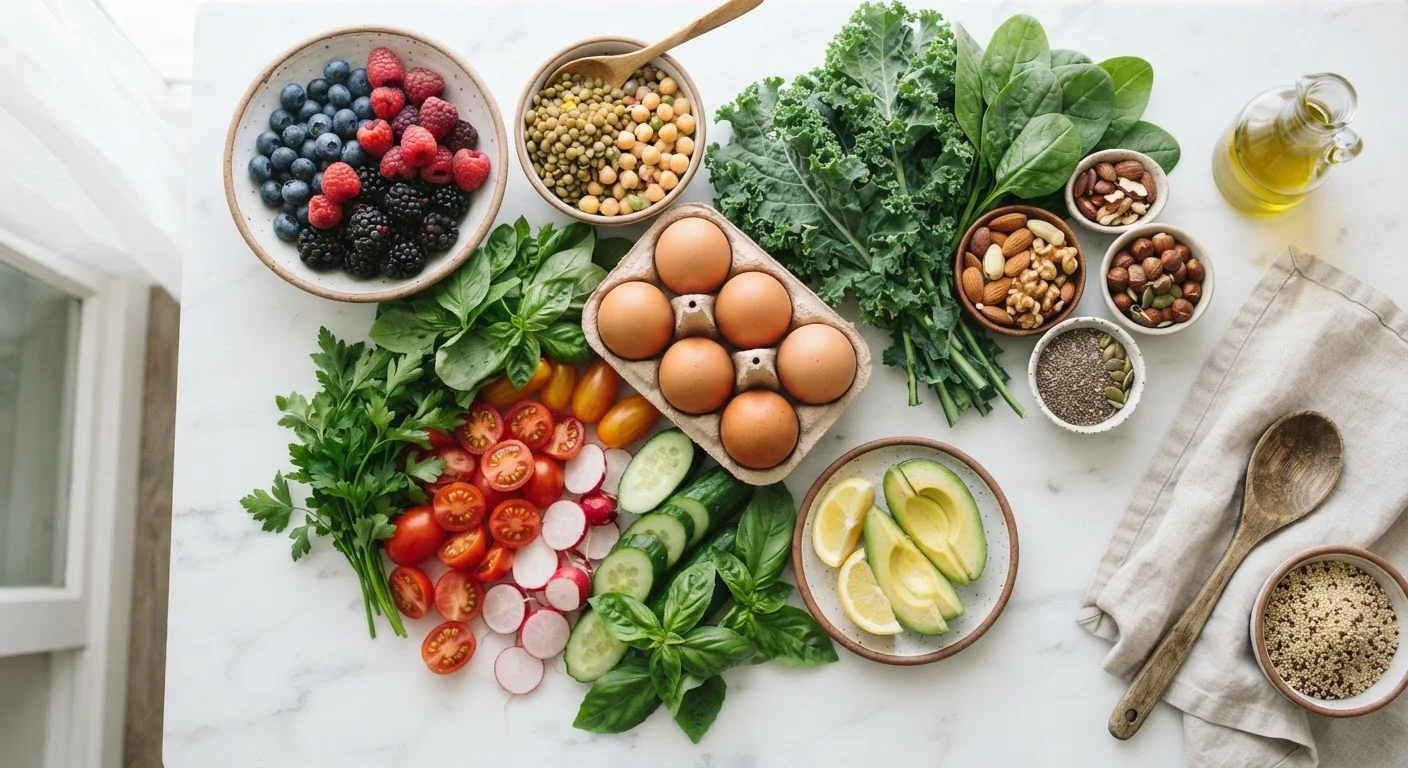
Nutrient-dense foods tend to share a few characteristics: they're relatively unprocessed, high in micronutrients (vitamins and minerals), and often contain fiber, quality protein, or beneficial fats alongside those micronutrients. Common examples include:
- Leafy greens (spinach, kale, arugula) - high in vitamins K, A, and C with very few calories
- Legumes (lentils, chickpeas, black beans) - strong sources of plant protein, iron, and folate
- Fatty fish (salmon, sardines, mackerel) - rich in omega-3 fatty acids, vitamin D, and B12
- Eggs - provide complete protein, choline, selenium, and B vitamins in a compact package
- Berries - relatively low in sugar, high in antioxidant compounds and vitamin C
- Nuts and seeds - calorie-dense but rich in magnesium, vitamin E, and healthy fats
Notice that nutrient density doesn't mean low-calorie. Nuts and fatty fish are both calorie-heavy and nutritionally rich. The relationship is about ratio, not raw numbers. For a deeper look at how these characteristics appear on packaging, see how to read a nutrition label.
~90%
Americans fall short on key micronutrients
According to U.S. dietary guidelines data, the vast majority of Americans do not meet recommended intakes for vegetables, fruits, dairy, and whole grains - food groups that anchor nutrient-dense eating patterns.
57%
of U.S. calories come from ultra-processed foods
Research published in BMJ Open estimated that ultra-processed foods - many of which are low in nutrient density - account for more than half of daily calorie intake in the average American diet.
3x
More nutrients per calorie in whole vs. processed
Nutritional analyses comparing whole food categories to their processed equivalents consistently find that minimally processed options deliver substantially more vitamins and minerals per calorie consumed.
Empty Calories and the Other End of the Spectrum
At the opposite end of the spectrum sit foods often described as providing "empty calories" - energy with minimal accompanying nutrients. Heavily processed foods, sugary beverages, and refined grain products are frequently cited examples. They supply carbohydrates and often fats, but little in the way of vitamins, minerals, or fiber.
This doesn't make them morally "bad" foods. But it does mean that eating a large proportion of your daily calories from low-density sources makes it harder to meet your nutritional needs without overeating. Research in nutritional epidemiology has consistently linked diets heavy in ultra-processed foods with poorer micronutrient status and higher rates of diet-related chronic conditions.
Understanding this spectrum also helps contextualize popular nutrition claims. Common nutrition myths often thrive in the space between calorie-focused and nutrient-focused thinking - for example, the idea that "a calorie is a calorie" in every context, regardless of food quality.
How to Use This Concept Without Obsessing Over Numbers
The practical value of nutrient density isn't in assigning scores to every meal - it's in developing a general intuition for food quality. A few principles help:
- Prioritize variety. No single food covers all nutrient bases. Rotating across different vegetables, proteins, and whole grains covers more micronutrient ground than repeating the same "healthy" foods daily.
- Anchor meals to whole food sources. Building meals around vegetables, legumes, lean proteins, and whole grains automatically tilts the nutrient density of your plate upward. Understanding what whole foods actually means is a useful starting point here.
- Use processed foods as additions, not foundations. Occasional processed foods within an otherwise nutrient-rich diet have little impact on overall quality. The issue is structural reliance on them.
Gut health adds another layer to this picture: nutrient-dense foods - particularly those high in fiber and fermented options - support a diverse gut microbiome, which in turn influences how well nutrients are absorbed. The role of gut health in nutrition is increasingly recognized as central to this process.
A Simple Daily Habit That Helps
Before building a meal, ask: "What's the most nutrient-dense food on this plate?" Anchoring each meal to at least one high-density item - a leafy green, a legume, a fatty fish - gradually shifts your dietary pattern without requiring strict rules or calorie tracking. Small, consistent shifts in food selection tend to produce durable improvements in overall diet quality.
This article is for general informational and educational purposes only and is not a substitute for professional medical or dietary advice. Consult a registered dietitian or qualified healthcare provider for guidance specific to your health needs.
Frequently Asked Questions
A nutrient-dense food delivers a meaningful amount of vitamins, minerals, fiber, or quality protein relative to its calories. Leafy greens, eggs, legumes, and berries are common examples. The idea is to get more nutritional value per calorie consumed.
Not necessarily. Some nutrient-dense foods - like nuts, avocados, and salmon - are relatively high in calories but pack substantial nutritional value. The concept is about the ratio of nutrients to calories, not calorie count alone.
Calorie density measures how many calories a food provides per gram or serving. Nutrient density measures how many beneficial nutrients come with those calories. A food can be calorie-dense but nutrient-poor, like many ultra-processed snacks.
Yes. Most dietitians emphasize that you don't need to count calories to benefit from this concept. Simply shifting toward foods that provide more vitamins, minerals, and fiber naturally supports better dietary quality without numerical tracking.
Most whole foods score well on nutrient density, but context matters. Plain white rice, for example, is a whole grain derivative but relatively low in micronutrients compared to quinoa or lentils. Variety across food groups covers nutritional gaps most effectively.
Not necessarily - dietary patterns matter more than individual foods. The goal is for the overall diet to be rich in nutrient-dense choices, while leaving room for flexibility. Rigid elimination often backfires over the long term, according to nutrition researchers.
The content on this site is for informational purposes only and is not a substitute for professional advice. Always consult a qualified professional for guidance specific to your situation.