

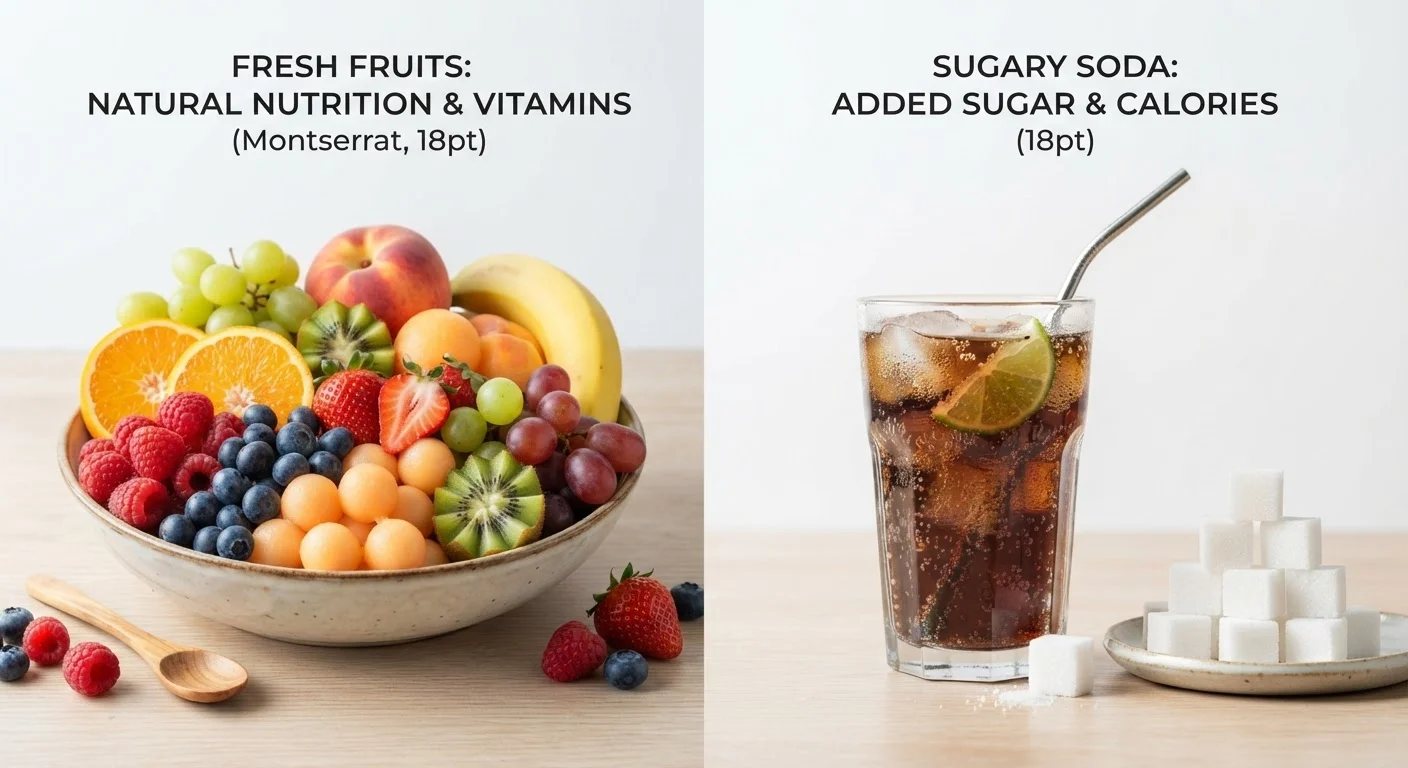
Option A
Natural Sugar
Sugar that comes packaged with nutrients in whole foods.
Best for: People seeking energy and sweetness alongside fiber, vitamins, and minerals found in whole fruits, vegetables, and dairy.
Option B
Added Sugar
Sugar introduced during processing, with no nutritional co-passengers.
Best for: Understanding what to moderate - added sugars in processed foods and beverages contribute calories without meaningful nutritional benefit.
The Core Difference: What Each Type Actually Means
When people hear that fruit and soda both contain sugar, a reasonable question follows: does the source actually matter? The short answer is yes - significantly. Sugar molecules themselves (primarily glucose, fructose, and sucrose) are chemically identical whether they come from an apple or a soft drink. What differs is the nutritional context surrounding them.
Natural sugars are those found inherently in whole foods - fructose in fruit, lactose in dairy, and small amounts of glucose and sucrose in vegetables. These foods deliver sugar alongside fiber, water, vitamins, minerals, and phytonutrients. The fiber in particular slows digestion and moderates how quickly sugar enters the bloodstream.
Added sugars, by contrast, are sugars and syrups incorporated into foods during processing or preparation. Common forms include table sugar (sucrose), high-fructose corn syrup, honey added to packaged goods, and fruit juice concentrates used as sweeteners. They contribute calories but arrive stripped of the nutritional co-passengers found in whole foods.
This distinction matters because your body processes the overall food, not just the isolated sugar molecule. See how this connects to the broader picture of food processing in our article on whole foods vs. processed foods.
| Criterion | Natural Sugar | Added Sugar |
|---|---|---|
| Primary sources | Fruit, dairy, some vegetables | Sodas, candy, baked goods, sauces |
| Nutrient co-passengers | Fiber, vitamins, minerals, antioxidants | Typically none |
| Effect on blood sugar | Moderated by fiber content | Often rapid absorption |
| Caloric contribution | Part of a nutrient-dense food | "Empty" calories |
| Label identification | Listed under "Total Sugars" | Listed under "Added Sugars" |
| Dietary guidance | No specific limit for whole food sources | Limit to <10% of daily calories |
Health Implications: What the Evidence Suggests
Research consistently links high added sugar intake to increased risk of obesity, type 2 diabetes, cardiovascular disease, and dental decay. A landmark analysis published in JAMA Internal Medicine found that adults consuming 17-21% of daily calories from added sugar had a significantly higher risk of cardiovascular mortality than those consuming less than 8%. These associations are not observed at comparable levels with naturally occurring sugars in whole foods.
Whole fruit, for instance, has a strong evidence base supporting its role in health promotion. Studies associate regular fruit consumption with lower risk of chronic disease - largely because of the fiber, antioxidants, and polyphenols that accompany the natural sugars. Fiber slows gastric emptying, which moderates blood glucose response and promotes satiety.
Dairy products like plain milk and unsweetened yogurt contain lactose (a natural sugar) alongside protein, calcium, and other nutrients. These, too, are not nutritionally equivalent to sugar-sweetened beverages, despite containing sugar.
17 tsp
Average daily added sugar intake for U.S. adults
According to the CDC, American adults consume roughly 17 teaspoons of added sugar daily - well above the recommended limit.
~40%
Share of added sugar calories from beverages
The CDC estimates that sugar-sweetened beverages are the single largest source of added sugars in the American diet.
<10%
Recommended daily calorie limit from added sugars
The 2020-2025 Dietary Guidelines for Americans advise keeping added sugar intake below 10% of total daily calories.
This content is for general informational purposes only and does not constitute medical or nutritional advice. Speak with a registered dietitian or qualified healthcare provider for guidance tailored to your individual health needs.
Reading Labels and Making Practical Choices
The U.S. Food and Drug Administration updated the Nutrition Facts label to include a dedicated "Added Sugars" line, expressed in grams and as a percentage of the Daily Value. This change was specifically designed to help consumers distinguish added sugars from naturally occurring ones. For a 2,000-calorie diet, the Daily Value for added sugars is 50 grams - based on the Dietary Guidelines recommendation of keeping added sugars below 10% of total calories.
Practical habits that reduce added sugar intake without sacrificing enjoyment include:
- Choosing plain or unsweetened versions of yogurt, oatmeal, and nut butters, then adding whole fruit for natural sweetness.
- Replacing sugar-sweetened beverages with water, sparkling water, or unsweetened drinks - this single swap is one of the most impactful changes most Americans can make.
- Scanning ingredient lists for added-sugar aliases: brown sugar, cane syrup, dextrose, maltose, and fruit juice concentrate all function as added sugars.
- Treating naturally sweet whole foods - berries, apples, bananas - as the primary vehicle for satisfying a sweet craving.
No whole food needs to be feared because it contains sugar. The goal is not zero sugar, but rather ensuring most of the sugar in your diet arrives with nutritional value attached.
A Note on Fruit Juice vs. Whole Fruit
Even 100% fruit juice, though it contains no "added" sugar, behaves more like added sugar than whole fruit in practice. Juicing removes most of the fiber, which means the natural sugars are absorbed more rapidly. Nutrition guidance generally favors whole fruit over juice for this reason. If you enjoy juice, treating it as an occasional addition rather than a daily staple is a reasonable approach for most people.
The content on this site is for informational purposes only and is not a substitute for professional advice. Always consult a qualified professional for guidance specific to your situation.