

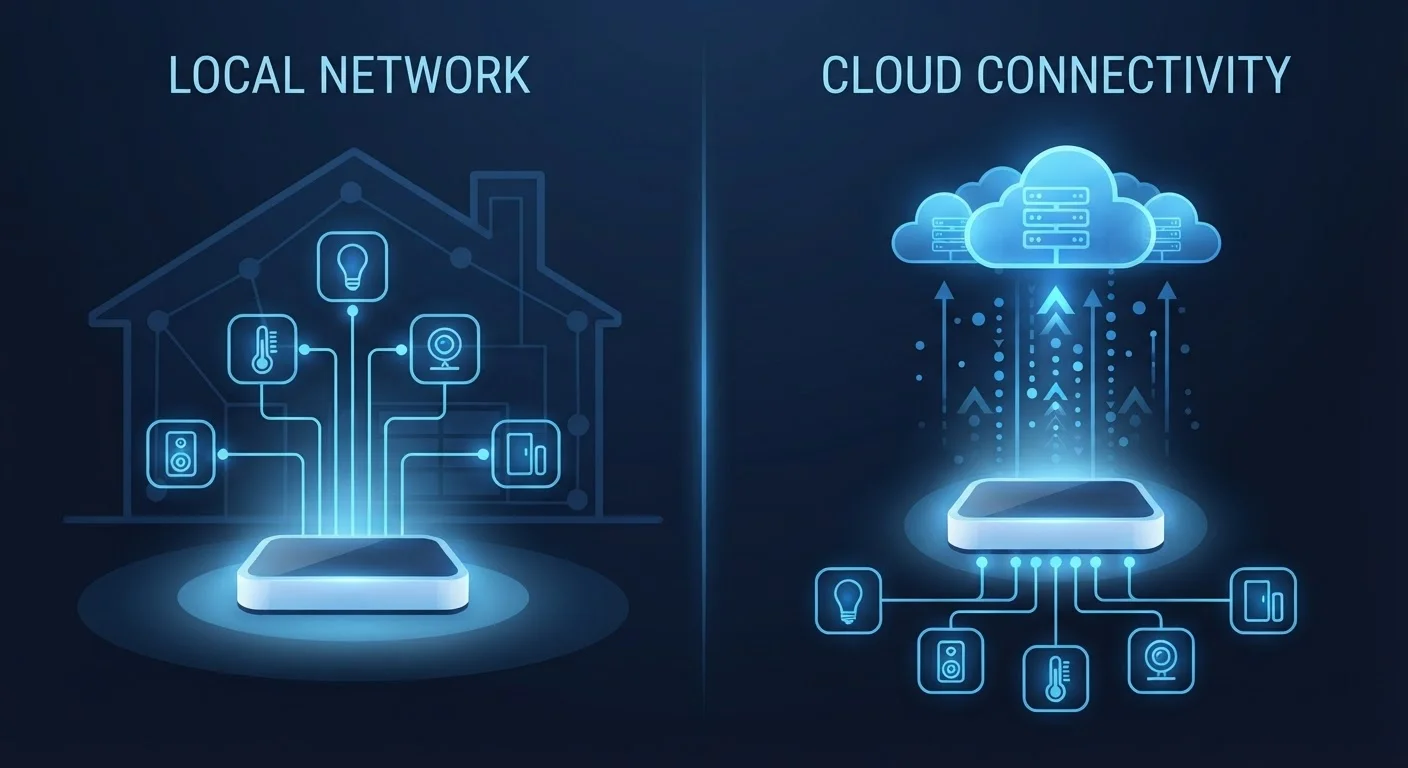
Option A
Local Processing
The self-contained, privacy-first approach.
Best for: Households that prioritize reliability, speed, and keeping data off remote servers.
Option B
Cloud Processing
The connected, feature-rich but dependent approach.
Best for: Users who want access to advanced AI features, remote control, and cross-device integration.
What Each Approach Actually Means
When a smart device receives a command - say, "turn off the kitchen lights" - something has to interpret that instruction and trigger the right action. Where that computation happens is the fundamental difference between local and cloud processing.
Local processing means the device handles the logic on hardware physically inside your home: a smart hub, the device itself, or a dedicated home server. The data doesn't leave your network. Cloud processing means the device sends data to remote servers operated by the manufacturer or a third-party platform, which processes the request and sends a response back.
For a deeper look at how smart home systems are structured, see Smart Home Technology, Explained for the Rest of Us.
| Criterion | Local Processing | Cloud Processing |
|---|---|---|
| Works without internet | Yes | No |
| Response speed | Very fast (milliseconds) | Slower (server round-trip) |
| Data privacy | High - data stays local | Lower - data leaves home |
| Advanced AI features | Limited | Extensive |
| Remote access | Requires extra setup | Built-in via app |
| Vulnerability to server shutdowns | None | High - device may brick |
| Setup complexity | Moderate to high | Typically simple |
Reliability and Speed: Where Local Has a Clear Edge
Local processing has one undeniable advantage: it doesn't depend on anything outside your home. If your internet goes down, a locally processed smart lock still unlocks. A locally controlled thermostat still responds. Cloud-dependent devices, by contrast, can become completely unresponsive during an outage - even if your home Wi-Fi is perfectly functional.
Latency is also lower with local processing. A command processed on a hub a few feet away resolves in milliseconds. A cloud round-trip - device to server to device - adds noticeable delay, especially during peak network traffic or on slow connections.
~25%
U.S. households with smart home devices
Statista estimates roughly one in four U.S. households had adopted smart home technology as of the mid-2020s, making reliability trade-offs increasingly relevant for mainstream consumers.
300ms+
Typical cloud command latency
Network engineers generally estimate that a full cloud round-trip for smart home commands adds several hundred milliseconds versus near-instant local processing.
That said, cloud infrastructure is genuinely robust for most urban and suburban users. For the majority of households with reliable broadband, outages are rare enough that this trade-off may not feel significant day-to-day.
Privacy: What Happens to Your Data
Every voice command sent to a cloud server is, by definition, leaving your home. Depending on the platform and its privacy policy, that data may be stored, reviewed, or used to improve AI models. For cameras and microphones in particular, this is a non-trivial consideration.
Local processing dramatically reduces this exposure. If voice recognition runs on a local hub, your spoken words never leave the network. The same applies to motion sensor logs, door activity, and energy usage patterns - data that can paint a detailed picture of daily life at home.
For a detailed breakdown of what connected devices typically collect, see our smart home privacy explainer.
What Happens When a Cloud Service Shuts Down
Several smart home platforms have discontinued their cloud services, rendering connected devices permanently non-functional - a scenario known informally as "bricking." Devices relying entirely on cloud processing have no fallback once the supporting server infrastructure is gone. Local processing devices, by contrast, continue working independently of any company's business decisions. This is worth factoring in when evaluating long-term value of any cloud-dependent device.
It's worth noting that privacy practices vary widely between manufacturers. Reading the privacy policy and checking whether a device has local processing options is a reasonable step before purchase.
Features, Flexibility, and the Hybrid Reality
Cloud processing enables capabilities that local hardware struggles to match. Sophisticated voice assistants, continuous learning routines, and cross-platform integrations generally rely on cloud infrastructure to function. If you want your home to adapt to your habits using machine learning, cloud connectivity is typically necessary today.
However, the industry is shifting. Open-source platforms and standards like Matter are making local processing more capable and interoperable. Some platforms now offer a hybrid model: basic automations and device control run locally, while advanced features optionally use cloud services.
This mirrors the broader trade-off explored in cloud vs. local storage - local gives you control and reliability; cloud gives you power and convenience. Building a flexible setup is also easier now; building a smart home without vendor lock-in is increasingly practical with modern open standards.
The content on this site is for informational purposes only and is not a substitute for professional advice. Always consult a qualified professional for guidance specific to your situation.