

Why Tire Pressure Is More Than a Maintenance Checkbox
Most drivers think of tire pressure as a minor detail - something to address when the warning light appears. In reality, the air inside your tires is doing structural work every second you're on the road. Tires are designed to operate within a precise pressure range. Outside that range, the tire's geometry changes, and those changes ripple into handling, wear patterns, and fuel consumption.
The National Highway Traffic Safety Administration (NHTSA) has linked underinflated tires to thousands of crashes annually. A tire running significantly low on pressure can overheat and fail catastrophically at highway speeds. That's not a scare tactic - it's a predictable physics outcome when rubber flexes harder and faster than it was engineered to handle.
For everyday guidance on how pressure interacts with other tire variables, see our article on tire pressure, alignment, and rolling resistance.
Up to 3%
Potential fuel economy improvement from proper inflation
According to the U.S. Department of Energy, tires inflated to the correct PSI can improve gas mileage by up to 3% compared to underinflated tires.
~1 PSI
Pressure lost per 10°F temperature drop
A widely cited general guideline in automotive maintenance holds that tire pressure changes approximately 1 PSI for every 10-degree Fahrenheit shift in ambient temperature.
1-2 PSI
Natural monthly pressure loss in typical conditions
Tires lose air gradually through the rubber and valve stem even without a puncture, making monthly checks a practical habit for most drivers.
The Safety Consequences of Getting It Wrong
Underinflation is the more common problem. When a tire runs low, its sidewalls flex excessively, generating heat. Heat is the primary enemy of tire rubber - it accelerates structural breakdown and dramatically increases blowout risk. An underinflated tire also distorts its contact patch, reducing the precision of steering inputs and lengthening braking distances.
Overinflation carries its own risks. A tire inflated beyond the recommended PSI becomes stiff and round, reducing the contact patch to a smaller central strip. Less rubber touching the road means less grip, especially during cornering and emergency maneuvers. Overinflated tires also transmit more road shock through the suspension, masking feedback that helps drivers sense hazards.
If you want a deeper understanding of what happens when tires lose grip, our piece on traction loss and what it means for control explains the mechanics plainly.
Always Check Pressure When Tires Are Cold
Driving heats your tires and temporarily raises their internal pressure - sometimes by 4-6 PSI above the actual resting level. If you check and adjust pressure on warm tires, you risk underinflating them once they cool down. Make pressure checks part of your routine before a drive, not after one.
Fuel Economy and Tire Wear: The Hidden Costs
The U.S. Department of Energy estimates that keeping tires properly inflated can improve fuel economy by up to 3%. That may sound modest, but across tens of thousands of miles, it adds up. An underinflated tire creates higher rolling resistance - the engine must work harder to push a tire that's squishing and dragging rather than rolling cleanly. For more on how this plays out at highway speeds, see why your engine works harder than it should on the highway.
Tire wear is equally affected. An underinflated tire wears fastest on both outer edges, while an overinflated tire wears down its center tread more rapidly. Either pattern shortens tire life significantly - potentially by tens of thousands of miles - and creates uneven grip characteristics that compound handling issues. Uneven wear is also a signal that other issues may be present, which is why regular rotation, balancing, and alignment services matter alongside proper inflation.
Your TPMS Light Isn't a Substitute for Monthly Checks
Most vehicles built after 2008 have a Tire Pressure Monitoring System (TPMS) that warns you when a tire drops significantly below the recommended PSI - typically 25% below. However, a tire can be meaningfully underinflated without triggering the light. Treating TPMS as a backup alarm, not a routine monitor, is a safer habit.
How to Check and Correct Your Tire Pressure
Checking tire pressure is a five-minute task that requires only an inexpensive gauge. Follow these steps:
- Check tires cold. Drive less than a mile before checking, or check before driving at all. Heat from driving temporarily increases pressure readings by 4-6 PSI, which leads to underinflation if you adjust based on a warm reading.
- Find your target PSI. Look at the sticker on the inside edge of your driver's door. It lists the correct front and rear PSI - these may differ. Ignore the number on the tire sidewall; that's the maximum the tire can hold, not your vehicle's recommendation.
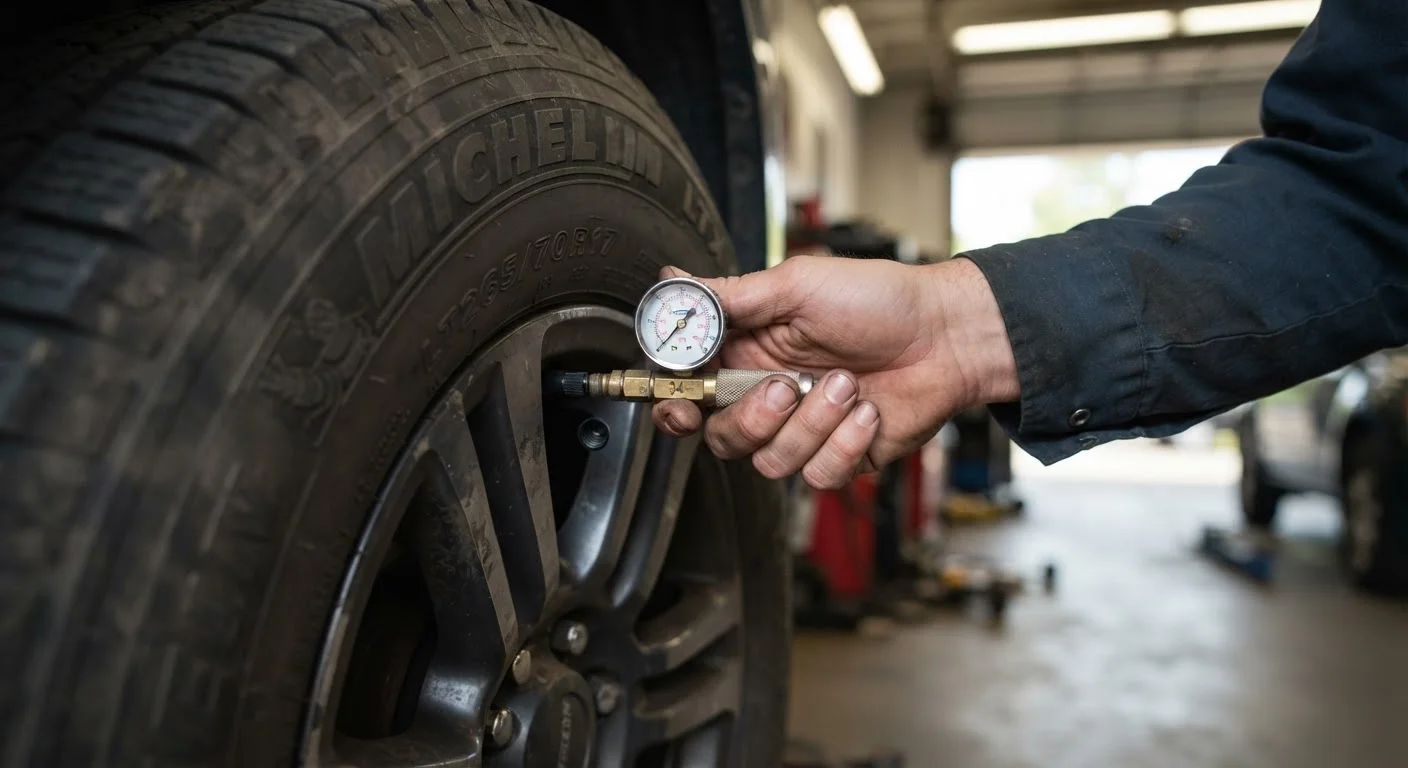
- Remove the valve cap on each tire and press your gauge firmly onto the valve stem. A digital gauge gives the clearest reading.
- Add or release air as needed. Most gas stations have air compressors. Add air in short bursts and recheck. To release air, press the small pin inside the valve stem with a pen tip or the back of many gauges.
- Don't forget the spare. A flat spare is useless in an emergency. Check it every few months.
For seasonal context - especially how cold winters affect pressure - our year-round driving habits reference has practical guidance month by month.
Frequently Asked Questions
Most mechanics recommend checking once a month and before any long road trip. Tires can lose 1-2 PSI per month naturally, and temperature swings accelerate that. A quick monthly check with an inexpensive gauge is all it takes.
Check the sticker on the inside of your driver's door jamb or your owner's manual. This is the vehicle manufacturer's recommended PSI for your specific car's weight and suspension. Do not use the maximum PSI printed on the tire sidewall - that's the tire's structural limit, not a driving recommendation.
Yes. Both underinflation and overinflation can compromise the tire's ability to grip the road consistently. An underinflated tire's contact patch deforms unpredictably under braking; an overinflated tire reduces the contact area. Either condition can increase stopping distances, particularly on wet pavement.
Cold air is denser, so tire pressure drops when temperatures fall - typically around 1 PSI for every 10°F decrease. When pressure falls below the vehicle's threshold, the TPMS (Tire Pressure Monitoring System) triggers a warning. Add air to the correct PSI and the light should go off once the tires warm slightly.
Yes, gas station air compressors work fine for topping off tires. Bring your own gauge for accurate readings, as station gauges can be unreliable. Fill incrementally and check frequently - it's easy to overfill quickly with a high-powered compressor.
The content on this site is for informational purposes only and is not a substitute for professional advice. Always consult a qualified professional for guidance specific to your situation.