

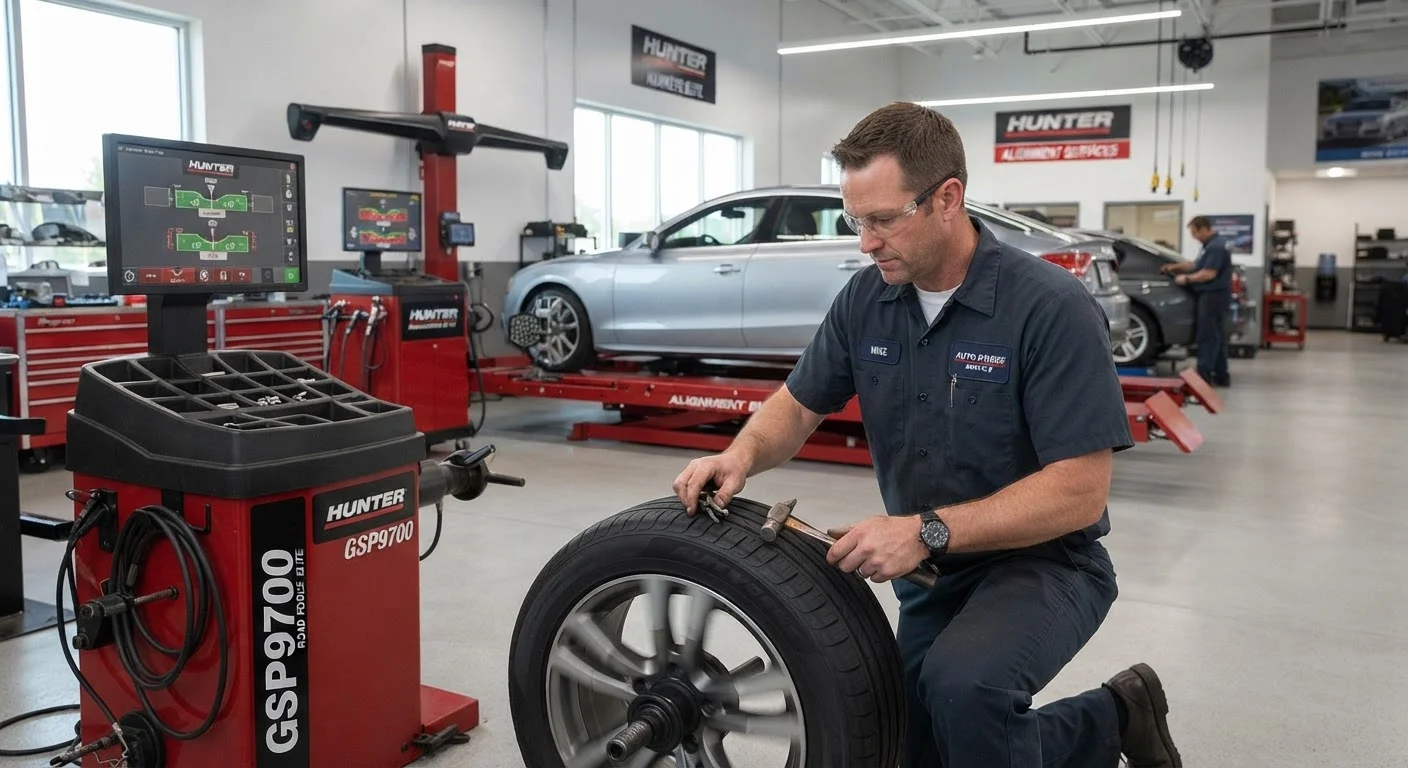
Why These Three Services Get Mixed Up
Ask most drivers what the difference is between tire rotation, balancing, and alignment, and you'll get a shrug or a guess. The terms get lumped together at the service counter, sometimes offered as a bundle, which only deepens the confusion. In reality, each service addresses a completely different problem - and skipping one because you think you just had it done can quietly cost you in tire wear, fuel economy, and ride quality.
Here's a plain-English breakdown of what each service actually does, what symptoms suggest you need it, and how often most vehicles require it. For a fuller picture of how these fit into your overall maintenance calendar, see your car's complete maintenance schedule decoded.
| Rotation frequency | Every 5,000-7,500 miles (General manufacturer guidance; confirm in your owner's manual) |
| Balancing frequency | With each tire mount or rotation; as needed after impacts (Standard shop recommendation) |
| Alignment frequency | Annually or every 12,000-15,000 miles (General manufacturer guidance; varies by vehicle) |
| Primary benefit of rotation | Extends overall tire life by evening out tread wear |
| Primary benefit of balancing | Eliminates vibration and reduces stress on suspension |
| Primary benefit of alignment | Prevents uneven edge wear and improves fuel economy |
Tire Rotation: Moving Tires to Even Out Wear
What it is: Rotation means physically moving each tire to a different position on the vehicle - front-left to rear-right, for example. The goal is to equalize wear across all four tires, because front and rear tires wear at different rates depending on whether the car is front-wheel drive, rear-wheel drive, or all-wheel drive. On a front-wheel-drive vehicle, the front tires do the steering and the driving, so they wear faster.
What it isn't: Rotation does nothing about a wheel that vibrates or pulls to one side. It strictly addresses uneven wear by redistributing which tire handles which job.
How often: Most vehicle manufacturers recommend rotation every 5,000 to 7,500 miles, though your owner's manual is the authoritative source. Many drivers simply do it with every other oil change as an easy rule of thumb.
~$0.11/mile
Estimated cost of uneven tire wear over time
Misaligned or under-rotated tires can reduce tread life significantly, raising per-mile tire costs according to industry estimates.
Up to 10%
Fuel economy loss from poor alignment
The U.S. Department of Energy notes that misalignment increases rolling resistance, which can meaningfully reduce gas mileage.
Wheel Balancing: Smoothing Out the Spin
What it is: Even a brand-new tire and wheel assembly isn't perfectly uniform. Minor weight differences - fractions of an ounce - cause the assembly to wobble slightly at speed. A technician mounts the wheel on a balancing machine that spins it and identifies heavy spots, then attaches small counterweights to the rim to compensate.
What it isn't: Balancing won't fix a vehicle that drifts left or right when you let go of the wheel - that's an alignment issue. It also won't fix uneven tread wear already in progress.
Symptoms you might notice: A steering wheel or seat vibration that worsens around 55-70 mph is the classic sign of an out-of-balance tire. The vibration may ease at higher or lower speeds, which is a useful diagnostic clue.
How often: Balancing is typically recommended when tires are mounted or rotated, and any time you notice vibration. Hitting a significant pothole or curb can knock a wheel out of balance mid-service interval.
Wheel Alignment: Pointing Every Tire in the Right Direction
What it is: Alignment refers to the angles at which your tires contact the road. Technicians measure and adjust three primary angles - camber (tilt inward or outward), toe (pointed inward or outward when viewed from above), and caster (the steering axis angle) - to match the vehicle manufacturer's specifications.
What it isn't: Alignment doesn't spin the tires or move them between positions. It's an adjustment to suspension geometry, not the tires themselves.
Symptoms you might notice: The vehicle pulling to one side, a steering wheel that sits off-center when driving straight, or tires wearing heavily on one edge are all common signs. Proper alignment also directly affects rolling resistance and fuel economy.
How often: Many manufacturers suggest checking alignment annually or every 12,000-15,000 miles. It should also be checked after hitting a major pothole, curb, or any suspension-affecting impact, and whenever new tires are installed.
Camber
The inward or outward tilt of a tire when viewed from the front of the vehicle. Excessive camber causes heavy wear on one edge of the tread.
Toe
The direction tires point relative to the vehicle's centerline when viewed from above. Toe misalignment is one of the most common causes of rapid, uneven tire wear.
Caster
The angle of the steering axis relative to vertical, viewed from the side. Caster affects steering stability and how the wheel returns to center after a turn.
Tread wear
The gradual erosion of a tire's rubber surface through contact with the road. Even tread wear across all four tires is a sign of a well-maintained rotation and alignment schedule.
For more on how tire condition connects to seasonal driving safety, see driving habits by season. And if you've been told you need all three at once, that's not necessarily a sales pitch - understanding which maintenance advice is legitimate versus overblown helps you evaluate the recommendation confidently.
The content on this site is for informational purposes only and is not a substitute for professional advice. Always consult a qualified professional for guidance specific to your situation.