

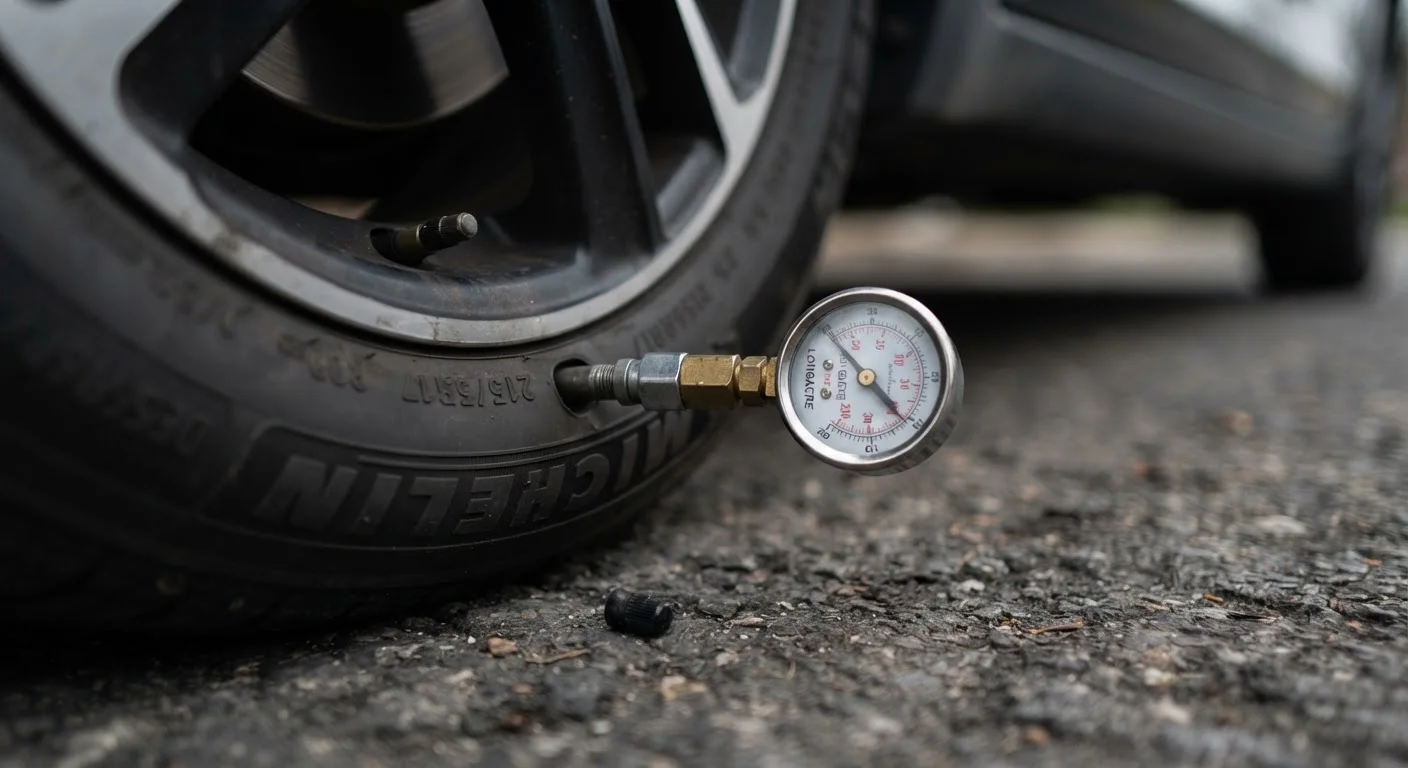
The Numbers on Your Doorjamb and What They're Telling You
Every passenger vehicle sold in the United States carries a tire information label on the driver's side doorjamb. That label lists the recommended tire pressure in PSI - not the maximum pressure molded into the tire's sidewall, which is a safety ceiling, not a target. Confusing the two is one of the most common tire mistakes drivers make.
| Recommended pressure source | Driver's side doorjamb label (not the tire sidewall) |
| Typical passenger car PSI range | 32-36 PSI (varies by vehicle) |
| Pressure change per 10°F temperature shift | ~1 PSI (General automotive engineering guideline) |
| Recommended check frequency | Monthly and before long trips |
| Alignment check interval | Every 12,000-15,000 miles or after a significant impact (General industry recommendation) |
| Primary alignment wear indicator | Uneven or feathered tread across the tire width |
Your vehicle's recommended PSI is calculated by the manufacturer to balance ride comfort, load capacity, handling response, and fuel efficiency for that specific platform. Running 4-8 PSI below the recommended figure may feel imperceptible from the driver's seat, yet the U.S. Department of Energy has noted that underinflation measurably reduces fuel economy. Tires also wear faster along their outer edges when underinflated because the contact patch spreads and flexes excessively.
Pressure changes with temperature: roughly 1 PSI for every 10°F shift in ambient temperature. That means tires that read correctly in summer can be noticeably low after the first cold snap - a key reason to check pressure monthly and after significant temperature swings. See our guide on seasonal driving adjustments for a full breakdown of how weather affects tire performance.
Alignment Angles: Camber, Toe, and Caster Explained
Wheel alignment describes the geometric relationship between your tires and the road. Three angles define it:
- Camber
- The inward or outward tilt of the tire when viewed from the front of the vehicle. Excessive negative camber (top tilted in) causes inner-edge wear; excessive positive camber causes outer-edge wear.
- Toe
- Whether the fronts of the tires point inward (toe-in) or outward (toe-out) relative to each other, viewed from above. Toe misalignment is the leading cause of rapid, feathered tread wear and is often described as the tire being "scrubbed" sideways as it rolls.
- Caster
- The angle of the steering axis viewed from the side. Caster primarily affects straight-line stability and steering returnability rather than tire wear, but significant caster imbalance - different angles side to side - can cause the vehicle to pull.
A vehicle drifting to one side, a steering wheel that sits off-center on a straight road, or uneven tread wear across an axle are all signals worth investigating. For a deeper look at related services, our article on tire rotation, balancing, and alignment clarifies what each procedure actually corrects.
PSI (pounds per square inch)
The unit used to measure tire inflation pressure in the United States. Your vehicle's recommended PSI is listed on the doorjamb label.
Rolling resistance
The energy a tire consumes to keep rolling under vehicle load. Lower rolling resistance generally improves fuel economy or EV range.
Toe alignment
The degree to which tires point inward or outward relative to each other when viewed from above. Incorrect toe causes rapid, feathered tread wear.
Camber
The vertical tilt of a tire viewed from the front of the vehicle. Too much tilt in either direction leads to uneven wear along one edge of the tread.
Contact patch
The small area of a tire that actually touches the road at any given moment. Its shape and size are affected by inflation pressure and load.
Rolling Resistance: The Hidden Fuel Tax
Rolling resistance is the energy a tire must expend to maintain continuous motion under load. It accounts for a meaningful share of total fuel consumption - industry estimates typically place tires responsible for roughly 5-15% of fuel use in passenger vehicles, depending on driving conditions and vehicle type.
5-15%
Share of fuel use attributed to tire rolling resistance
Industry estimates for passenger vehicles; figure varies by driving conditions, vehicle type, and tire specification.
~1 PSI
Pressure drop per 10°F temperature decrease
A widely cited general engineering guideline useful for anticipating seasonal pressure loss.
4-8 PSI
Common underinflation amount drivers don't notice by feel
Tires can appear visually normal while meaningfully below target pressure, increasing wear and energy loss.
Three factors drive rolling resistance upward: low tire pressure (the deformed contact patch flexes more with each revolution), aggressive tread compounds designed for grip over efficiency, and misalignment that creates lateral scrub. High-efficiency or "low rolling resistance" tires use stiffer sidewall compounds and shallower tread patterns to minimize energy loss - a trade-off that can slightly reduce wet-weather grip, so understanding the balance matters.
For electric vehicle drivers, rolling resistance carries extra weight because range is directly tied to how much energy each wheel rotation consumes. But the principle applies to every vehicle: a properly inflated, well-aligned tire does less work and costs less to operate over its lifetime. Aggressive driving habits compound the effect - our piece on the real costs of aggressive driving explains how braking and acceleration patterns interact with tire wear.
Maintaining correct pressure and scheduling alignment checks as part of your regular service intervals - outlined in your car's maintenance schedule, decoded - is the most cost-effective way to keep rolling resistance in check without any hardware changes.
The content on this site is for informational purposes only and is not a substitute for professional advice. Always consult a qualified professional for guidance specific to your situation.