

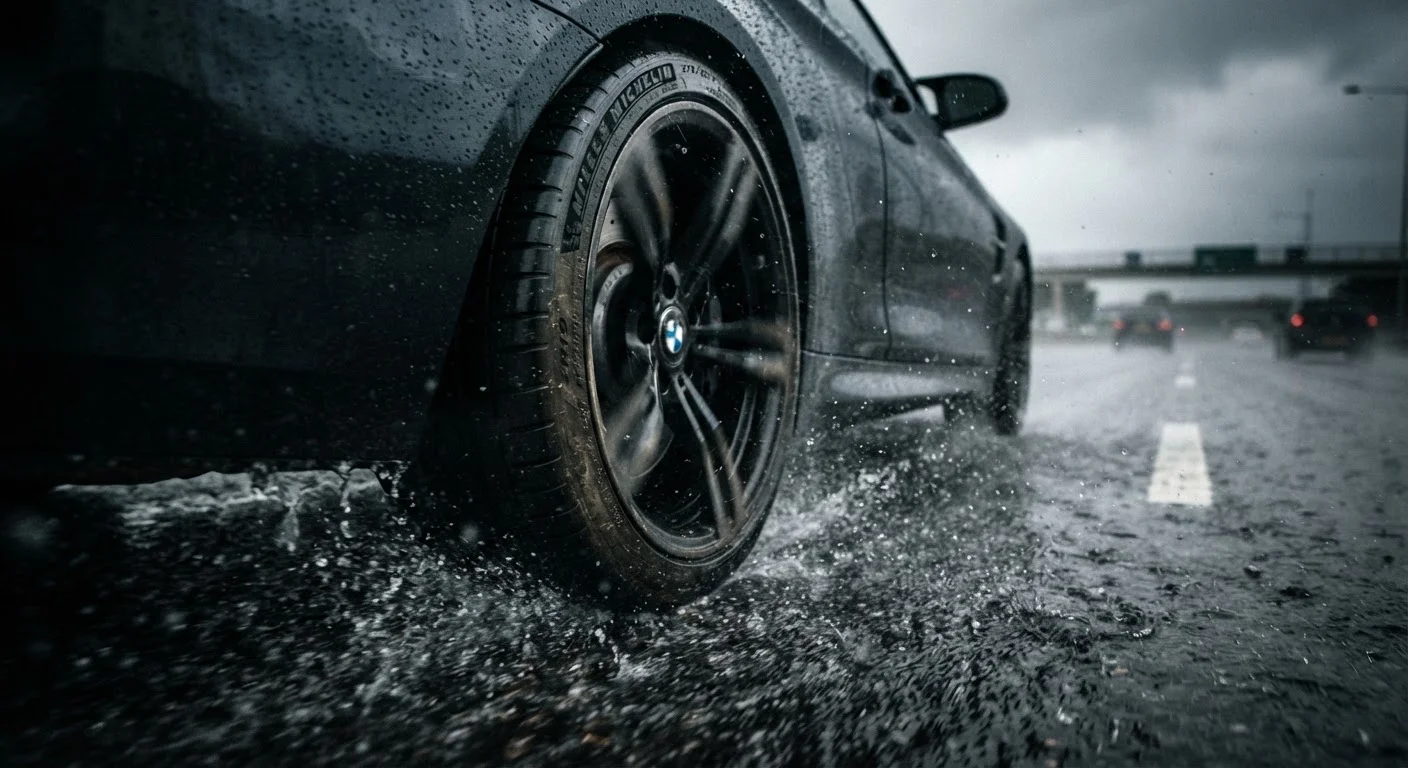
The Physics Behind Grip
Every tire has a finite amount of grip to offer at any moment. Engineers describe this as the tire's friction circle - a conceptual limit on the total force the contact patch can manage. That force can be spent on braking, cornering, or acceleration, but not all three at once without risk. Push beyond what the contact patch can handle and the tire transitions from rolling to sliding.
Road surface, tire compound, tread condition, inflation pressure, and temperature all influence where that limit sits. A dry, clean highway offers far more grip than a rain-slicked curve. Tire pressure plays a direct role in how much of that grip potential is actually available - a tire operating at the wrong pressure is starting at a disadvantage before conditions even change.
2/32"
Legal minimum tire tread depth in most U.S. states
Many safety organizations recommend replacing tires at 4/32" for improved wet-weather performance.
35 mph
Speed at which hydroplaning can begin
Research from tire safety organizations indicates hydroplaning risk starts at relatively modest highway speeds on worn tires.
~34%
Reduction in crash fatalities linked to ESC
The National Highway Traffic Safety Administration (NHTSA) has credited Electronic Stability Control with significant reductions in single-vehicle crash fatalities.
Understeer, Oversteer, and Hydroplaning - Defined
Understeer occurs when the front axle loses traction before the rear. The car continues in a wider arc than intended - or straight ahead - regardless of how much steering input is applied. Front-wheel-drive vehicles are more naturally prone to understeer under hard cornering because the front tires are simultaneously tasked with steering and transmitting engine power.
Oversteer is the opposite: the rear axle breaks loose first, rotating the tail of the car outward. Rear-wheel-drive vehicles are more susceptible, especially under throttle mid-corner. A controlled drift is a managed form of oversteer; an unplanned one on a public road is a serious hazard.
Hydroplaning is a distinct phenomenon in which a wedge of water builds up faster than the tire tread can evacuate it, literally lifting the contact patch off the pavement. At that moment, steering and braking inputs have little effect because the tire is riding on water, not asphalt. Tread depth is critical here - worn tires cannot channel water away efficiently. See how seasonal driving conditions affect traction risks year-round for additional context.
“Tires are the single most safety-critical component on any vehicle. Every force that controls or moves the car - braking, steering, accelerating - passes through four contact patches roughly the size of a human hand.”
— NHTSA Vehicle Safety Communications, U.S. National Highway Traffic Safety Administration
How to Respond - and What Not to Do
The instinctive response to traction loss - stamping on the brakes and wrenching the steering wheel - is often the wrong one. Hard braking on a sliding tire locks the wheel and removes any remaining cornering ability. Abrupt steering amplifies the slide rather than correcting it.
The more effective approach is counterintuitive until practiced: look where you want the car to go, apply smooth, measured corrections, and reduce inputs rather than add them. For understeer, ease off the throttle and very slightly reduce steering angle to let the front tires recover grip. For oversteer, steer gently toward the direction of the slide while gradually reducing throttle.
Modern vehicles equipped with Electronic Stability Control (ESC) - mandatory on new U.S. passenger cars since the 2012 model year - will automatically apply individual brakes and reduce engine output to help manage both conditions. ESC is a genuine safety aid, but it works within the same grip limits the tires face. It cannot conjure friction that does not exist.
Practice Smooth Inputs in Safe Conditions
The habits that prevent traction loss - gradual braking, early entry speed reduction, smooth steering - can be reinforced in low-risk conditions like empty parking lots on a rainy day. Practicing threshold braking with your vehicle (checking your owner's manual for ABS guidance first) builds the muscle memory that matters most when conditions deteriorate unexpectedly.
Prevention: Where Driver Control Actually Lives
The most effective traction management happens before the skid, not during it. Maintaining adequate tread depth - the commonly cited minimum is 2/32 of an inch, though 4/32 is a more conservative benchmark for wet roads - directly preserves the tire's ability to channel water and maintain the contact patch. Checking and adjusting inflation to the vehicle manufacturer's specification (found on the door jamb placard, not the tire sidewall) keeps the contact patch geometry stable.
Speed management matters enormously. Traction limits drop on curves, wet pavement, and loose surfaces. Entering a corner at appropriate speed leaves reserve grip available; entering too fast consumes all of it before any correction is possible. Using engine braking to reduce speed before a corner rather than braking through it distributes forces more safely. Comprehensive car maintenance practices - including routine tire inspection - form the foundation of traction safety that no driving skill can fully compensate for when neglected.
This article is for general informational purposes. For specific concerns about your vehicle's handling or safety systems, consult a qualified mechanic.
Frequently Asked Questions
Understeer happens when the front tires lose grip first, causing the car to plow straight rather than follow the steering input. Oversteer occurs when the rear tires let go, swinging the back of the car outward. Both are forms of traction loss but require opposite corrective actions.
Hydroplaning can begin at speeds as low as 35 mph on a wet road, depending on tire tread depth, tire pressure, and the amount of standing water. At highway speeds, the risk increases substantially. Worn tires with shallow tread are especially vulnerable.
All-wheel drive improves acceleration traction by powering all four wheels, but it does not improve cornering or braking grip beyond what the tires themselves can provide. Drivers of AWD vehicles can still experience understeer, oversteer, and hydroplaning.
Look and steer where you want the car to go - avoid overcorrecting or mashing the brakes. In an understeer situation, ease off the throttle and reduce steering input slightly. In oversteer, steer gently into the slide. Electronic stability control in modern vehicles will assist, but smooth inputs are still critical.
Underinflated tires flex excessively, reducing the stability of the contact patch and increasing heat buildup, both of which degrade grip. Overinflated tires shrink the contact patch. Maintaining the manufacturer-specified pressure keeps the tire working as designed.
The content on this site is for informational purposes only and is not a substitute for professional advice. Always consult a qualified professional for guidance specific to your situation.