

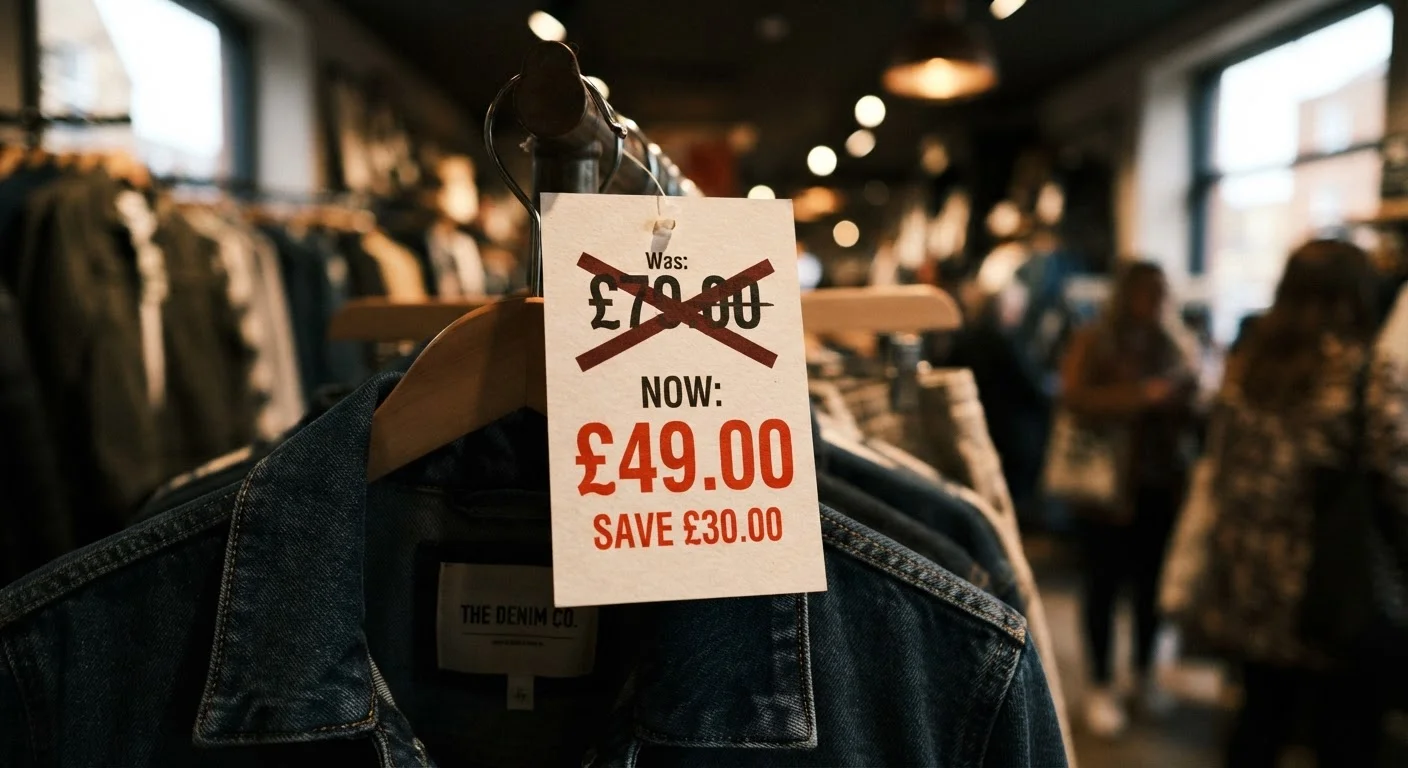
What the Crossed-Out Number Is Really Doing
Walk through any retail store or scroll an online product page and you'll see them everywhere: prices with a line through them, sitting just above a bolder, lower number in red. The message is simple - you're getting a deal. But the crossed-out figure isn't just informational. It's the anchor.
The anchor is the first number your brain latches onto. Once that number is in your head, every other price gets evaluated relative to it. A $60 jacket feels cheap when it's displayed next to a crossed-out $120. The same jacket sitting alone on a rack with a $60 tag feels like... a $60 jacket. Same price, very different psychology.
This is price anchoring - and it's one of the most consistently effective tools in retail pricing. Understanding how it works is the first step to seeing through it.
Anchoring Affects Everyone, Including Experts
Knowing about cognitive bias doesn't make you immune to it. Research has shown that even people familiar with anchoring are influenced by high reference numbers when evaluating prices. The practical defense isn't willpower - it's substituting external, verifiable data for the retailer's reference point.
How Retailers Set the Anchor
There are several common ways a reference price gets created - and not all of them reflect what you'd actually have paid.
- Manufacturer's Suggested Retail Price (MSRP): A theoretical list price set by the manufacturer. Many products rarely or never sell at MSRP in practice, making it a convenient but misleading anchor.
- Inflated 'original' price: Some retailers briefly list a product at a high price before immediately marking it down, technically satisfying the requirement to have 'offered' it at that price.
- 'Compare at' pricing: A reference to what a competing retailer supposedly charges - often unverified and unregulated.
- Bundled value pricing: A price representing the theoretical cost if items were bought separately, even when they're almost never sold that way.
The FTC has guidelines around former price advertising, but enforcement is inconsistent, and some anchor prices are constructed more to impress than to inform. See our guide to spotting real discounts for more on how to read price history critically.
~40%
Lift in perceived value from anchoring
Academic research in behavioral economics consistently finds that high anchor numbers can increase a buyer's perceived value of an item by significant margins, even when the anchor is arbitrary.
7 in 10
Shoppers who check price history before buying
Consumer surveys suggest a majority of online shoppers say they compare prices across sites, though fewer use dedicated price-tracking tools to verify historical pricing.
The Tactics That Amplify the Effect
Anchoring rarely works alone. Retailers layer additional psychological cues on top of it to make the perceived deal feel even more compelling.
- Urgency signals: Countdown timers and 'limited stock' labels create pressure to act before you've properly evaluated the price. Flash sale pricing frequently combines anchoring with artificial urgency.
- Percentage-off badges: '50% off' is processed emotionally before you calculate whether the resulting price is actually competitive.
- Color and typography: Red sale prices and bold crossed-out figures aren't accidental design choices - they direct your eye and trigger associations with savings.
- Placement: Sale items are often positioned prominently at store entrances or at the top of search results, where the anchored price frames everything else you see afterward.
Together, these tactics make the cognitive shortcut feel like a well-reasoned conclusion. It isn't. See how promotional pricing affects your overall budget for a fuller picture.
Check the Price History, Not Just the Tag
Before treating a 'sale' price as a deal, use a price-tracking browser extension to pull up the item's historical price on major e-commerce platforms. If the current price is where it spends most of its time, the crossed-out anchor is doing all the heavy lifting - not the discount.
How to Evaluate a Price Without the Anchor
The most effective counter to anchoring is simple: replace the retailer's reference number with your own independent research.
Before deciding whether a sale price is good, ask these questions:
- What does this item cost across multiple retailers right now? A quick search of competing sites gives you a real market price to compare against, not a manufactured one.
- What has this item historically sold for? Price-tracking tools and browser extensions can show you the price history for many products on major e-commerce platforms. If the current 'sale' price is the normal price 90% of the time, the anchor means little.
- Would I still want this at the sale price if there were no crossed-out number? Removing the anchor mentally - just looking at the actual price - helps you evaluate affordability and value on its own terms.
- Is the urgency real? Many 'limited time' promotions reset or recur. Outlet and overstock channels often run near-permanent markdowns that carry no real time pressure.
For a deeper look at how pricing tactics differ by channel, see deal hunting across shopping platforms. And for broader shopping budget discipline, the Smart Budgeting hub has practical frameworks to keep promotional pricing in perspective.
Frequently Asked Questions
In the U.S., the FTC has guidelines requiring that advertised 'former prices' reflect actual prices at which the item was genuinely offered for a reasonably substantial period. However, enforcement varies, and some retailers use inflated reference prices that were never realistically offered at retail. Always verify price history independently.
Browser extensions and third-party price-tracking tools can show you historical price data for items sold on major e-commerce platforms. Checking multiple retailers for the same item also gives you a real-world sense of what a fair price looks like.
No. Online retailers use anchoring extensively through crossed-out prices, 'compare at' labels, and percentage-off badges. The psychology works the same way regardless of whether you're shopping in-store or on a screen.
A 'compare at' price is a reference price a retailer claims reflects what the item sells for elsewhere. It's not always verified or regulated, and in some cases it may reflect a manufacturer's suggested retail price that few customers ever actually paid.
Charm pricing uses just-below-round numbers to make prices feel meaningfully lower. Combined with anchoring, a product marked down from $799 to $499 can feel like a substantial deal even when the gap is mostly a psychological construct.
The content on this site is for informational purposes only and is not a substitute for professional advice. Always consult a qualified professional for guidance specific to your situation.