

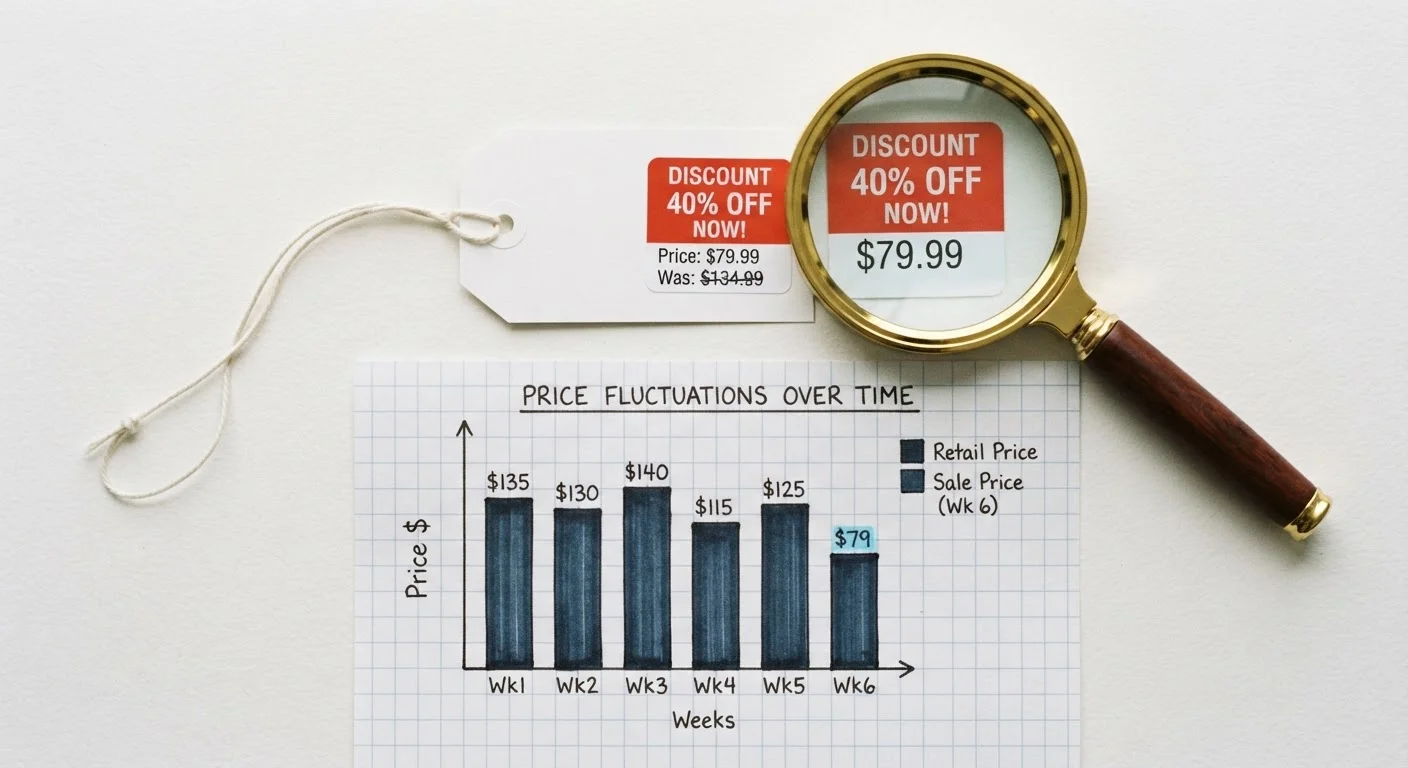
Why 'On Sale' Doesn't Mean 'A Deal'
Walk into any retail environment - physical or digital - and you're surrounded by percentage-off badges, strikethrough prices, and countdown timers. The implicit message is always the same: act now, save big. But the presence of a discount label tells you almost nothing about whether you're actually paying less than you should.
A genuine deal has a specific anatomy. It requires three things to be true simultaneously: the reference price must have been real, the current price must be meaningfully lower than the item's typical selling price, and the timing must represent an actual market low rather than an engineered one. Strip away any of these three elements, and you're not looking at a deal - you're looking at marketing.
Understanding this distinction is the foundation of smarter shopping. The tactics retailers use to simulate deals are well-documented, and once you can name them, they lose most of their power. See our beginner's orientation to deal hunting for a broader framework on building these habits from scratch.
~33%
Shoppers who verify price history before buying
Consumer research consistently shows that only a minority of shoppers check price history tools before completing a purchase, despite their free availability.
87%
Consumers who believe sale prices are lowest available
Research into consumer price perception suggests most shoppers assume a prominently displayed discount represents a genuine market low, regardless of price history.
2 min
Average time to verify a price with history tools
Browser-based price tracking tools typically return a full price history chart for a listed product within about two minutes of installation and use.
Anchor Pricing: The Reference Price Trick
The most common mechanism behind fake deals is anchor pricing - the practice of displaying a high 'original' or 'was' price alongside the sale price to make the discount look dramatic. Your brain processes the gap between the two numbers as evidence of value. It isn't.
For an anchor price to be meaningful, the item must have actually sold at that price for a real and sustained period. When a retailer briefly lists an item at an elevated price - sometimes for as little as a single day - before marking it 'down,' the anchor is artificial. You're being shown a gap that was manufactured for the purpose of being shown to you.
The FTC's former-price guidelines address this directly: a comparison price is only legitimate if the item was genuinely offered at that price for a reasonable period in the recent past. Retailers who systematically inflate reference prices before promotional events operate in a gray area that regulators have scrutinized repeatedly.
“Consumers systematically overestimate the savings from sale prices because the reference price does most of the perceptual work. The absolute price paid matters far less to the brain than the gap from the anchor.”
— Richard Thaler, Nobel Laureate in Economics, known for research on consumer price perception and behavioral economics
Practical defense: don't treat any displayed 'original' price as a data point until you've independently verified it. A quick check of a product's price history will tell you whether that anchor was real.
Price History: The Clearest Signal You Have
Price history charts show you exactly what a product has sold for over time across retailers. They're the single most useful tool for evaluating whether a discount is genuine, and they're freely available. If the current 'sale' price sits comfortably within the item's normal price range - or higher than its periodic lows - you're not looking at a meaningful deal.
What you're looking for in a price history chart:
- Consistent floor price: The lowest price the item has reached during normal selling periods, not counting clearance or error pricing. The current sale should approach or beat this floor to qualify as a genuine low.
- Pre-sale inflation: A price spike in the weeks immediately before a sale event is a strong signal of manufactured discounting. The 'original' price was set high specifically to make the markdown look bigger.
- Seasonal patterns: Many categories follow predictable markdown cycles. Knowing when a category typically hits its lowest prices lets you wait strategically rather than react to urgency cues.
For a deeper look at how to read these charts, our practical price history walkthrough covers what each signal means. And if you want to understand why flash sales in particular can be misleading, this article on flash sale pricing breaks it down clearly.
Use Price History Before Any Major Purchase
Before buying any item over $50, run a quick price history check using a free browser extension or price-tracking site. Look specifically for pre-sale price inflation in the two to four weeks before the current promotion. A clean history with a consistent floor price is the clearest signal that today's price represents genuine value.
Applying the Framework Before You Buy
Evaluating a deal doesn't require significant time or technical skill. A practical pre-purchase check looks like this: confirm the price history is clean (no pre-sale inflation), verify the reference price was real, compare the current price against the item's historical floor, and check whether the discount holds across multiple retailers or only at one.
That last point matters more than most shoppers realize. A deal that exists only at one retailer - especially during a limited-time event - warrants more scrutiny than one that reflects a broad market price drop. Competitive pricing across multiple sellers is a stronger signal of genuine value.
The psychology of discount spending is also worth understanding: the feeling of saving and the reality of saving are two different things. Sale prices are designed to trigger a purchase decision, and they often succeed even when the underlying deal is weak. For a closer look at how promotional pricing affects spending behavior, this piece on discount psychology is worth reading before your next major purchase.
For a structured walkthrough of the full pre-purchase verification process, see the deal hunter's pre-purchase checklist. It's a concise set of steps that takes under two minutes and can prevent the most common forms of overspending.
Timing Matters by Product Category
Not all categories discount on the same schedule. Electronics tend to drop around new model releases and major shopping holidays; appliances follow a different cycle tied to trade show seasons. Understanding category-specific timing is a practical extension of price verification. Shopping the discount calendar by category covers this in detail.
Frequently Asked Questions
Free browser extensions and price-tracking websites display a product's price history over weeks or months. If the 'original' price was only set briefly before the sale, the discount is likely manufactured. Comparing across multiple retailers also helps establish a fair market price.
Anchor pricing is when a retailer displays a high 'was' price next to a lower 'now' price to make the deal seem larger. If the item was rarely or never sold at the 'was' price, it's a psychological framing technique rather than a genuine saving. The FTC has guidelines requiring former prices to be real and recent.
Not reliably. Flash sales create urgency, but the discounted price is sometimes higher than quieter sale periods throughout the year. Price history data often shows better deals during off-peak promotional windows.
No. Electronics, appliances, apparel, and home goods each follow distinct markdown cycles tied to new model releases, seasonal demand, and retail inventory. Learning the timing for the category you're shopping gives you a concrete edge.
Not necessarily. A lower price on an older, discontinued model may be less valuable than a slightly higher price on a current one. Total value - including warranty, return policy, and product generation - matters alongside the sticker price.
The content on this site is for informational purposes only and is not a substitute for professional advice. Always consult a qualified professional for guidance specific to your situation.