

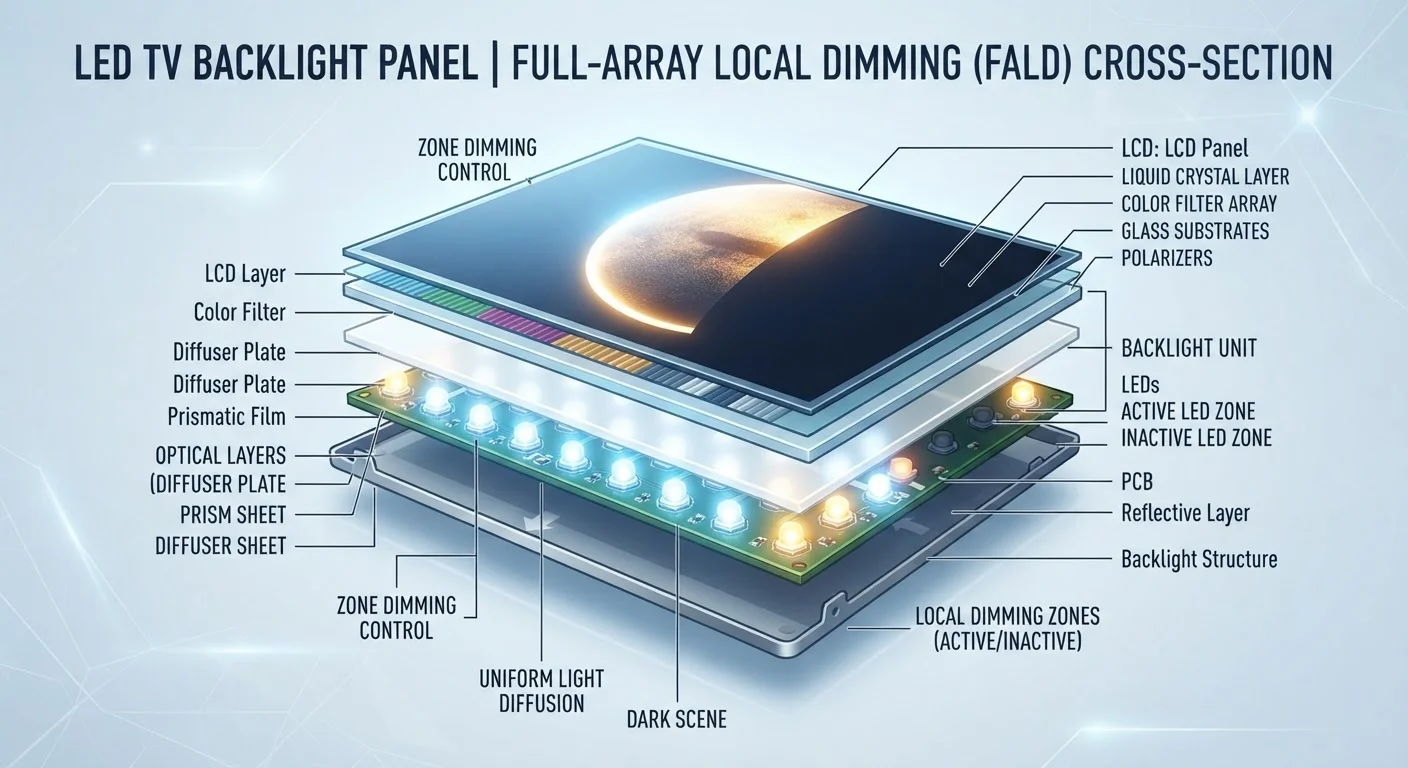
Why Backlight Architecture Matters
Walk into any electronics store and you'll find rows of LED TVs with overlapping specifications - 4K resolution, HDR support, high refresh rates. What those spec sheets rarely highlight is how the backlight is structured, which is arguably the single biggest factor determining how the image actually looks in a real living room.
All LED TVs work by shining light through a liquid crystal panel. The LCD layer controls which pixels let light through and in what quantity, but it cannot produce true black on its own - it can only block light to varying degrees. This is why the backlight's behavior is so critical: it sets the absolute floor for how dark the darkest areas of the image can actually get.
The three main approaches - edge-lit, full-array without local dimming, and full-array with local dimming - produce meaningfully different results, especially when the content on screen has a mix of bright highlights and dark shadows in the same frame. Understanding the differences helps explain why a TV can look impressive in a showroom but flat at home.
Hundreds to thousands
Dimming zones in modern full-array TVs
Zone counts vary widely across full-array and mini-LED implementations; higher-end mini-LED panels from multiple manufacturers now routinely exceed 1,000 individual dimming zones.
~1,000:1
Typical native contrast ratio for LCD panels
Most LCD panels have a native contrast ratio in the range of 1,000:1 to 5,000:1; effective local dimming can raise the dynamic contrast ratio to multiples of that figure in practice.
Edge-Lit Backlights: Slim but Limited
Edge-lit TVs place LED strips along one or more sides of the panel - typically the bottom edge, though some designs use all four sides. A diffusion layer then spreads that light across the full screen area. This approach allows for very thin TV profiles and lower manufacturing costs, which is why it remains common in budget and mid-range models.
The tradeoff is spatial precision. Because the LEDs are positioned at the perimeter rather than behind the image, the light has to travel across the entire panel to reach the opposite edge. That travel path makes it difficult to independently darken a region in the center of the screen while keeping a corner bright. Local dimming in edge-lit sets is possible, but it operates in broad horizontal or vertical bands rather than discrete zones - the result is a cruder approximation of contrast control.
In practice, edge-lit TVs often show elevated black levels (dark scenes look grayish rather than truly black) and can exhibit uneven brightness, sometimes called flashlighting, where the corners or edges are visibly brighter than the center in a dark scene.
Test Edge-Lit TVs in Your Actual Room
If you're considering an edge-lit TV, test it or watch reviews conducted in a room with similar lighting to your own. The elevated black levels and flashlighting that are invisible under bright store lights can become distracting in a normally lit or darker home environment. Your viewing room is the real-world benchmark.
Full-Array Backlights: A More Direct Approach
Full-array backlights distribute LEDs across the entire back surface of the panel. This geometric advantage means every region of the screen has LEDs directly behind it, making it far more practical to control brightness on a zone-by-zone basis.
Without local dimming enabled, a full-array TV still illuminates the whole screen at one level - the LEDs are simply better distributed. The real benefit emerges when local dimming is active: the TV's processor analyzes each frame and dims zones that correspond to dark content while boosting zones with bright highlights. The result is a noticeably higher contrast ratio - the difference between the darkest and brightest parts of the image - compared to edge-lit designs.
The number of zones varies considerably between models. Entry-level full-array sets may have only a few dozen zones; higher-end implementations can reach into the hundreds. More zones mean finer control and less blooming - the visible halo of light that appears around bright objects on a dark background when a dimming zone is larger than the bright element it contains.
For viewers who watch a lot of HDR content, this architecture matters significantly. HDR formats like Dolby Vision and HDR10+ are specifically designed to take advantage of simultaneous bright highlights and deep shadows - something a full-array backlight handles far more convincingly than an edge-lit one.
“The number of local dimming zones is one of the most important - and most underreported - specifications for an LED TV. It directly determines how convincingly the display can separate bright and dark elements in the same frame.”
— Display Technology Research Community, Industry commentary on LED backlight engineering
Mini-LED: More Zones, Tighter Control
Mini-LED backlighting represents a further refinement of the full-array principle. By shrinking individual LEDs to a fraction of their conventional size, manufacturers can pack thousands of them behind the panel rather than hundreds. The practical consequence is a dramatic increase in dimming zone count - some implementations reach into the thousands.
With that many zones, the gap between a bright star on a dark sky and the surrounding blackness can be rendered far more accurately. Blooming is reduced to near-imperceptible levels on well-implemented sets. Mini-LED TVs can also achieve higher sustained peak brightness compared to standard full-array designs, which benefits both HDR rendering and bright-room viewing.
It's worth noting that mini-LED is a backlight technology, not a panel type - it still illuminates an LCD layer. This is a meaningful distinction when comparing it to OLED, which generates light at the pixel level and achieves effectively infinite contrast. Mini-LED and OLED take fundamentally different paths to picture quality, and each has trade-offs worth weighing.
Mini-LED Is Still an LCD Technology
Despite significant marketing emphasis, mini-LED remains a backlight method for LCD panels - it does not eliminate the fundamental properties of liquid crystal displays. It cannot produce true pixel-level black like OLED, though the gap has narrowed significantly with high zone counts. Understanding this distinction helps set accurate expectations when comparing premium TV categories.
Choosing Based on Your Viewing Environment
Backlight architecture does not exist in a vacuum - its impact depends heavily on how and where you watch. In a bright living room with significant ambient light, the differences between edge-lit and full-array local dimming are partially masked by the room's own illumination. The eye adapts to the brighter environment, and elevated black levels become harder to notice.
In a darker room - the environment where most dedicated home theater viewing happens - the differences become stark. An edge-lit TV's elevated black floor and uneven illumination are obvious next to a well-implemented full-array set. Dark scenes in films, nighttime sports footage, and space sequences in sci-fi are where backlight quality is most visible.
Pairing backlight quality with appropriate picture settings also matters. Default picture modes often work against the TV's hardware capabilities - calibrating local dimming intensity, brightness, and contrast settings to your room makes a measurable difference in what the backlight architecture can actually deliver.
Understanding what's behind the panel is ultimately about making an informed trade-off. Edge-lit designs remain a reasonable choice for bright rooms and tighter budgets. Full-array local dimming, and especially mini-LED implementations, are worth the additional consideration for darker viewing environments and HDR-heavy content libraries. Brightness specifications alone won't tell you this - backlight architecture is the context that makes those numbers meaningful.
Frequently Asked Questions
Edge-lit TVs place LEDs along one or more sides of the panel and diffuse that light across the screen. Full-array TVs position LEDs directly behind the entire panel surface. Full-array designs allow more precise control over which parts of the screen are bright or dark at any given moment.
More zones generally improve contrast precision, but zone count alone doesn't tell the whole story. The quality of the dimming algorithm, panel calibration, and overall brightness also matter. A well-tuned TV with fewer zones can sometimes outperform a poorly calibrated one with more.
Blooming is a visible halo of light that appears around bright objects on a dark background. It occurs when a dimming zone is larger than the bright element it's illuminating, causing light to spill into surrounding dark areas. Smaller, more numerous zones reduce blooming.
It depends on your viewing environment and content. Local dimming makes the biggest difference during dark-room viewing and HDR content with high contrast scenes. For bright-room, daytime viewing or watching sports, its impact is less noticeable.
HDR content is designed to show bright highlights and deep shadows simultaneously in the same frame. A TV needs precise backlight control to render this effectively - which is why full-array local dimming generally handles HDR better than edge-lit designs.
Mini-LED is an evolution of full-array backlighting that uses significantly smaller LEDs, allowing manufacturers to fit thousands of them behind the panel. This dramatically increases the number of dimming zones, improving contrast precision compared to standard full-array designs.
The content on this site is for informational purposes only and is not a substitute for professional advice. Always consult a qualified professional for guidance specific to your situation.