

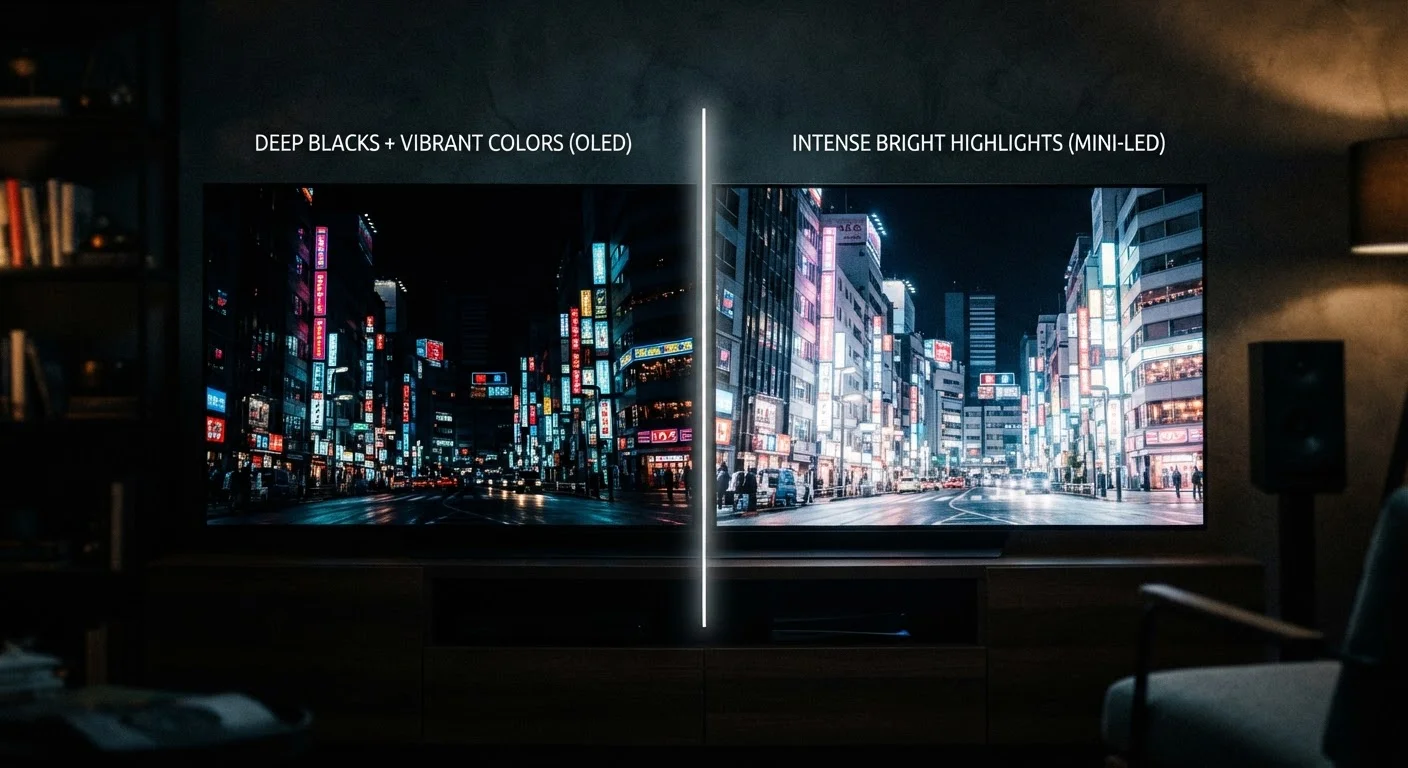
Option A
Mini-LED
The high-brightness, long-lasting LCD evolution.
Best for: Bright living rooms and viewers who prioritize peak luminance and worry-free longevity.
Option B
OLED
The pixel-perfect contrast champion.
Best for: Dedicated home theater rooms and viewers who value absolute black levels and per-pixel precision.
How Each Technology Produces a Picture
Understanding the core difference between Mini-LED and OLED starts with how each panel generates light. OLED - Organic Light-Emitting Diode - uses organic compounds that emit light at the individual pixel level. When a pixel needs to display black, it simply turns off entirely. There is no separate light source behind the screen.
Mini-LED is an evolution of traditional LCD technology. A conventional LCD panel cannot produce its own light, so it relies on a backlight. Mini-LED replaces the relatively sparse LEDs of older designs with thousands of much smaller LEDs grouped into independently controlled dimming zones. This gives the panel far finer backlight control than standard full-array or edge-lit designs - but it still operates as a backlight behind an LCD layer. To understand why that distinction matters for contrast, see our guide to local dimming and backlight architectures.
This fundamental structural difference - self-emissive versus backlit - drives nearly every performance gap and trade-off between the two technologies.
Contrast, Brightness, and the HDR Equation
Contrast ratio is where OLED has a structural advantage. Because individual pixels switch off completely, OLED achieves what manufacturers describe as an infinite contrast ratio - true black alongside bright highlights in the same frame. Mini-LED's dimming zones are small, but they cover areas larger than a single pixel. A bright object surrounded by a dark background can cause faint halos or blooming around its edges as the zone supplying that object's light bleeds slightly into neighboring zones.
Brightness, however, favors Mini-LED. Premium Mini-LED TVs routinely sustain higher peak luminance - often measured in the thousands of nits - across large portions of the screen. OLED panels can reach very high nit counts in small highlight areas, but sustaining that brightness over a large window causes organic materials to manage heat, which moderates overall luminance.
| Criterion | Mini-LED | OLED |
|---|---|---|
| Light source | LED backlight behind LCD layer | Self-emissive organic pixels |
| Black level | Very good; limited by zone size | Absolute black; pixel turns off |
| Peak brightness | Higher sustained luminance | High in small areas; moderated across large windows |
| Contrast ratio | Very high; some blooming possible | Effectively infinite |
| Burn-in risk | None | Low but non-zero with static content |
| Viewing angle | Varies; IPS panels perform better | Consistently wide-angle accurate |
| Large screen availability | Broad, including 85"+ sizes | Available but fewer options above 83" |
| Typical price tier | Premium to very premium | Premium to very premium |
For HDR content specifically, both technologies support major formats including Dolby Vision and HDR10+. How well a panel renders those formats depends on its physical limits. Mini-LED's brightness edge helps with specular highlights - the glint of sunlight on water, for example - while OLED's black-level precision enhances shadow detail. Our breakdown of HDR formats explains how the standard you're watching also shapes what the panel can deliver.
Longevity, Burn-In, and Practical Ownership
One concern that follows OLED is burn-in - the gradual, permanent retention of static image elements caused by uneven wear of organic compounds across pixels. Modern OLED panels include pixel-refreshing algorithms and screensaver protections that have meaningfully reduced real-world burn-in incidents. Still, viewers who leave static overlays - a cable news ticker, a sports network logo, a gaming HUD - on screen for many consecutive hours per day carry a non-zero risk over years of use. Our companion article on OLED burn-in risk examines the evidence in detail.
Mini-LED panels use inorganic LED components behind an LCD layer. They do not experience burn-in and their longevity profile is closer to conventional LCD televisions. For shared-space or commercial display environments where content variety is limited, this difference is material.
1,000+
Dimming zones in high-end Mini-LED TVs
Top-tier Mini-LED panels can incorporate over 1,000 independent backlight zones, dramatically reducing blooming compared to earlier full-array designs.
~100%
DCI-P3 color volume typical of OLED
OLED panels routinely cover close to the full DCI-P3 wide color gamut used in cinema and HDR content production, according to display measurement reports.
0 nits
OLED black level (pixel off state)
When an OLED pixel is switched off, it emits no measurable light, which is why contrast ratio is described as theoretically infinite.
Viewing angle performance also differs. OLED panels generally maintain color and contrast accuracy at wide off-axis angles. Many LCD-based panels, including Mini-LED sets, can show color shift or contrast reduction when viewers sit to the side, though IPS-panel Mini-LED designs partially address this.
Size, Availability, and Pricing Considerations
Mini-LED TVs are available across a broad range of screen sizes, including very large formats above 85 inches, where manufacturing costs remain more manageable than for equivalently sized OLED panels. OLED technology, while now available at 83 inches and beyond from some manufacturers, tends to carry a higher price premium at larger diagonals.
At mid-range screen sizes - roughly 55 to 77 inches - the price gap between competitive Mini-LED and OLED models has narrowed considerably as OLED manufacturing has matured. Neither technology is inexpensive at the premium tier, and both have seen price movement as production scales. Readers evaluating specific panels should look at current retail pricing rather than assuming either technology commands a fixed premium.
Panel Variants Within Each Category
Not all Mini-LED or OLED panels perform identically. Mini-LED sets vary significantly by zone count and LCD panel type (VA versus IPS). OLED itself comes in variants - including QD-OLED, which adds a quantum dot layer for wider color volume and higher brightness. When comparing specific models, look at independent display measurement data rather than relying on category generalizations alone.
Ultimately, the right choice depends on your specific viewing environment, content habits, and tolerance for different trade-offs rather than a single technology being objectively superior in every scenario.
The content on this site is for informational purposes only and is not a substitute for professional advice. Always consult a qualified professional for guidance specific to your situation.