

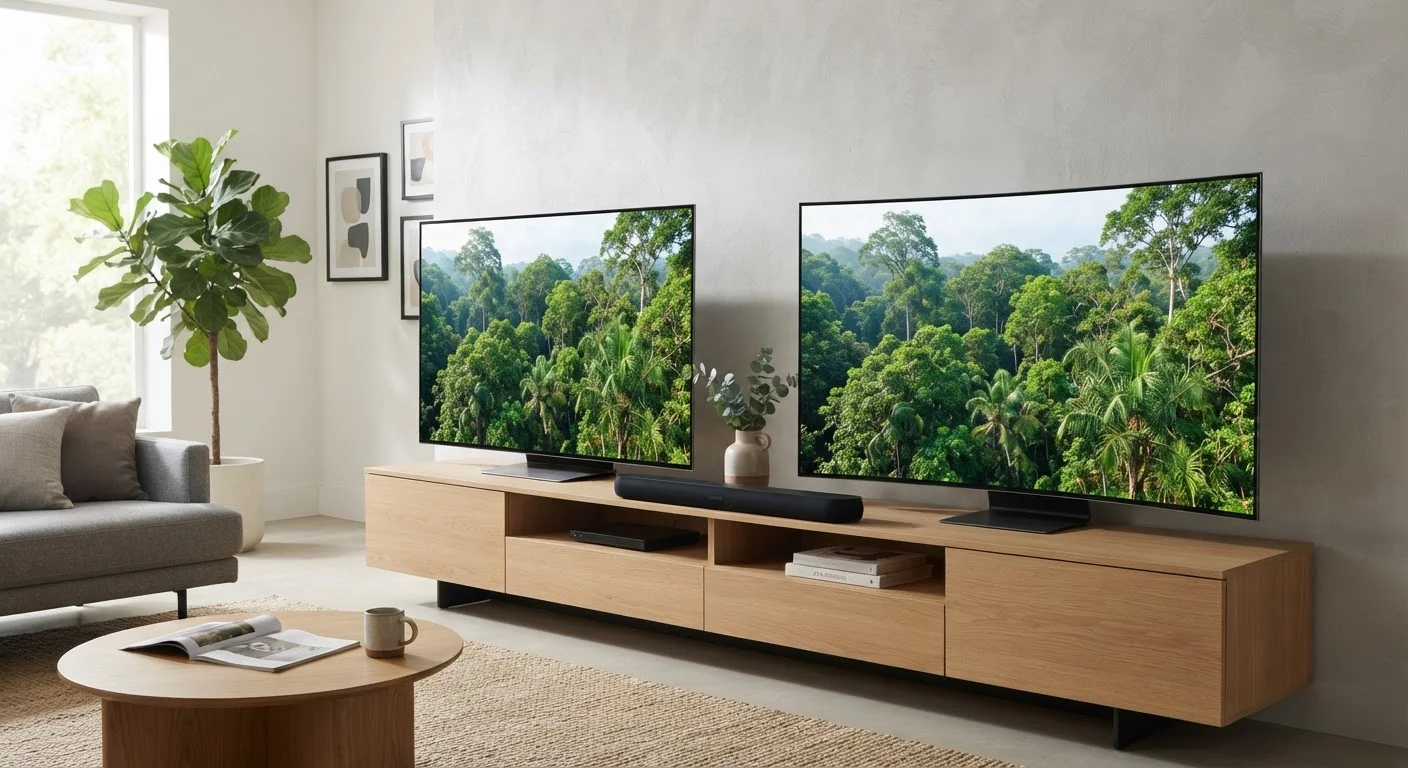
Our Verdict
Curved TVs introduced a genuinely interesting idea - wrapping the screen to better match how eyes perceive depth - but the engineering trade-offs undercut the promise in real living rooms. For the vast majority of viewers, a flat panel delivers more consistent image quality, simpler installation, and broader seating flexibility. The curved format hasn't disappeared entirely; it survives where the geometry actually helps, primarily in large ultrawide computer monitors used at close range.
Flat panels suit nearly every household; curved screens may still appeal to solo viewers who use large ultrawide monitors at a fixed, close desk distance.
The Rise and Fall of Curved TVs
Around 2013-2014, several major television manufacturers began releasing curved-screen televisions positioned as a leap forward in immersive home viewing. The pitch was intuitive: cinema screens curve, stadium scoreboards wrap - shouldn't your living room TV do the same? Premium price tags and prominent placement in retail showrooms reinforced the idea that curved was the next tier of picture quality.
By the late 2010s, however, curved TV lines were quietly being phased out. Understanding why requires separating the genuine optical ideas behind the design from the practical realities of a family room. As showroom conditions can flatter almost any display, curved sets benefited from carefully staged demo environments that didn't reflect how most people actually watch television.
The Optical Argument for Curvature
The engineering rationale for curved panels centers on a concept called equidistance: a curved screen keeps every point on the display at roughly the same distance from a single viewer's eyes, which can reduce perceived distortion at the extreme edges of very large screens. Proponents also argued that the curved shape produces a mild "wraparound" effect, increasing the sense of peripheral engagement.
There is some geometric truth here - but the effect is meaningful only under a narrow set of conditions. The viewer must be seated at a specific distance and directly in the center of the screen. At that sweet spot, edge distortion is slightly reduced. The moment a second person sits to the side, or the viewer shifts off-center, the curve introduces its own distortion rather than correcting it.
Panel Technology Is a Separate Question
Screen curvature is independent of panel type - a curved TV can use LCD, OLED, or QLED technology just as a flat TV can. The image quality differences between those panel technologies are generally far more significant than whether the screen is flat or curved. Understanding panel types is worth doing before settling on any screen geometry preference.
For a deeper look at how panel technology itself affects what you see - independent of screen shape - see our guide on what OLED, QLED, and LED labels actually mean.
Pros and Cons at a Glance
The trade-offs between curved and flat screens are concrete. Below is a balanced breakdown of where each format holds up and where it falls short.
Slight edge distortion reduction at the center seat
Curved screens can marginally reduce geometric distortion at the far edges of very large panels for a single viewer positioned directly in the center at a specific distance.
Perceived depth enhancement for solo viewers
Some viewers report a mild sense of increased depth or immersion, particularly on screens 65 inches and larger, when seated at the manufacturer's recommended viewing distance.
Stronger case for wide desktop monitor use
At close desk distances, a curved ultrawide monitor can keep screen edges within comfortable sightlines, reducing the need for head movement across a wide display.
Significantly worsens off-angle viewing
Anyone seated to the side of a curved TV sees noticeable image distortion and color shift, making it a poor choice for households with multiple viewers or wide seating arrangements.
Amplifies ambient light reflections
The curved surface bends reflections across a broader arc of the screen, making glare from windows and ceiling lights harder to manage compared to flat panels.
Complicates wall mounting
The protruding curvature means the screen does not sit flush against a wall, creating an uneven gap that many homeowners find visually and practically awkward.
No meaningful benefit at typical viewing distances
The equidistance advantage requires the viewer to sit at a precise, relatively close distance; at the 8-12 feet common in most living rooms, the optical benefit largely disappears.
Limited content and setup optimization
No streaming or broadcast format is produced specifically for curved displays, meaning curved TVs are displaying content designed and tested for flat screens.
Why Flat Panels Won the Living Room
The practical problems with curved TVs compound in typical American homes. Most living rooms seat multiple viewers spread across a sofa, not a single person centered at a precise measured distance. Curved screens intensify light reflections, bending ambient light across a wider arc of the panel surface - a significant issue in rooms with windows or overhead lighting. Wall mounting is also complicated by the protruding curve, which creates an uneven gap against flat walls.
~2%
Estimated curved TV share of new TV shipments
Industry display market analyses from the late 2010s indicated curved TVs never exceeded a small fraction of total TV unit shipments globally before most manufacturers discontinued the lines.
21:9+
Aspect ratio where curved monitors persist
Curved panel production has largely consolidated around ultrawide computer monitor formats, where close viewing distances make the geometry more defensible.
Flat panels, meanwhile, kept improving rapidly in the areas that matter most to picture quality: contrast ratio, peak brightness, color volume, and local dimming precision. Technologies like OLED and QLED, detailed in our panel technology explainer, advanced independently of screen shape. A flat OLED in a bright room will outperform a curved LCD in almost every measurable dimension of image quality that viewers can actually perceive.
Resolution advances told a similar story. As covered in our look at 4K vs. 8K resolution, the gains viewers can realistically see depend heavily on seating distance and content availability - factors orthogonal to whether the panel curves. Manufacturers and consumers both recognized that panel technology and content pipeline mattered far more than screen geometry.
If you're approaching a TV purchase without a strong existing baseline, the first-time TV shopper's primer covers the full range of specs worth weighing before stepping into a store.
Where Curved Screens Still Make Sense
The curved format isn't universally obsolete. Ultrawide curved computer monitors - typically 34 inches or wider with an aspect ratio of 21:9 or wider - present a legitimately different use case. At desk viewing distances of roughly two feet, a wide curved monitor can keep the edges of the display within comfortable eye movement, reducing neck rotation and contributing to a more consistent sense of depth across the full panel width. This is why the curved display market has largely migrated to the PC monitor category rather than the living room television.
Interestingly, the tension between screen geometry and user experience has surfaced in automotive contexts as well. Automakers experimented with large curved interior displays before encountering their own usability complications - a dynamic explored in why automakers are rethinking the interior screen. The pattern is consistent: ambitious display geometry tends to encounter real-world friction that flat, conventional formats avoid.
For most TV shoppers today, the curved question is largely academic - the market has answered it. Focus your evaluation on panel type, peak brightness, local dimming zones, and refresh rate. Those are the variables that determine what you'll actually see on screen, night after night.
The content on this site is for informational purposes only and is not a substitute for professional advice. Always consult a qualified professional for guidance specific to your situation.