

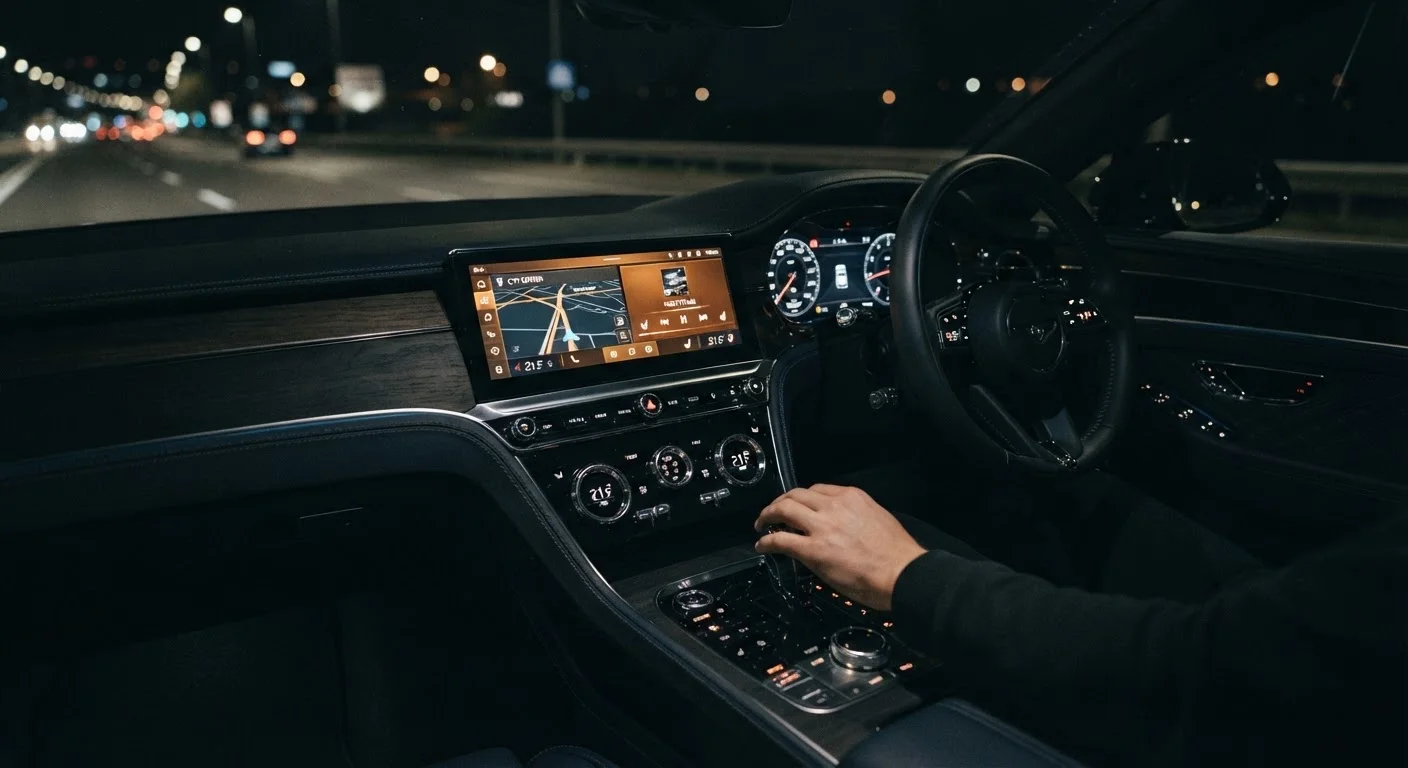
How Screens Took Over the Cabin
A decade ago, a 7-inch touchscreen was considered a premium feature. Today, some vehicles carry screens measuring 15 inches or more, and a handful of concept cars have replaced nearly every physical switch with glass. The logic made intuitive sense: consolidating controls into software meant fewer parts, easier updates, and an interior that looked unmistakably modern.
Automakers were also responding to consumers who had grown accustomed to smartphones and tablets. If drivers already navigated menus by touch at home, why not in the car? The result was a rapid industry-wide pivot that treated the touchscreen as the default solution for everything from climate settings to seat heaters.
What that pivot underestimated was the fundamental difference between using a phone on a couch and reaching for a control while traveling at 70 mph. Situational awareness behind the wheel depends on keeping eyes on the road - and screens, by design, demand visual attention.
The Distraction Problem in Plain Numbers
Physical buttons have a built-in advantage: they can be found by touch. A driver who has used the same volume knob for months develops muscle memory that lets them adjust audio without glancing away from traffic. A touchscreen offers no such shortcut - every interaction begins with locating the control visually.
~40 sec
Average time to complete complex in-vehicle tasks
AAA Foundation for Traffic Safety research found that some infotainment interactions can demand driver attention for extended periods - far exceeding the recommended two-second glance limit.
~100 ft
Distance traveled in 2 seconds at 55 mph
The NHTSA uses this benchmark to illustrate why even brief eyes-off-road moments carry significant risk at typical highway speeds.
3-4×
Longer glance time for touchscreen vs. physical controls
Multiple distraction studies have found touchscreen interactions consistently require more visual attention than equivalent operations on dedicated physical controls.
The AAA Foundation for Traffic Safety has conducted multiple studies measuring driver distraction from in-vehicle technology. Findings consistently show that tasks performed on touchscreens take longer to complete and demand more visual attention than equivalent tasks using dedicated physical controls. Even a two-second glance away from the road at 55 mph means traveling roughly the length of a basketball court without watching where you're going.
This concern isn't limited to safety researchers. Some European new-car assessment programs have begun evaluating how easily drivers can operate key functions without excessive distraction - a signal that usability is becoming part of the broader safety conversation.
Why Some Manufacturers Are Reversing Course
Driver frustration has been vocal and well-documented. Climate control buried three menu layers deep, volume sliders that require precision tapping, and haptic feedback that offers no confirmation until you look - these complaints accumulated in owner surveys and automotive press reviews alike.
“There's a reason aircraft cockpits still use physical switches for critical functions. When the stakes are high and time is short, tactile controls outperform touchscreens every time.”
— Jakob Nielsen, Usability researcher and principal at Nielsen Norman Group
Volkswagen made headlines when it publicly acknowledged that moving key controls to a touchscreen in certain models had gone too far, and committed to restoring physical shortcuts in subsequent updates. Volvo similarly reversed some touchscreen-only decisions after customer feedback. These weren't isolated admissions - they reflected an industry reckoning with the gap between a clean-looking prototype and the daily experience of driving.
The broader trend connects to how driver-assist systems are evolving too. As vehicles take on more automated tasks, the human-machine interface becomes even more critical - a poorly designed screen can undercut the safety benefits that automation is supposed to provide.
Test the Interface Before You Buy
When evaluating a vehicle, spend time operating the climate controls, audio, and navigation while seated - not just standing outside looking at the screen. Ask yourself whether you could adjust the most common settings without taking your eyes off an imaginary road. How quickly you can locate and operate basic controls is a reliable preview of daily ownership experience.
What a Better Balance Looks Like
The emerging consensus among ergonomics researchers and automotive designers is not to abandon touchscreens - it's to assign the right tasks to the right interface. Controls used frequently and often under stress (volume, temperature, hazard lights) belong on physical surfaces where they can be operated without looking. Navigation maps, media libraries, and vehicle configuration menus are well-suited to touchscreens because drivers typically interact with them while stopped or during low-demand moments.
Some manufacturers are exploring head-up displays and voice control as additional layers, allowing drivers to access information without diverting their gaze from the windshield at all. These technologies carry their own learning curves and limitations, but they represent a genuine attempt to reduce visual load rather than simply shifting it.
It's also worth noting that touchscreen design quality varies enormously. Lag, poor contrast in direct sunlight, and overly small tap targets are interface failures - not inherent flaws in touchscreen technology. As the industry refines these systems, some of the distraction penalty may shrink. For now, though, the trend is clear: more physical controls are coming back, and that's largely good news for drivers. Keep in mind that subscription-gated features increasingly live inside these same interfaces, so how screens are designed also affects what you can access and when.
Frequently Asked Questions
Touchscreens offered a way to consolidate dozens of physical controls into a single, software-driven panel that could be updated over time. They also projected a tech-savvy image and allowed manufacturers to reduce manufacturing complexity by using fewer physical components. Lower hardware costs and consumer enthusiasm for smartphone-like interfaces helped accelerate the trend.
Research from organizations like the AAA Foundation for Traffic Safety indicates that touchscreen interactions generally require longer glance durations than tactile controls, because drivers can't locate a button by feel and must look at the screen. Physical controls allow muscle memory to take over, keeping eyes on the road longer. However, distraction levels also depend heavily on interface design and where functions are placed.
Several manufacturers - including Volkswagen and Volvo - have publicly acknowledged over-reliance on touchscreens and reintroduced physical volume knobs and shortcut buttons in newer models. This is a broader industry conversation rather than an isolated decision by a single brand.
Almost certainly, yes - but the consensus forming is that large screens work best for navigation, media browsing, and settings menus, while frequently used controls like volume, climate, and hazard lights benefit from physical placement. A hybrid approach appears to be the direction most manufacturers are heading.
Formal regulations specifically targeting touchscreen distraction are still limited in the United States, though the National Highway Traffic Safety Administration (NHTSA) has issued voluntary guidelines for minimizing driver distraction from in-vehicle electronics. Some European safety assessment programs have begun factoring screen usability into their ratings.
The content on this site is for informational purposes only and is not a substitute for professional advice. Always consult a qualified professional for guidance specific to your situation.