

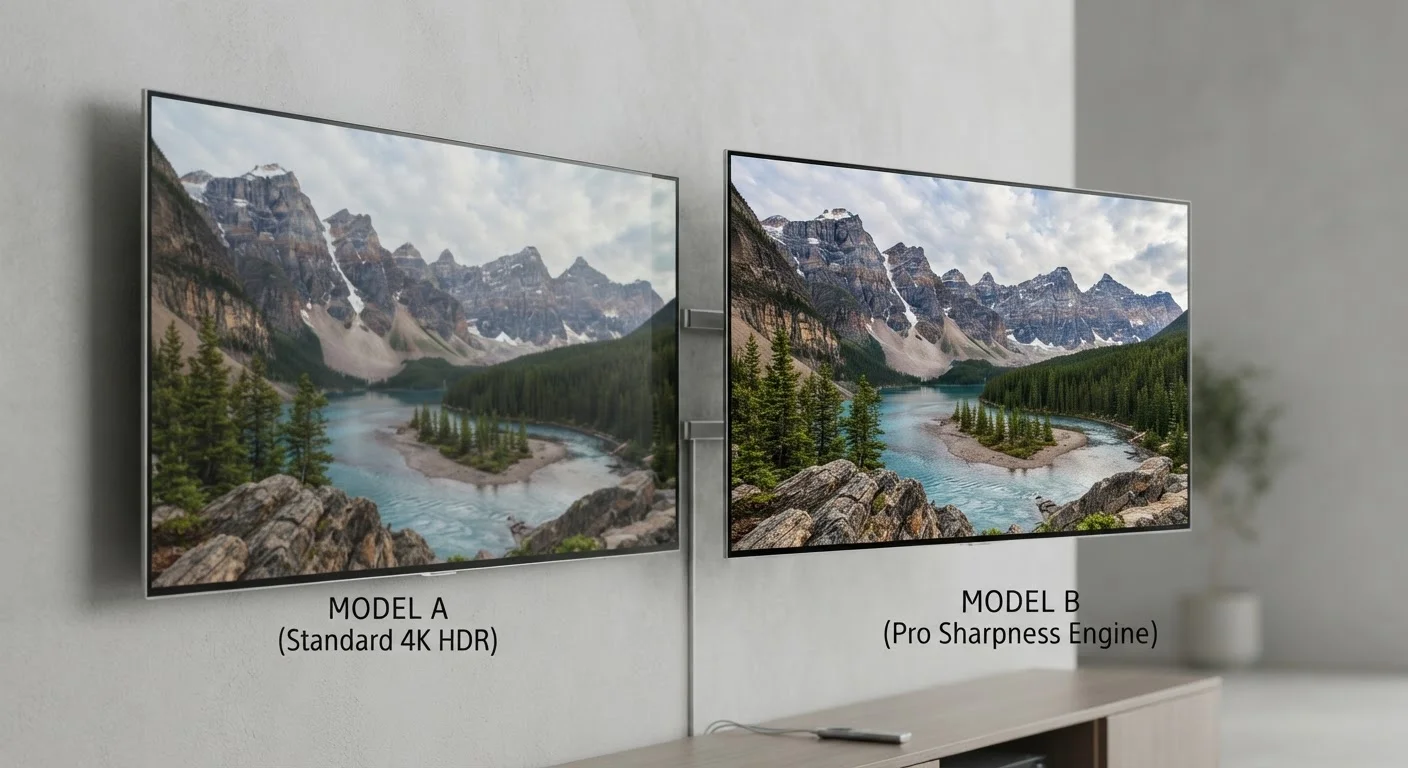
Option A
4K Resolution (3840 × 2160)
The current mainstream standard with broad content support.
Best for: Households watching streaming, cable, or gaming content on screens up to about 85 inches from a typical living-room distance.
Option B
8K Resolution (7680 × 4320)
The next-generation format with limited real-world content.
Best for: Very large screens (85 inches and above) viewed at close range, or future-proofing enthusiasts who can tolerate limited native content today.
What the Numbers Actually Mean
Resolution describes how many individual pixels a screen uses to construct its image. A 4K display contains roughly 8.3 million pixels arranged in a 3840 × 2160 grid. An 8K display multiplies that four times over - 7680 × 4320, or approximately 33.2 million pixels. On paper, the leap sounds dramatic. In practice, whether you can actually see that difference depends on factors the spec sheet doesn't show you.
The key variable is angular resolution - how many pixels your eye resolves at a given distance. Human vision has limits. Sit far enough from either display and both will look equally sharp; move close enough and the 8K advantage begins to emerge. For a 65-inch TV viewed from 8-10 feet away - a common living-room setup - the visual gap between 4K and 8K is marginal at best. This is why screen size and seating distance matter as much as the resolution spec. See our guide to screen size and viewing distance for a practical framework on matching display size to your room.
| Criterion | 4K (3840 × 2160) | 8K (7680 × 4320) |
|---|---|---|
| Total pixels | ~8.3 million | ~33.2 million |
| Native content availability | Broad - streaming, disc, gaming | Very limited - mostly upscaled |
| Perceptible sharpness gain at 8-10 ft on 65" | Baseline | Minimal to undetectable |
| Perceptible sharpness gain at 85"+ close range | Baseline | Noticeable under ideal conditions |
| Upscaling requirement | Rarely needed | Required for nearly all content |
| Price premium over comparable 4K | - | Substantial |
| Gaming support (native resolution) | Well supported | Largely unsupported by current hardware |
| HDR ecosystem maturity | Mature - Dolby Vision, HDR10+ | Developing - varies by panel |
The Content Problem 8K Can't Escape
Even if a viewer's eyes could distinguish 8K at their specific setup, there's a more immediate obstacle: almost no native 8K content exists for home viewing. Streaming services deliver the vast majority of their libraries at 4K or below. Physical media - 4K Blu-ray - tops out at 4K. Broadcast television in the United States has not adopted 8K standards for distribution.
8K TVs handle this by applying upscaling, which is a form of image processing that estimates and adds pixels to a lower-resolution source. Manufacturers have invested in upscaling algorithms and some results are creditable, but upscaled 4K is not the same as native 8K. It's also worth noting that upscaling quality varies significantly between panel manufacturers and even between models within the same brand's lineup.
4×
More pixels in 8K vs. 4K
8K's 33.2 million pixels are exactly four times the pixel count of a 4K panel - a mathematical fact that doesn't automatically translate to a visible difference at typical viewing distances.
~20 ft
Distance where 4K and 8K look identical on a 65" screen
Based on standard visual acuity models, the human eye generally cannot distinguish 4K from 8K on a 65-inch screen at viewing distances beyond roughly 5-6 feet, depending on individual vision.
<1%
Estimated share of streaming content in native 8K
As of the current streaming landscape, native 8K content represents a negligible fraction of available titles across major on-demand platforms.
By contrast, 4K has a fully developed content ecosystem. Major streaming platforms deliver 4K HDR titles broadly, gaming consoles output natively at 4K, and 4K Blu-ray remains the highest-quality physical home video format available. If you want to explore what HDR formats accompany that 4K content, our breakdown of HDR standards explains what HDR10, Dolby Vision, and others actually deliver.
What Actually Drives Picture Quality Day to Day
Resolution is one dimension of picture quality - and arguably not the most impactful one for typical viewing conditions. Panel technology, HDR (High Dynamic Range) performance, local dimming capability, peak brightness, and color volume all contribute more visibly to the image you perceive than whether it's rendered in 4K or 8K.
A 4K display with excellent contrast ratios, wide color gamut coverage, and strong local dimming will typically look more impressive than an 8K display with weak HDR performance - even when both are showing the same source. This is why the showroom experience of a TV often misleads buyers - demo content and boosted modes obscure real-world performance. Resolution is measurable and easy to market; the interplay of brightness, contrast, and color is harder to communicate on a box.
Upscaling Is Not the Same as Native Resolution
When an 8K TV receives a 4K or 1080p signal, it uses algorithms to estimate the missing pixel data - a process called upscaling. Modern upscaling can produce clean, detailed results, but it is an approximation, not a true 8K image. Viewers evaluating 8K sets in a showroom may be watching upscaled content rather than native 8K material, which can make direct comparisons misleading.
Refresh rate is another spec that intersects with resolution in ways worth understanding. Higher-resolution panels demand more processing bandwidth, which can affect motion handling. Our article on refresh rates and motion smoothing explains what those numbers mean in practice.
The Honest Bottom Line
For the overwhelming majority of home viewers today, 4K represents the practical ceiling of what content pipelines deliver and what eyes can distinguish from a normal seating distance. A well-chosen 4K panel with strong HDR and good panel calibration will produce outstanding results with everything currently available to watch.
8K makes more sense on screens above 85 inches, at closer viewing distances, or for buyers who explicitly want to reduce the likelihood of upgrading again in three to five years. Even then, the content ecosystem for 8K will take time to mature - just as 4K content took years to become ubiquitous after 4K TVs appeared.
The more durable principle: prioritize panel quality over pixel count. A high-performing 4K display will serve most households better than a lower-quality 8K set at the same price. Resolution is the starting point of the conversation, not the conclusion. And for households integrating a new TV into a broader home setup, pairing picture quality with capable audio - see our piece on what Dolby Atmos delivers in a living room - rounds out the experience resolution alone can't provide.
The content on this site is for informational purposes only and is not a substitute for professional advice. Always consult a qualified professional for guidance specific to your situation.