

Option A
Zigbee
The open-standard, device-rich mesh protocol.
Best for: Consumers who want a wide device selection and are comfortable managing a hub-based setup.
Option B
Z-Wave
The interoperability-focused, interference-resistant alternative.
Best for: Consumers who prioritize reliable connections and guaranteed device compatibility over sheer product variety.
How Each Protocol Works
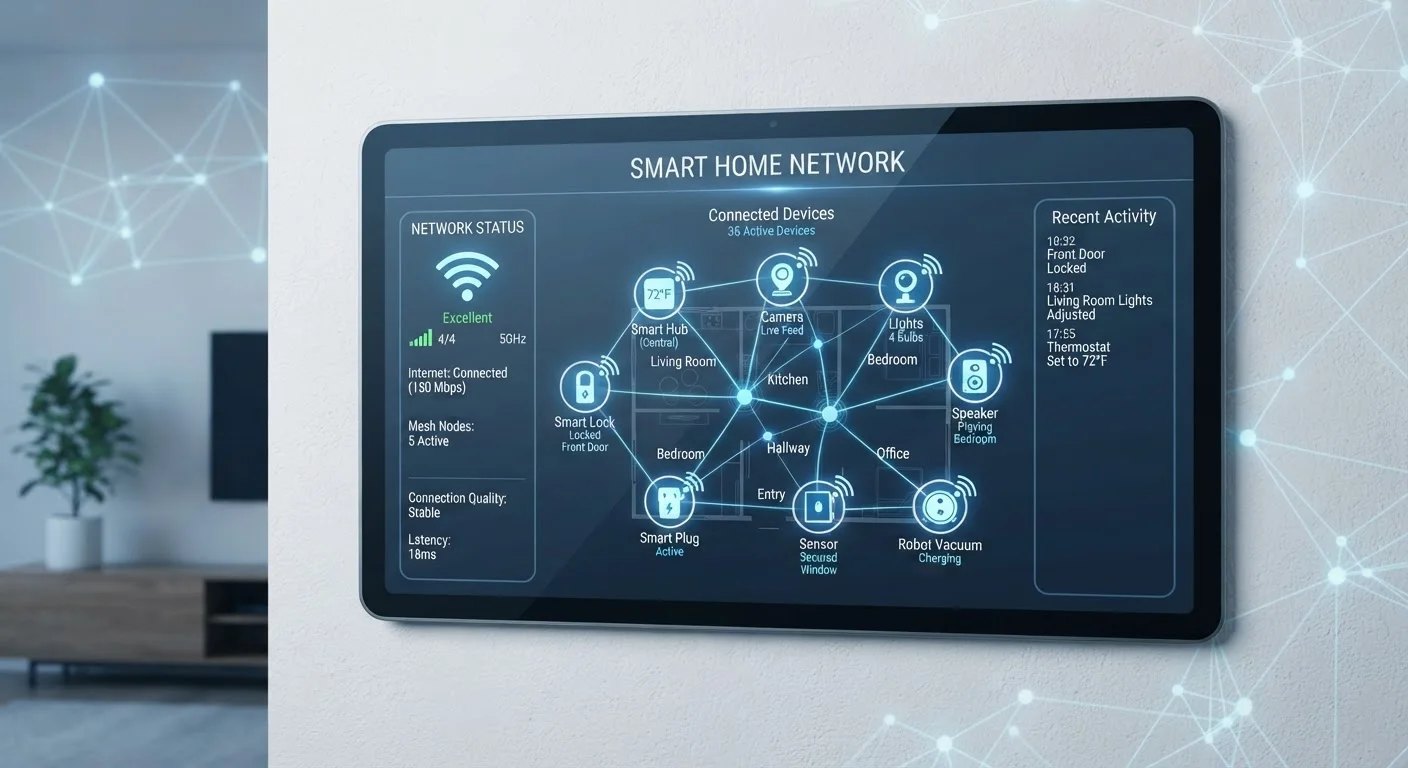
Both Zigbee and Z-Wave are low-power mesh networking protocols designed specifically for smart home devices. Unlike Wi-Fi, which connects every device directly to your router, mesh protocols let devices relay signals through each other - so a smart plug in your kitchen can pass a command along to a sensor in your basement without needing a direct line to the hub.
The key difference at the radio level is frequency. Zigbee broadcasts on the 2.4 GHz band - the same crowded spectrum used by Wi-Fi, Bluetooth, and microwave ovens. Z-Wave operates on a sub-GHz frequency (around 908 MHz in the US), which experiences far less interference from other household electronics. That lower frequency also travels through walls and floors more effectively, though at shorter range per hop.
For a broader look at how these protocols fit alongside Wi-Fi and Thread, see our wireless standards overview.
| Criterion | Zigbee | Z-Wave |
|---|---|---|
| Operating Frequency | 2.4 GHz | Sub-GHz (~908 MHz in US) |
| Interference Risk | Higher (shared with Wi-Fi) | Lower (dedicated band) |
| Max Devices per Network | Up to 65,000 | Up to 232 |
| Cross-Brand Compatibility | Variable (open spec) | More consistent (certified) |
| Product Ecosystem Size | Very large | Moderate |
| Typical Device Price | Generally lower | Generally higher |
| Hub Required | Yes | Yes |
Compatibility and Ecosystem Size
Zigbee is governed by the Connectivity Standards Alliance (CSA) as an open specification, which means any manufacturer can build a Zigbee device without paying per-device licensing fees. The result is an enormous product catalog - thousands of bulbs, switches, sensors, and locks from dozens of brands. The trade-off is that Zigbee's openness can lead to fragmented implementations. A Zigbee device from one manufacturer doesn't always communicate cleanly with a hub or coordinator from another, even when both technically comply with the spec.
Z-Wave takes a more controlled approach. Silicon Labs holds the IP and requires all Z-Wave devices to pass a mandatory certification program. This keeps the device catalog smaller but makes cross-brand compatibility far more predictable. If a product carries Z-Wave certification, it should work with any Z-Wave hub - no asterisks.
232
Max Z-Wave devices per network
Z-Wave's architecture caps networks at 232 nodes - sufficient for most homes but a firm ceiling for large installations.
65,000+
Max Zigbee devices per network
Zigbee's specification allows for extremely large mesh networks, making it well-suited to high device-count deployments.
One consideration worth noting: the Matter standard is now bridging both ecosystems. Several hubs support Matter alongside Zigbee or Z-Wave, which could future-proof your investment. Learn more in our smart home ecosystems explainer.
Network Limits, Range, and Reliability
Zigbee supports up to 65,000 devices per network - a ceiling almost no household will approach. Z-Wave caps out at 232 devices, which is still ample for most homes but could constrain commercial or high-density installations. Both protocols benefit from the mesh effect: every mains-powered device acts as a repeater, so adding more devices generally strengthens your network rather than straining it.
Z-Wave's sub-GHz signal typically achieves better wall penetration and is less susceptible to the interference spikes common in dense urban environments. Zigbee's 2.4 GHz signal is faster in raw data throughput but more vulnerable to disruption - particularly if your home has many overlapping Wi-Fi networks. For most suburban homes with a well-placed hub, both protocols perform reliably day-to-day.
If you're also weighing whether to go wireless at all, our wired vs. wireless smart home comparison lays out the broader trade-offs.
A Note on Hub Placement
Both Zigbee and Z-Wave networks depend on mains-powered devices to act as mesh repeaters. Battery-powered devices - like door sensors and motion detectors - are end nodes and don't repeat signals. If your network feels unreliable, adding a mains-powered device (such as a smart plug) between your hub and distant sensors can significantly improve performance.
Cost, Hubs, and Long-Term Considerations
Neither Zigbee nor Z-Wave devices connect directly to your router - both require a compatible hub or coordinator. Popular hubs like Samsung SmartThings and Home Assistant support both protocols, though often via separate radio modules. Some platforms are Zigbee-only or Z-Wave-only, so verify hub compatibility before committing to a device ecosystem.
On price, Zigbee devices tend to run cheaper on average, driven partly by the sheer volume of manufacturers and competition. Z-Wave devices often carry a modest premium, partly reflecting certification costs passed along to consumers. Neither protocol locks you into a single brand for cloud services, though your hub platform choice may.
Choosing a protocol is closely tied to choosing a broader smart home platform. Our platform comparison guide can help you think through which ecosystem fits your setup before you invest in hardware.
The content on this site is for informational purposes only and is not a substitute for professional advice. Always consult a qualified professional for guidance specific to your situation.