

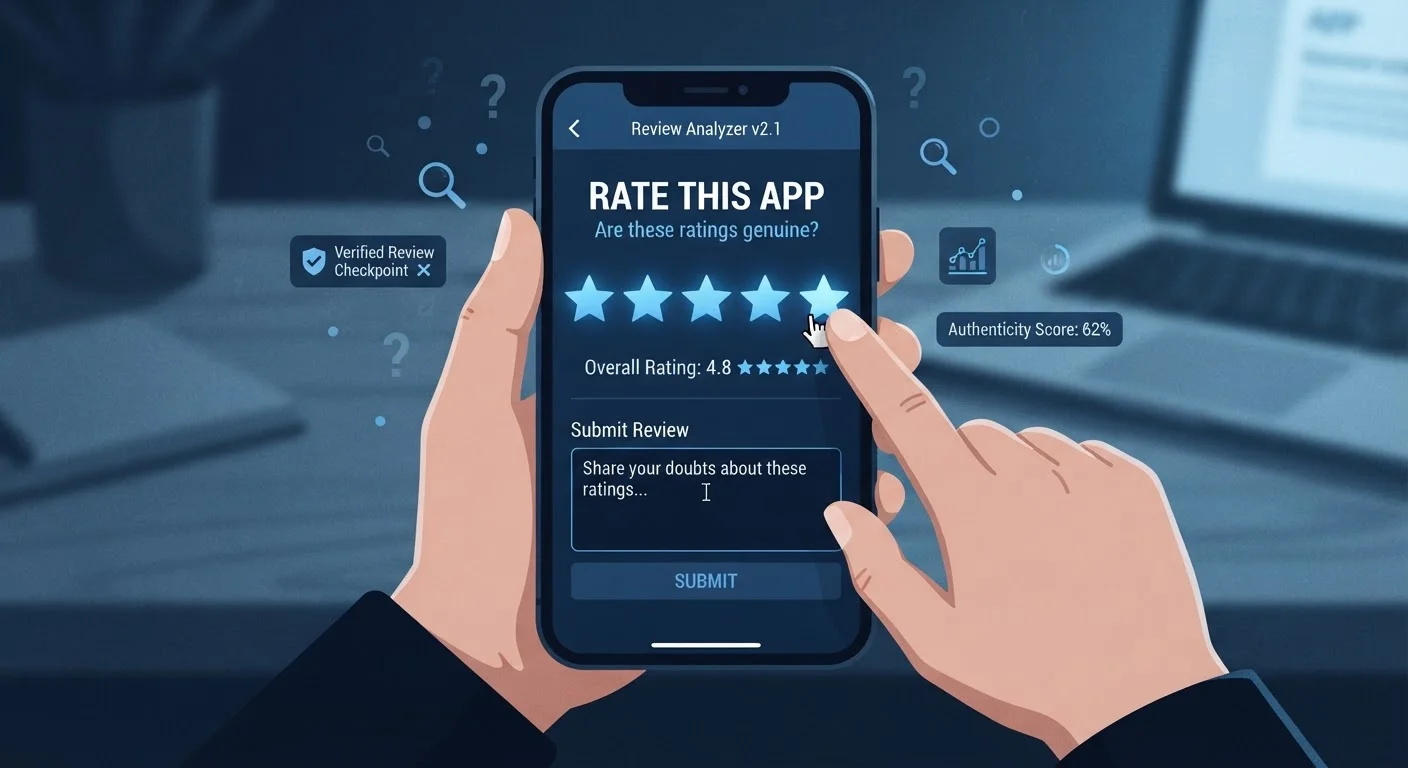
Why Star Ratings Are an Incomplete Signal
An app sitting at 4.7 stars with 200,000 ratings looks safe to install. But those numbers can be gamed, skewed by incentivized reviews, or inflated by a wave of early enthusiasm that predates the current version's bugs. App stores aggregate every review ever left - meaning a solid reputation earned two years ago can mask recent crashes, privacy policy changes, or a shift to aggressive monetization.
Star ratings also suffer from selection bias. Users who bother to rate tend to cluster at the extremes - love it or hate it - while the silent majority who had a mediocre or mixed experience never weigh in. The result is a number that tells you about emotional reactions, not functional reliability.
For a broader look at how this dynamic plays out across product categories, see The Pitfalls of Relying on Star Ratings Alone.
| Rating reliability threshold | Generally improves significantly above ~1,000 ratings (Statistical consensus on review volume and reliability) |
| Data disclosure requirement | Required on both Apple App Store and Google Play (Apple App Store, Google Play policy documentation) |
| Key update warning sign | No updates in 12+ months for an active-use app (General developer maintenance best practices) |
| Most actionable review filter | Sort by "Most Recent" and read one-star reviews first (Consumer research heuristic) |
| Privacy policy requirement | Mandatory for apps collecting personal data (U.S. and most major markets) (App store developer policies) |
What to Look At Instead
More useful signals are hiding in plain sight on every app store listing - most people just scroll past them.
Update frequency and version history
A developer who pushes regular, meaningful updates is actively maintaining their product. Look for a changelog that describes real fixes and feature improvements, not just vague notes like "performance improvements." Long gaps between updates - or a final update that's years old - suggest the app may be abandoned.
Number of ratings versus the rating itself
A 4.2-star app with 85,000 ratings is statistically more reliable than a 4.9-star app with 40 ratings. Volume matters because it dampens outlier distortion.
Recent reviews, sorted by newest
Always filter to the most recent reviews before drawing conclusions. A pattern of one-star reviews in the last 30 days - even if buried under years of positive ones - signals something has recently broken. Look for specific, repeatable complaints: crashes on a particular OS version, hidden charges surfacing after a free trial, or sudden permission changes.
Privacy label and data practices
Both the Apple App Store and Google Play now require developers to disclose what data their app collects and how it's used. Treat vague or expansive data declarations as a red flag. An app that needs your contacts, microphone, and location to function as a basic flashlight replacement is overcollecting. Signs an App Is Collecting More Data Than It Needs walks through this in detail.
Developer transparency
Does the listing include a real privacy policy URL and working support contact? Legitimate developers provide both. A missing or broken privacy policy link is a meaningful warning sign, not a minor omission.
~42%
App reviews estimated to be unreliable or fake
Analysis by review integrity researchers found a substantial share of app store reviews show signals of manipulation, including incentivized or coordinated posting patterns.
1 in 3
Top-rated apps with recent complaint spikes in newest reviews
Independent audits of app store listings have found that highly-rated apps frequently show a divergence between historical scores and recent reviewer sentiment.
Reading Reviews Like an Analyst
Not all written reviews are worth your time, but the right ones are genuinely informative. Look for reviews that describe a specific task attempted, the device and OS version used, and a concrete outcome. Generic praise - "Love this app!" - carries almost no information. A review that says "Crashes every time I try to export a PDF on iOS 17 on an older phone" is actionable.
Pay attention to how the developer responds to negative reviews. A team that acknowledges bugs, provides timelines, and follows up after fixes demonstrates accountability. Dismissive or defensive responses - or no responses at all - suggest a different kind of culture.
For a framework on evaluating written reviews across any product category, The Anatomy of a Trustworthy Product Review is a useful companion read. And if you want to understand what permissions you're granting before you tap Install, App Permissions Explained breaks down each category in plain language.
Rating inflation
The artificial elevation of an app's average star rating through incentivized, coordinated, or fake reviews. It can make a mediocre or problematic app appear more trustworthy than it actually is.
Privacy label
A standardized disclosure on app store listings that summarizes what user data an app collects, how it is used, and whether it is shared with third parties. Required by Apple and Google.
Version history
A log of an app's past updates, including release dates and changelogs. It signals how actively a developer maintains and improves their product over time.
Selection bias (reviews)
The tendency for only highly satisfied or highly dissatisfied users to leave ratings, while the majority with moderate experiences stay silent. This skews aggregate scores away from the typical user experience.
Permission scope
The range of device features and data - such as camera, contacts, or location - that an app requests access to. Excessive scope relative to an app's function is a data-privacy red flag.
The content on this site is for informational purposes only and is not a substitute for professional advice. Always consult a qualified professional for guidance specific to your situation.