

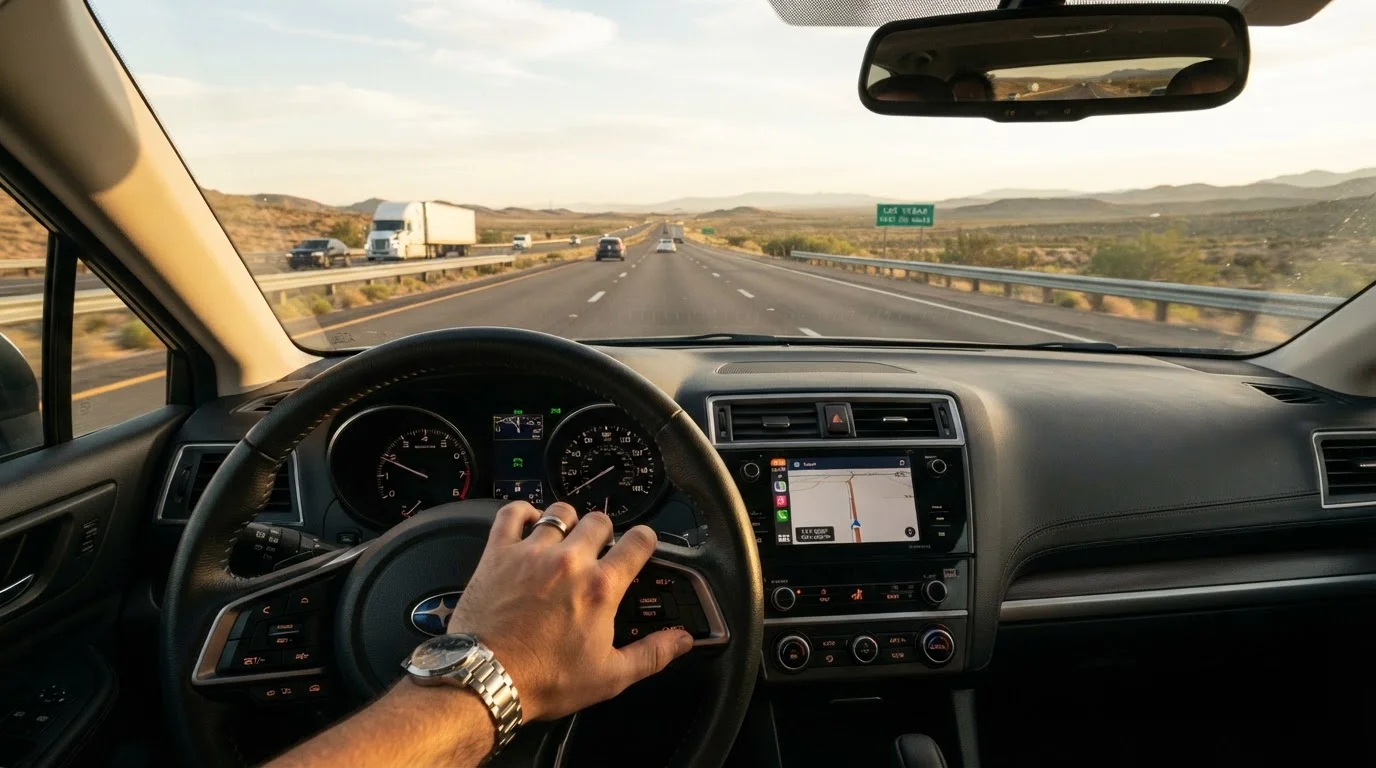
The Core Mechanics: How Cruise Control Manages Speed
When you set cruise control, your vehicle's engine control unit (ECU) takes over throttle management. Instead of your foot modulating the accelerator, the ECU continuously compares your actual speed to your target speed and adjusts fuel delivery accordingly. The goal is a flat speed line - no drift up, no drift down.
This matters for fuel consumption because the human foot is surprisingly inconsistent. Studies of real-world driving behavior show that drivers on long highway stretches unconsciously vary their speed by several miles per hour over short intervals - accelerating slightly, coasting, then accelerating again. Each unnecessary acceleration event burns extra fuel. Cruise control eliminates this micro-variation, which is its primary efficiency advantage.
See our guide to what makes your engine work harder on the highway for a closer look at how throttle behavior connects to overall fuel drain.
~7-14%
Estimated fuel savings from steady-speed driving
The U.S. Department of Energy notes that avoiding aggressive speed fluctuations can improve fuel economy by roughly 7-14% on the highway.
3-5 mph
Typical unconscious speed variation by drivers
Driver behavior research indicates most people unconsciously vary their highway speed by several miles per hour, creating repeated unnecessary acceleration events.
65+ mph
Speed where aerodynamic drag sharply increases
According to the U.S. Department of Energy, fuel economy drops noticeably above 65 mph as aerodynamic drag becomes the dominant load on the engine.
Flat Roads vs. Hilly Terrain: Why Context Is Everything
The efficiency case for cruise control collapses quickly when the road starts to roll. On a flat highway, holding 60 mph requires a relatively constant throttle position. On a grade, the system must increase throttle - sometimes significantly - to prevent the car from slowing below the set speed.
A skilled human driver often takes a different approach: they allow the vehicle to lose a few mph going uphill, then recover speed naturally on the descent, using gravity as a free energy source. Cruise control, programmed to hold its target precisely, can't make this trade-off unless the system is specifically designed with terrain-sensing logic (found in some newer adaptive systems). The result on rolling terrain can be higher fuel consumption than simply driving manually.
This dynamic is directly tied to how braking and coasting interact with momentum. Our explainer on coasting and engine braking covers how letting a vehicle breathe on descents can recoup efficiency losses.
Try the "Uphill Release" Technique Manually
When driving hilly roads without cruise control, try gently easing off the accelerator slightly as you approach the crest of a hill rather than maintaining full speed to the top. Allowing your speed to drop a few mph on the climb and recover naturally on the descent mimics what skilled hypermilers do deliberately. It won't work with standard cruise control engaged, but it can meaningfully reduce fuel use on undulating terrain.
Adaptive Cruise Control: A More Nuanced Tool
Standard cruise control is binary in its response - it accelerates or it doesn't. Adaptive cruise control (ACC) adds a layer of situational awareness through radar or camera sensors. When a slower vehicle enters the lane ahead, ACC gradually reduces speed rather than forcing the driver to brake hard and then re-accelerate.
That graduated deceleration is more fuel-efficient than a sharp brake-and-floor-it cycle, particularly in highway traffic that isn't fully free-flowing. Some ACC systems also incorporate predictive or topographic data, adjusting speed proactively before a hill rather than reacting to it. These features narrow the terrain gap between flat-road efficiency and hilly-road efficiency - though they don't eliminate it entirely.
For drivers choosing between drive modes that interact with cruise behavior, understanding Eco Mode vs. Sport Mode provides useful context on how the vehicle's broader settings shape throttle response.
When to Use It - and When to Turn It Off
The practical guidance from the evidence is straightforward: use cruise control on long, flat, uninterrupted highway segments where you won't need to brake frequently. Disengage it on extended grades, winding mountain roads, or any congested stretch where you'd be canceling and re-engaging it constantly.
Rain, ice, or snow are additional reasons to skip cruise control entirely - not for fuel reasons, but because the system can't respond to traction loss the way an attentive driver can. Maintaining direct throttle control in slippery conditions is a basic safety practice.
Fuel-saving driving involves more variables than any single system can address. Understanding how fuel economy differs between city and highway driving helps frame where cruise control fits within the larger picture of efficient driving habits. And if you've heard claims about cruise control saving fuel in all conditions, our look at fuel-saving myths that don't hold up addresses some of those misconceptions directly.
Frequently Asked Questions
No - cruise control saves fuel primarily on flat, consistent terrain where maintaining a steady speed is achievable. On rolling or hilly roads, it can actually burn more fuel because it accelerates harder to hold the set speed on uphills rather than allowing a slight, natural slowdown.
Most vehicles are most fuel-efficient between 45 and 65 mph. Aerodynamic drag increases significantly above 65 mph, meaning the engine must work harder to maintain speed. Setting cruise control within this range on flat highway stretches typically yields the best efficiency.
In many driving situations, yes. Adaptive cruise control smooths out speed transitions more gradually when approaching other vehicles, which can reduce unnecessary acceleration and braking cycles compared to both manual driving and standard cruise control.
Generally, no. Stop-and-go traffic makes cruise control impractical and counterproductive - frequent braking cancels the system and the constant speed changes negate any efficiency benefit. Cruise control is most effective on roads where you can travel uninterrupted for extended stretches.
Consistent throttle inputs from cruise control on flat roads can result in smoother engine operation compared to erratic driver inputs, but the effect on long-term engine wear is minimal. Proper maintenance - oil changes, air filters, tire pressure - has a far greater impact on engine longevity.
The content on this site is for informational purposes only and is not a substitute for professional advice. Always consult a qualified professional for guidance specific to your situation.