

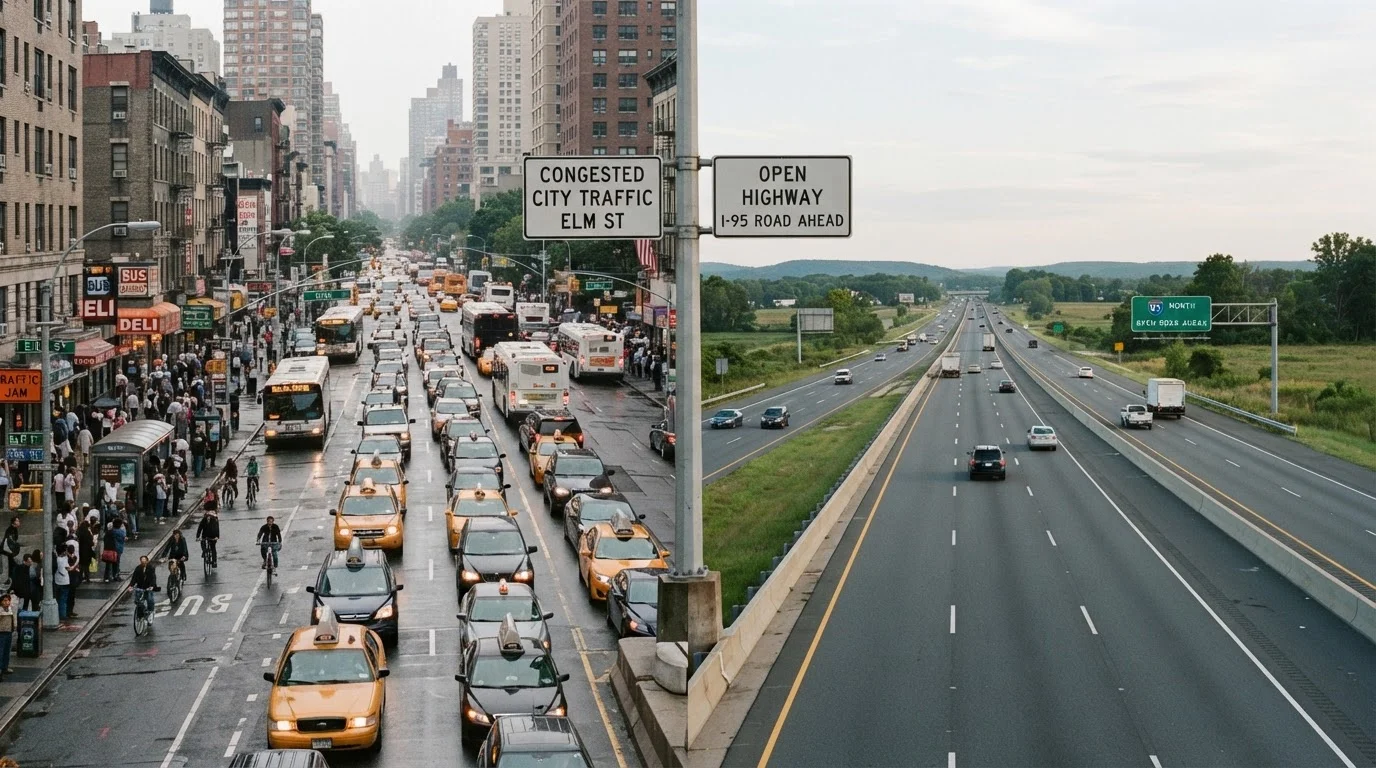
Option A
City Driving
The stop-and-go efficiency challenge.
Best for: Short errands and commutes where idling, frequent braking, and cold-engine operation are unavoidable.
Option B
Highway Driving
The steady-speed efficiency sweet spot - with caveats.
Best for: Long-distance travel where consistent speeds allow the engine and transmission to operate in their most efficient ranges.
Why the Environment You Drive In Changes Everything
The miles-per-gallon rating on a vehicle's window sticker is split into two numbers - city and highway - for a reason. Fuel economy isn't simply a function of the engine or the vehicle; it's deeply shaped by the driving environment. Stop-and-go city traffic and steady-speed highway cruising impose fundamentally different demands on a powertrain, and understanding those differences helps drivers make smarter decisions behind the wheel.
City driving is characterized by frequent acceleration and deceleration cycles, extended idling at traffic lights, and shorter trips where the engine may never fully reach operating temperature. Each of these factors burns fuel without moving the vehicle meaningful distances. Idling, for instance, delivers exactly zero miles per gallon - fuel is consumed to keep the engine running while the car sits still.
Highway driving eliminates most of those inefficiencies, but introduces its own fuel drain: aerodynamic drag. As speed increases, the energy needed to push the vehicle through air grows exponentially. This is why the efficiency advantage of highway driving diminishes - and can even reverse - at very high speeds. See our explainer on highway engine demands for a deeper look at what's happening under the hood.
| Criterion | City Driving | Highway Driving |
|---|---|---|
| Typical MPG impact | Lower - frequent stops waste energy | Higher at moderate speeds |
| Primary fuel drain | Idling, braking, cold-engine starts | Aerodynamic drag at high speeds |
| Engine operating range | Inefficient - constant RPM swings | Efficient - steady high-gear cruise |
| Hybrid / EV advantage | Strong - regen braking recaptures energy | Moderate - less regen opportunity |
| Driver control over efficiency | High - throttle smoothness matters most | High - speed choice is critical |
| Air conditioning impact | Significant at low speeds and idle | Moderate - partially offset by speed |
The Physics Behind the Numbers
In city driving, kinetic energy - the energy your vehicle builds as it accelerates - is largely wasted as heat through the brakes every time you slow down. In a conventional gasoline vehicle, that energy is simply gone. Frequent acceleration from a stop also forces the engine to operate outside its most efficient load range, consuming more fuel per mile than steady cruising would require.
On the highway, the engine settles into a relatively narrow, efficient operating band. Automatic transmissions shift into higher gears, engine RPM drops, and fuel consumption per mile falls - up to a point. The aerodynamic drag equation means that driving at 70 mph can require substantially more fuel than driving at 55 mph, even though both feel like "highway" driving. According to the U.S. Department of Energy, fuel economy typically decreases rapidly at speeds above 50 mph.
~14%
Fuel economy loss per 5 mph above 50 mph
The U.S. Department of Energy estimates roughly a 7-14% fuel economy penalty for each 5 mph increase in speed above 50 mph.
0 MPG
Fuel economy while idling
Idling consumes fuel while moving the vehicle zero miles, making it one of the most direct sources of urban fuel waste.
Up to 40%
City MPG improvement in some hybrids vs. conventional cars
Hybrid vehicles can show dramatically better city-condition efficiency compared to equivalent conventional vehicles, largely due to regenerative braking systems.
The notable exception is hybrid and electric vehicles. Their regenerative braking systems capture kinetic energy during deceleration and return it to the battery - which means the stop-and-go nature of city driving actually works in their favor. Many hybrids post their best real-world efficiency numbers in city conditions, flipping the conventional wisdom. Learn more about how coasting and regenerative braking compare in different driving scenarios.
Practical Habits That Improve Efficiency in Both Environments
Regardless of where you drive, the single most impactful variable within a driver's control is throttle smoothness. Hard acceleration followed by abrupt braking wastes fuel in both environments - for a fuller picture of those costs, see our article on the real costs of aggressive driving.
In the City
- Accelerate gradually from stops - this keeps the engine in a more efficient load range.
- Anticipate red lights and coast toward them early, reducing brake wear and recovering momentum where possible.
- Avoid excessive idling - if you expect to be stopped for more than a minute, modern fuel-injected engines use less fuel restarting than idling.
- Consolidate short trips when possible, since cold-engine starts consistently consume more fuel until operating temperature is reached.
On the Highway
- Drive at moderate speeds - the efficiency penalty at higher speeds is real and measurable.
- Use cruise control on flat roads to maintain consistent speed without unconscious speed creep. Note that cruise control's effectiveness varies on hilly terrain.
- Check tire pressure before long trips - underinflated tires increase rolling resistance and reduce highway fuel economy.
- Reduce unnecessary load - cargo weight and roof-mounted carriers both increase fuel consumption at highway speeds.
Also worth examining are the common fuel-saving myths that persist around both city and highway driving - not every popular tip holds up under scrutiny.
This article is for general informational purposes. Actual fuel economy varies by vehicle, driving conditions, and individual habits. Consult your vehicle's owner manual and qualified automotive professionals for guidance specific to your situation.
The content on this site is for informational purposes only and is not a substitute for professional advice. Always consult a qualified professional for guidance specific to your situation.