

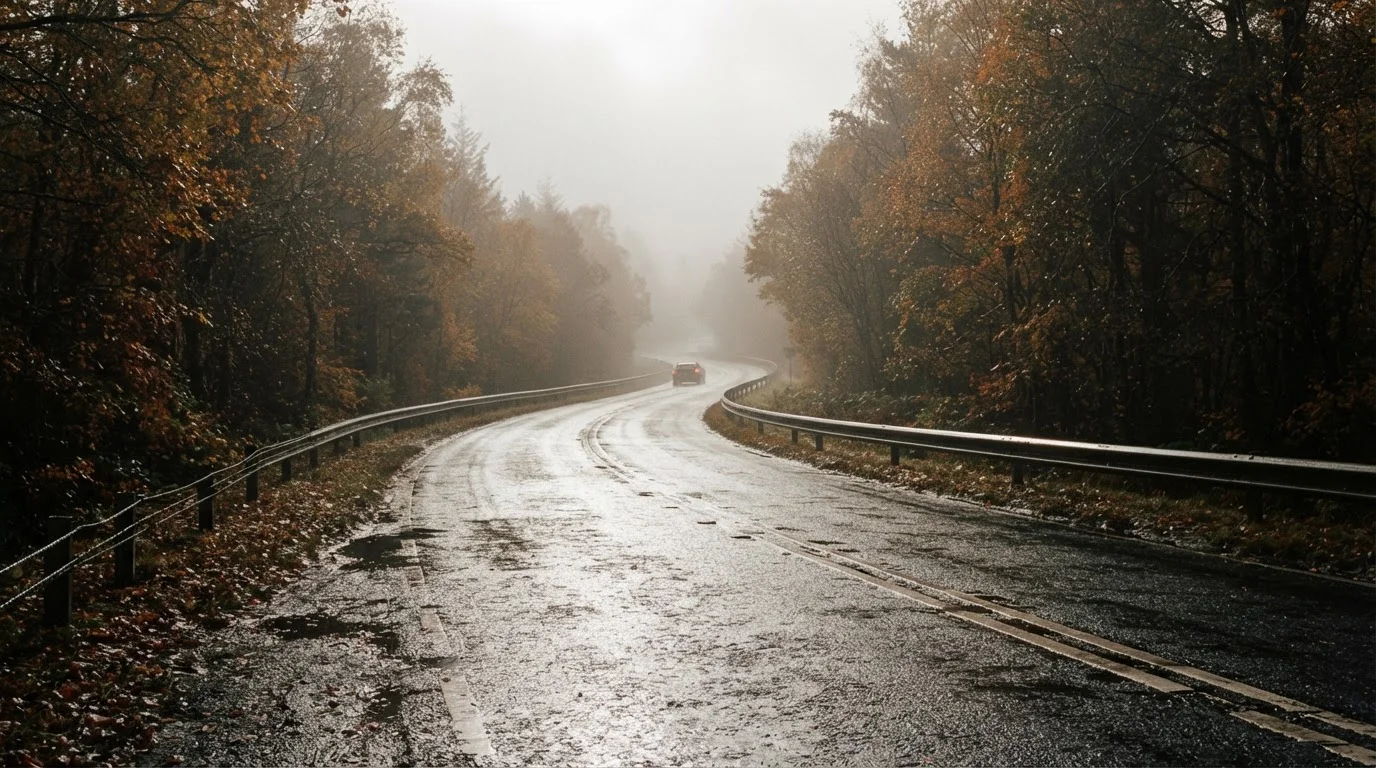
Why Experience Alone Isn't Enough
Years of driving can build genuine skill, but they can also breed a quiet overconfidence. Experienced drivers often rely on pattern recognition - and that's exactly what certain road conditions exploit. Black ice looks like a damp road. Sun glare arrives without warning. A familiar route can turn hazardous after a single overnight rain.
The conditions covered here aren't rare outliers. They appear on ordinary commutes and highway stretches across every part of the country. What makes them dangerous is the gap between how they look and how they actually behave under your tires. Understanding that gap - and adjusting your driving before a problem develops - is the foundation of situational awareness behind the wheel.
Each condition below includes what to watch for, why it catches drivers off guard, and what a measured response looks like.
Black Ice
Black ice is a thin, nearly transparent layer of ice that forms on road surfaces - most commonly on bridges, overpasses, and shaded stretches - when air temperature hovers near or just below freezing. It earns its name because it takes on the color of the pavement beneath it, making it essentially invisible until you're already on it.
What catches drivers off guard is the sudden and total loss of steering feedback. On normal pavement, the steering wheel communicates resistance and grip. On black ice, that feedback disappears. Braking makes things worse: hard braking on ice dramatically extends stopping distance and can send a vehicle sideways.
What to do: Reduce speed well before bridges and shaded areas when temperatures are near freezing. If you feel your vehicle begin to skid, ease off the accelerator gently - do not brake hard. Keep steering inputs small and smooth. Increase following distance to at least three times your normal gap.
Hard braking on black ice dramatically extends stopping distance and can send a vehicle sideways.
Sun Glare
Sun glare - particularly during the low-sun angles of early morning and late afternoon - can reduce forward visibility to nearly zero in a matter of seconds. It's most severe when the sun aligns directly with the road ahead, especially when the windshield is dirty or scratched, which scatters light further.
The danger is that glare arrives fast. A driver cresting a hill or turning onto a straight eastbound road can lose sight of vehicles, pedestrians, and stop signs almost instantly. Experience doesn't compensate for what your eyes literally cannot detect.
What to do: Keep a clean windshield - inside and out - and replace worn wiper blades that leave streaking. Use your visor and quality polarized sunglasses. Slow down in advance of sun-facing stretches, particularly near intersections. Increase following distance so you have time to react to what you can't yet see clearly.
Glare arrives fast - a driver can lose sight of vehicles and stop signs almost instantly.
Standing Water and Hydroplaning
Hydroplaning occurs when a tire encounters more water than it can disperse, causing the tread to lift off the road surface and ride on a thin film of water instead. At that point, steering and braking inputs have little to no effect - the tire is no longer in contact with the pavement.
Many drivers assume hydroplaning only happens at highway speeds during heavy rain. In practice, it can occur at speeds as low as 35 mph on standing water, and tire tread depth plays a major role - shallower tread disperses water less effectively. Even a brief downpour can leave enough pooled water on a highway to create conditions.
What to do: Slow down in wet conditions, especially if you notice water pooling in low sections of road. Avoid sudden steering changes or hard braking if you feel the vehicle begin to float. Ease off the accelerator and hold the wheel straight until traction returns. Have your tire tread checked regularly - see car maintenance essentials for guidance.
Hydroplaning can occur at speeds as low as 35 mph, even with relatively new tires.
Loose Gravel and Chip-Sealed Roads
Chip seal - a road surface treatment that bonds loose aggregate (small stones) to asphalt - is common on rural and secondary roads across the U.S. When freshly applied, the surface can be deeply unpredictable: stones scatter under tires, reducing grip, and can be thrown into windshields and undercarriages by passing vehicles.
Even older chip-seal roads accumulate loose gravel at the edges, in curves, and after heavy rain. Drivers accustomed to smooth highway asphalt often carry too much speed into these sections, unaware of how the road surface will react - particularly during cornering.
What to do: Reduce speed on any road marked with gravel or chip-seal warning signs. Increase following distance significantly - the vehicle ahead can spray stones. Avoid sharp braking and steering inputs in corners. If your vehicle begins to slide on loose aggregate, steer smoothly in the direction you want to go and ease off the accelerator.
Drivers carrying highway-level speed into gravel sections often discover the problem mid-corner.
Fog - Dense and Patchy
Dense fog is a recognized hazard, and most drivers slow down when they can see it forming. Patchy fog is more deceptive. On certain roads - near rivers, low-lying farmland, or coastal areas - visibility can drop from clear to near-zero in under a hundred feet, then open up again almost immediately. Drivers who've just passed through a clear section may carry speed into the next fog bank.
Overdriving your headlights - moving at a speed that doesn't allow you to stop within the distance your lights illuminate - is a primary risk in fog. High beams make the problem worse by reflecting light back off water droplets and further reducing what you can see.
What to do: Use low-beam headlights and fog lights if your vehicle has them. Slow down enough that you can stop within your visible range. Watch for other vehicles that may be stopped or moving slowly ahead. If fog becomes severely dense, consider pulling well off the road and waiting for conditions to improve. For season-specific driving adjustments, year-round driving habits covers fog-prone seasons in more detail.
Patchy fog can drop visibility from clear to near-zero in under a hundred feet.
Staying Ahead of Changing Conditions
No single skill eliminates hazardous road conditions - but preparation and anticipation narrow the window where surprise can become crisis. Before any longer drive, a pre-road-trip vehicle inspection that checks tire tread depth, brake responsiveness, and wiper condition directly affects how your car handles the conditions above.
Keep Your Tires Match-Ready for Conditions
Tire condition directly determines how your vehicle handles black ice, standing water, and loose gravel. Check tread depth regularly using the penny test - if Lincoln's head is fully visible, tread is worn low. Ensure tires are inflated to the manufacturer's recommended pressure, which changes with temperature. A qualified mechanic or tire shop can assess wear patterns that aren't obvious to the naked eye.
Many of these hazards also intensify after dark, when visual cues become even harder to read. The habits discussed in night driving safety pair directly with the daytime strategies here. And for a broader framework covering how road type shapes your risk profile, defensive driving techniques by road type is a practical companion resource.
Conditions change. Adjustment is the skill.
The content on this site is for informational purposes only and is not a substitute for professional advice. Always consult a qualified professional for guidance specific to your situation.