

Our Verdict
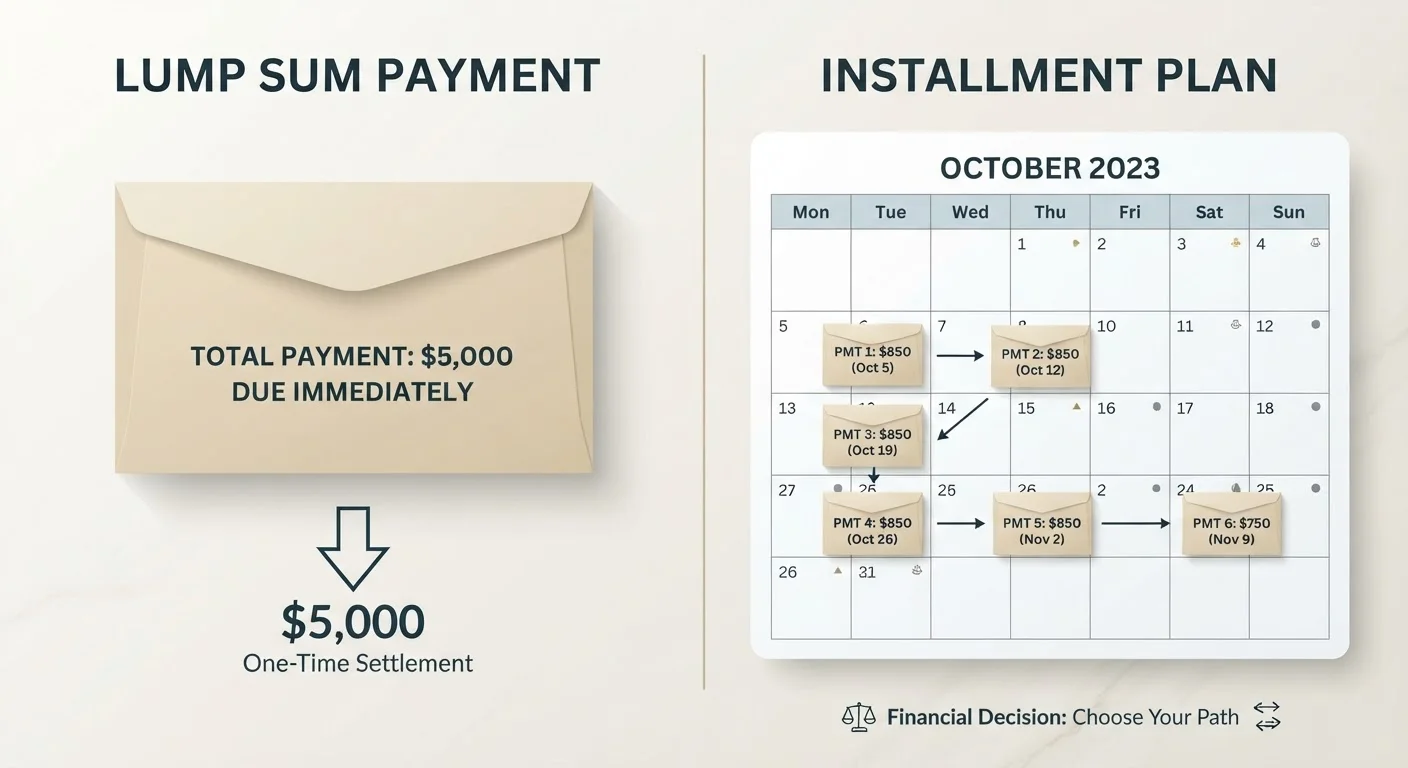
Neither lump-sum nor installment payment is universally better. The right approach depends on the interest rate attached, your current liquidity, and how you'd otherwise deploy that capital. When installments carry zero interest and you're disciplined about on-time payments, spreading costs can make sense. When interest is involved, paying upfront almost always costs less in total.
| Best for | Recommended |
|---|---|
| Those with sufficient savings and access to interest-bearing installment plans | Lump-Sum Payment |
| Those with genuinely zero-percent financing and reliable cash discipline | Installment Payment |
| Those with tight monthly budgets who need to preserve cash flow | Installment Payment (with caution) |
| Those evaluating total cost of ownership over convenience | Lump-Sum Payment |
The Core Question Isn't About Convenience
Most consumers frame the lump-sum vs. installment decision around ease: can I afford the payment each month? But that framing skips the more important question - what does each option actually cost in total?
Understanding the difference between price, value, and total cost is foundational here. A $1,200 appliance paid in 12 monthly installments of $110 isn't a $1,200 purchase - it's a $1,320 purchase. That extra $120 is the cost of spreading the payment. Whether that cost is worth it depends on context, not habit.
This article is general financial information and education, not personalized financial advice. For decisions specific to your situation, consult a qualified financial professional.
| Lump-Sum Payment | Installment Payment | |
|---|---|---|
| Total cost | Equals sticker price (no interest) | Higher if interest or fees apply |
| Cash flow impact | Large immediate outflow | Smaller, spread-out payments |
| Interest risk | None | Moderate to high, depending on terms |
| Liquidity preserved | Low - capital is spent | High - cash stays available |
| Behavioral risk | Low - transaction is final | Higher - requires consistent on-time payments |
| Best when... | You have liquid savings and pay full price | Rate is 0% and cash flow is prioritized |
What Lump-Sum Payments Actually Mean for Your Finances
Paying in full upfront has one clear mathematical advantage: you pay exactly the sticker price and nothing more (assuming no prepayment discount). No interest accrues. No fees accumulate. The transaction is closed.
The real cost of a lump-sum payment, however, is the liquidity you give up. Spending $1,200 today means that $1,200 is no longer available for emergencies, investment, or other priorities. This is the opportunity cost of the purchase - what else that money could have done.
If your savings earn meaningful interest or returns, paying a large sum upfront has a measurable cost even when no financing fee is involved. That doesn't automatically make installments better - it just means the calculation is more nuanced than it first appears.
Calculate the Break-Even Before Deciding
Before choosing between lump-sum and installments, calculate the total dollar difference between the two paths. If installments cost more overall, ask whether the monthly cash flow benefit justifies that premium given your specific budget. A simple spreadsheet or loan calculator can make this comparison concrete in under five minutes.
How Installment Plans Add Hidden Costs
Installment plans - whether through a retailer's financing program, a buy-now-pay-later service, or a credit card - often carry interest rates that substantially increase what you pay. A common annual percentage rate (APR) on retail financing can range widely; even a modest rate applied to a mid-size purchase adds real dollars over 12 to 24 months.
Deferred-interest arrangements are especially worth scrutinizing. These plans appear interest-free but may retroactively apply all accumulated interest to the original balance if you don't pay in full by the end of the promotional period. The Consumer Financial Protection Bureau has noted this structure can surprise consumers who don't read the fine print carefully.
For a broader look at how structured repayment affects overall debt management, see the avalanche vs. snowball debt payoff comparison.
~30%
Average retail financing APR range
Retail store credit cards have historically carried average APRs well above standard credit cards, according to Consumer Financial Protection Bureau data.
1 in 4
BNPL users who report payment difficulty
A 2023 CFPB report on buy-now-pay-later lending found a notable share of users experienced challenges keeping up with multiple simultaneous installment obligations.
When Zero-Percent Financing Changes the Math
Genuine zero-percent financing - where no interest is charged for a set period and there is no deferred-interest catch - is a different situation. If a retailer offers 12 months at 0% APR with no fees and you can confidently make every payment on time, installments may be financially equivalent to paying upfront, and potentially advantageous if the cash you keep earns more than zero.
The risks are behavioral: missing a payment, underestimating your budget, or carrying a balance past the promotional window. If any of those happen, the math shifts quickly against you. Zero-percent offers also sometimes require opening a new credit account, which carries its own considerations around credit utilization and inquiry impact.
When evaluating these offers, think alongside broader questions about when to pay down debt versus build savings - because new financing is, functionally, new debt.
A Framework for Making the Call
Rather than defaulting to habit, run through three concrete questions before deciding:
- What is the total cost of each path? Add up all payments in the installment scenario and compare to the lump-sum price. The difference is what you're paying for flexibility.
- What happens to the cash if you don't spend it now? If liquid savings sit in a low-yield account, the opportunity cost of paying upfront is minimal. If that cash has a productive use - such as shoring up an emergency fund or other financial priority - then preserving it via installments may have real value.
- How reliable is your cash flow over the installment period? Installments that stretch 18 to 24 months introduce risk if your income changes. A plan that looks comfortable today may become stressful during an unexpected expense period.
For consumers building or refining their overall approach, the budgeting basics hub offers practical frameworks for tracking where each dollar goes.
Deferred Interest Is Not the Same as Zero Interest
Some retail financing promotions advertise 'no interest if paid in full' - a structure that defers interest rather than eliminating it. If you carry any balance past the promotional deadline, all interest from the entire purchase period may be added to your balance at once. Always read the full financing agreement, not just the headline rate.
The content on this site is for informational purposes only and is not a substitute for professional advice. Always consult a qualified professional for guidance specific to your situation.