

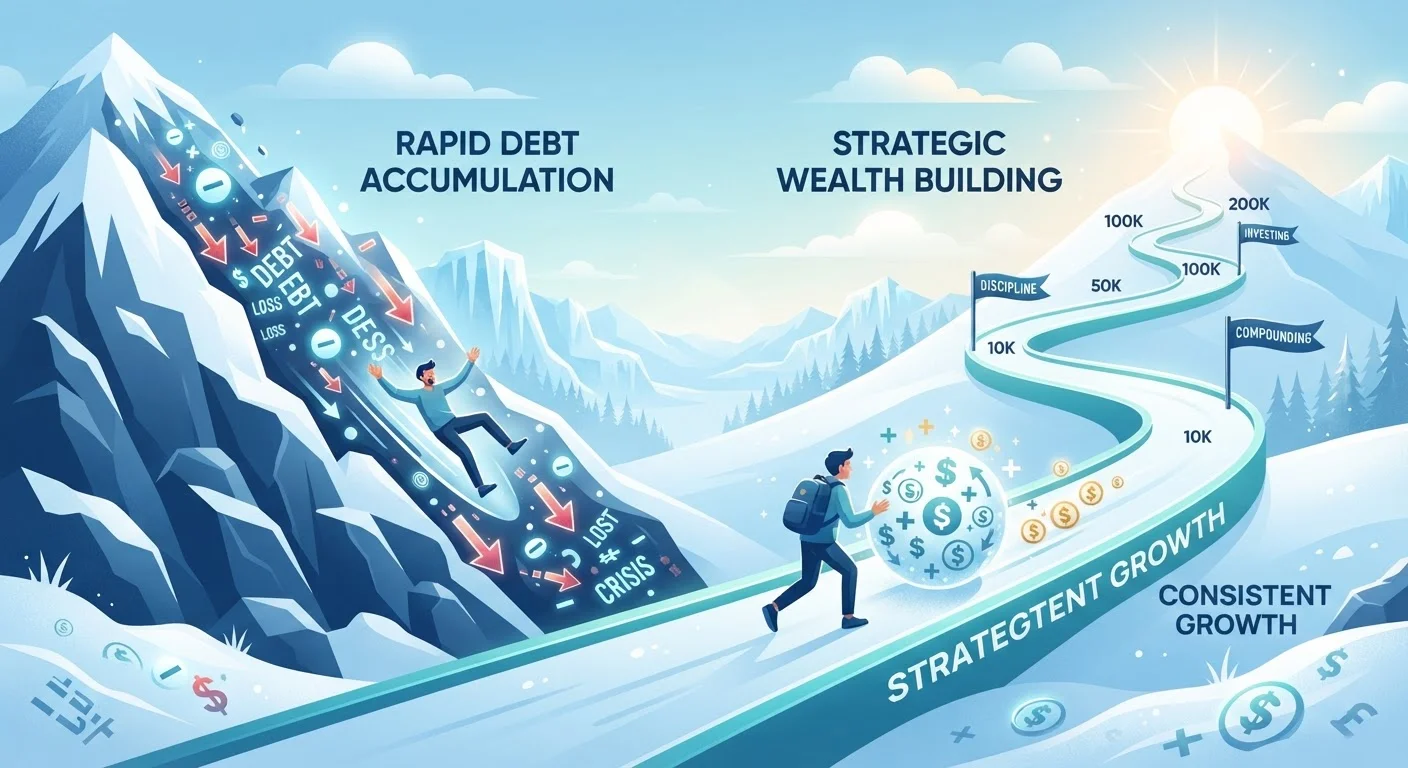
Option A
Debt Avalanche Method
The mathematically optimal, interest-minimizing approach.
Best for: People motivated by long-term savings who can stay disciplined without frequent early wins.
Option B
Debt Snowball Method
The psychologically rewarding, momentum-building approach.
Best for: People who need visible progress and motivational milestones to stay on track.
How Each Method Works
Both the avalanche and snowball methods share the same core mechanic: pay the minimums on every debt, then throw any extra dollars at one specific target account. They differ only in how that target is chosen.
Avalanche method: List your debts from highest interest rate to lowest. Direct all extra payments toward the highest-rate balance first. Once it's eliminated, roll that payment into the next highest-rate debt, and so on. Interest rates - not balances - drive the sequence.
Snowball method: List your debts from smallest balance to largest, regardless of interest rate. Attack the smallest balance first with every extra dollar. Once it's gone, redirect that payment to the next smallest balance. Account size - not cost - determines the order.
The mechanics are simple, but the implications for your wallet and your motivation are meaningfully different. To understand the trade-offs in everyday terms, see how the two approaches also relate to broader spending decisions - our look at lump-sum versus installment payment trade-offs explores the same tension between short-term cost and long-term math.
| Criterion | Debt Avalanche | Debt Snowball |
|---|---|---|
| Payoff sequence | Highest interest rate first | Smallest balance first |
| Total interest paid | Lower (mathematically optimal) | Higher (rate ignored in sequencing) |
| Time to first payoff | Often longer | Often faster |
| Motivational structure | Delayed gratification | Frequent early wins |
| Best debt profile | Large, high-rate balances | Many small, scattered accounts |
| Behavioral dropout risk | Higher without strong discipline | Lower due to milestone rewards |
| Complexity | Requires tracking interest rates | Straightforward balance comparison |
The Math vs. The Psychology
On paper, the avalanche method wins every time. By neutralizing high-interest balances faster, you reduce the principal on which interest compounds - meaning less total interest accumulates over the life of your debts. The difference can be significant: a few percentage points on a large balance, compounded over months or years, adds up quickly.
But personal finance research has repeatedly found that the mathematically optimal strategy isn't always the one people complete. A study published in the Journal of Marketing Research found that consumers who paid off smaller accounts first showed greater overall debt reduction - not because the strategy was cheaper, but because they stayed engaged longer.
~$1,000+
Potential interest saved with avalanche on typical mixed debt
Estimated difference in total interest paid between avalanche and snowball methods varies widely based on balances, rates, and payoff timeline - individual results differ.
54%
Americans carrying credit card debt month to month
According to Federal Reserve survey data, more than half of U.S. credit card holders carry a balance - making repayment strategy selection a high-stakes decision for millions of households.
20%+
Average credit card APR in recent years
Federal Reserve data shows average credit card interest rates have reached historically high levels, amplifying the long-term cost of slow repayment regardless of method chosen.
The snowball's psychological advantage comes from what behavioral economists call the "goal gradient effect" - our motivation intensifies as we approach the finish line of any goal. Eliminating a debt entirely, even a small one, triggers a sense of accomplishment that keeps many borrowers in the game.
For households navigating shared finances or inconsistent income, these behavioral factors carry extra weight. Our guides on debt paydown as a household and repayment planning on an irregular income explore how to adapt whichever method you choose to real-life complexity.
Both Methods Require the Same Starting Point
Before choosing avalanche or snowball, list every debt with its current balance, interest rate, and minimum monthly payment. Without this inventory, neither method can be applied correctly. Many households discover debts they'd mentally minimized once they see the full picture in one place. This clarity alone often motivates faster action.
Choosing the Right Method for Your Situation
Neither method is universally superior - the right choice depends on your debt profile, your cash flow, and your honest assessment of your own motivation patterns.
Choose the avalanche if:
- You have one or two large, high-interest balances (particularly credit card debt above 20% APR) where the interest savings are most pronounced.
- You're analytically motivated and can tolerate a long runway before your first payoff milestone.
- Your income is stable and your budget is locked in, reducing the temptation to abandon the plan mid-course.
Choose the snowball if:
- You have several small balances cluttering your budget with minimum payments.
- You've started debt payoff plans before and lost momentum - past behavior is the most reliable predictor of future behavior.
- You want to reduce the number of monthly obligations quickly, especially useful if income varies month to month.
Some people use a hybrid: apply snowball logic to eliminate one or two small nuisance debts, then switch to avalanche sequencing for the remaining balances. This isn't a textbook approach, but if it keeps you consistent, it's a legitimate tool.
Once you've settled on a method, you'll likely face the adjacent question of how to balance these payments against savings goals. Our article on paying off debt versus building savings walks through when each priority should take precedence - a natural next step after choosing your repayment strategy. And if you're thinking even further ahead, where your next dollar should go covers the broader sequencing question across savings, retirement, and debt paydown.
This article is for general informational and educational purposes only and does not constitute personalized financial advice. Consult a qualified financial professional before making decisions about your specific debt situation.
The content on this site is for informational purposes only and is not a substitute for professional advice. Always consult a qualified professional for guidance specific to your situation.