

Why Allocation Isn't a Set-It-and-Forget-It Decision
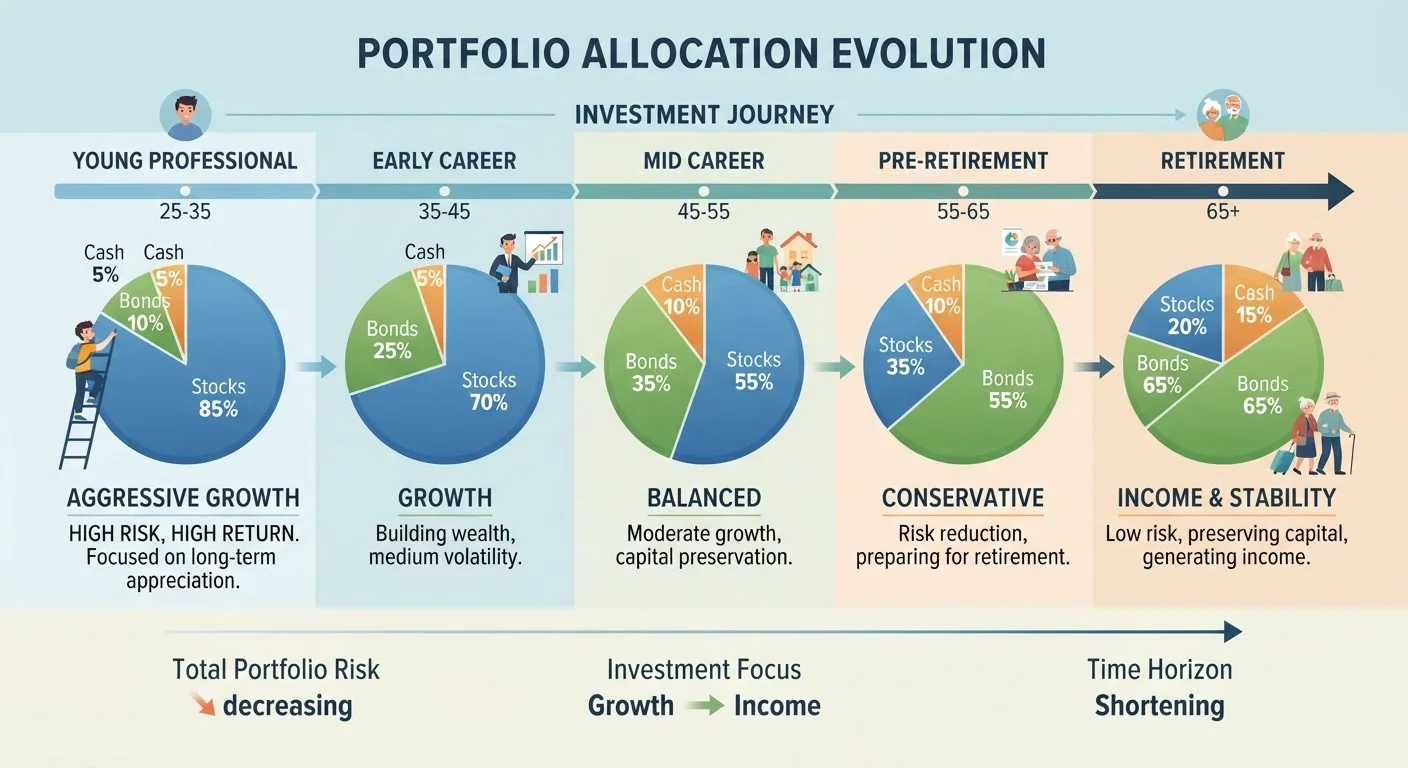
Asset allocation - how you divide your investments among stocks, bonds, cash, and other assets - is arguably the single most important driver of long-term portfolio outcomes. But the mix that serves a 28-year-old building wealth looks nothing like what makes sense for a 62-year-old protecting it. Time horizon, income stability, and risk tolerance all shift across a lifetime, and your allocation should shift with them.
This isn't about timing the market or reacting to economic headlines. It's about structuring your portfolio to match what you're actually trying to accomplish at each stage of life. The general principle is straightforward: when you have time on your side, you can absorb volatility in exchange for higher long-term growth potential. As your timeline shortens, stability matters more - particularly if you'll be drawing on the portfolio soon.
Understanding how retirement accounts function at each stage is foundational to this. See how a retirement account evolves from first contribution to first withdrawal for context on the mechanics behind the strategy.
This Is Education, Not Personal Advice
Asset allocation decisions depend on your individual financial situation, goals, tax circumstances, and risk tolerance. The frameworks described here are general educational concepts - not personalized investment recommendations. Consult a licensed financial adviser before making significant changes to your portfolio.
What You'll Need Before You Start
Getting your allocation right requires knowing your full financial picture first - not just your brokerage balance. Gather the tools and information below before working through the steps.
What you will need
Net worth statement
Provides a full picture of assets and liabilities so allocation decisions reflect your total financial situation, not just one account.
Risk tolerance questionnaire
Helps identify how much portfolio volatility you can realistically stomach - many brokerages offer these for free.
Target-date fund prospectus
Details the glide path (how allocation shifts over time) of a specific fund so you can compare it to your own preferences.
Tax-advantaged account summary (401(k), IRA)
Understanding what account types hold your investments helps optimize where to place bonds versus stocks for tax efficiency.
If you're still working on foundational priorities - like whether to pay down debt before investing more aggressively - this breakdown of where to put your next dollar can help you sequence decisions before adjusting allocation.
Step-by-Step: Adjusting Your Allocation Over Time
The following steps walk through how to assess, set, and maintain an allocation that evolves alongside your financial life. This process applies whether you're starting from scratch or reviewing an existing portfolio.
Identify your time horizon
Before setting any allocation, anchor everything to one number: how many years until you need to draw on this money. A 30-year-old saving for retirement at 65 has roughly 35 years - enough time to ride out multiple market cycles. Someone at 58 has a much shorter runway. The longer your horizon, the more volatility your portfolio can absorb without derailing your goals.
Factor in that retirement isn't the end of your investment horizon. If you retire at 65, your money may need to last another 25-30 years. That ongoing growth need means even retirees often maintain meaningful stock exposure.
Assess your actual risk tolerance
Risk tolerance is both financial (can your plan survive a 30% portfolio drop?) and emotional (will you panic-sell?). These aren't always the same. Many investors overestimate their emotional comfort with volatility during bull markets, then make reactive decisions during downturns that lock in losses.
Most major brokerage platforms offer free risk questionnaires. Be honest - answering based on how you want to feel rather than how you actually behaved in past downturns produces a misleading result.
Apply an age-based starting framework
A common starting heuristic: subtract your age from 110 (or 120 for those comfortable with higher risk) to get a rough stock allocation percentage. At 35, that suggests 75-85% stocks; at 60, roughly 50-60%. These are rough anchors - not prescriptions.
Early career (20s-30s): higher equity exposure makes sense. Mid-career (40s): begin a gradual shift, especially if retirement savings are on track. Pre-retirement (late 50s-early 60s): continue reducing equity volatility and building stable income-producing assets. In-retirement: focus on income and capital preservation while maintaining enough growth exposure to combat inflation over a potentially long retirement.
Choose between a DIY glide path and a target-date fund
A glide path is the scheduled shift from growth-oriented assets toward stability over time. You can construct your own by gradually adjusting allocations each year, or you can use a target-date fund - a single fund that does this automatically based on a projected retirement year.
Target-date funds are genuinely useful for investors who want a hands-off approach, but review the fund's glide path before assuming it matches your preferences. Some funds become quite conservative early; others maintain significant equity exposure well into retirement. Neither is wrong - they reflect different philosophies about longevity risk versus market risk.
Rebalance at least annually
Markets drift. If stocks rally strongly, a portfolio that started at 70/30 stocks-to-bonds might become 80/20 without you doing anything - exposing you to more risk than you intended. Rebalancing means selling what has grown beyond its target weight and buying what has fallen below, restoring your intended allocation.
Doing this annually - or when any asset class drifts more than 5 percentage points from its target - keeps your risk profile intentional. Rebalancing inside tax-advantaged accounts (401(k), IRA) avoids triggering capital gains taxes.
Revisit allocation at major life events
Beyond annual rebalancing, certain life changes warrant a more thorough review: a job loss, inheritance, divorce, serious health diagnosis, or decision to retire early all change the financial assumptions underlying your allocation. Don't wait for the calendar if your life circumstances have shifted materially.
For a broader look at planning checkpoints across your adult life, see financial milestones worth tracking by decade.
Use the Rebalance as a Check-In
Annual rebalancing isn't just a mechanical task - use it as a moment to reassess your whole financial picture. Has your income changed? Are you closer to a major expense? A yearly review keeps your allocation purposeful rather than accidental.
For investors who prefer a rules-based approach to how money enters the market, lump-sum investing versus dollar-cost averaging covers the trade-offs of each method.
Common Pitfalls and How to Avoid Them
Even investors who understand the principles make avoidable mistakes. The most common: never updating allocation at all. Many people set a portfolio in their 30s and don't revisit it for decades - ending up either too conservative (sacrificing growth they still had time to capture) or too aggressive heading into retirement.
A second pitfall is confusing account balance with asset allocation. Having money in a 401(k) doesn't tell you whether it's allocated correctly - the funds within that account matter. Review the underlying holdings, not just the account total.
Don't Ignore Sequence-of-Returns Risk
Retiring into a major market downturn can permanently damage a portfolio that is still heavily weighted in stocks. A bad sequence of early withdrawals forces you to sell shares at depressed prices, locking in losses. This is one of the primary reasons shifting toward stability in your late career years is widely recommended by financial planners.
Finally, don't treat allocation in isolation from tax strategy. Holding bonds inside a tax-advantaged account and stocks in a taxable account is a commonly discussed approach to tax-location efficiency - but the right structure depends on your individual tax situation. This is one area where professional input adds real value. Understanding the difference between account types, such as traditional versus Roth IRAs, can also shape where you place different asset types.
This article is for general informational and educational purposes only and does not constitute personalized investment, tax, or financial advice. Consult a qualified, licensed financial professional for guidance specific to your situation.
The content on this site is for informational purposes only and is not a substitute for professional advice. Always consult a qualified professional for guidance specific to your situation.