

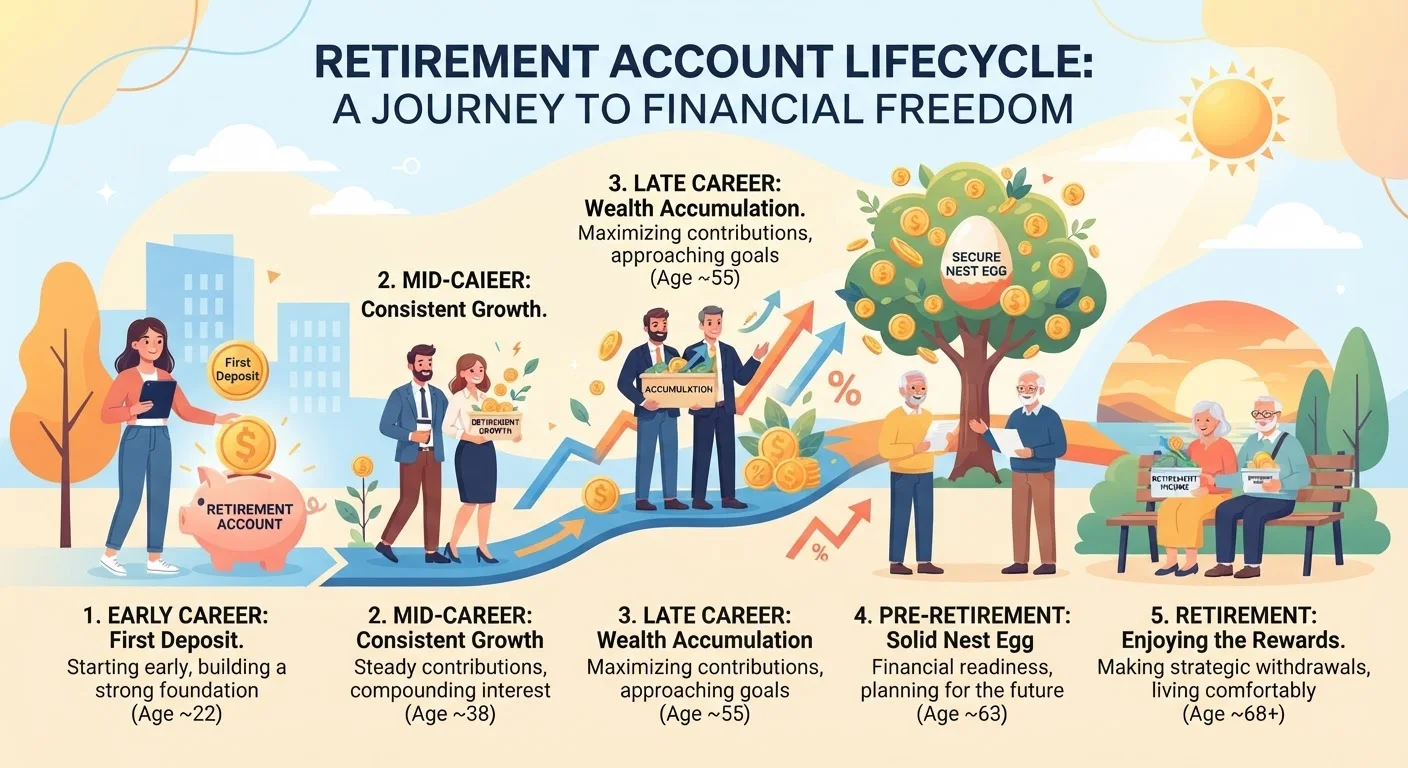
Stage One: Making Your First Contribution
The lifecycle begins the moment money enters the account. For most workers, that first contribution arrives through an employer-sponsored 401(k), often paired with an employer match - which is effectively a guaranteed return on that portion of your savings.
For those without a workplace plan, or who want to save beyond it, traditional and Roth IRAs are the common alternatives. Each account type determines when taxes are paid: traditional accounts defer taxes until withdrawal, while Roth accounts use after-tax dollars so qualified withdrawals are tax-free later.
Starting early matters more than starting large. A modest contribution made at 25 compounds over 40 years into a figure that a much larger contribution at 45 can't easily match. This is the central logic of retirement saving - time is the multiplier. If you're unsure how the full planning picture fits together, see our complete overview of long-term financial planning.
$23,000
2024 annual 401(k) employee contribution limit
Per IRS guidelines; workers aged 50 and older may contribute an additional $7,500 as a catch-up contribution.
Age 73
RMD start age for most traditional retirement accounts
The SECURE 2.0 Act raised the required minimum distribution starting age from 72 to 73 for those born in 1951 or later.
10%
Early withdrawal penalty before age 59½
In addition to ordinary income taxes owed, most pre-59½ withdrawals from traditional accounts incur this IRS penalty with limited exceptions.
Stage Two: The Accumulation Years
During the long middle stretch - typically your 30s through late 50s - the account's primary job is growth. Contributions pile up, investment returns compound, and the account balance builds. This is when asset allocation decisions carry the most weight.
Early in accumulation, most financial guidance suggests holding a higher proportion of stocks, which carry more short-term volatility but historically deliver stronger long-term growth. As retirement approaches, the conventional wisdom shifts toward a gradually more conservative mix. How that allocation evolves over a lifetime is worth understanding before your 50s arrive.
This stage also involves navigating contribution limits, vesting schedules if an employer match is involved, and occasional decisions like rolling over an old 401(k) after a job change. If terminology like «vesting» or «fiduciary» trips you up, the key terms inside every retirement plan document is a useful reference.
Don't Let an Old 401(k) Sit Forgotten
When you leave a job, it's easy to lose track of a former employer's retirement plan. Unclaimed accounts can sit idle for years, missing contribution opportunities and potentially incurring fees. Consider rolling the balance into your current plan or an IRA to keep it consolidated and actively managed. Check the National Registry of Unclaimed Retirement Benefits if you suspect you have an old account you've misplaced.
Stage Three: Approaching and Entering Retirement
As you close in on retirement age, the priorities shift from aggressive growth to capital preservation and income planning. This is the time to think carefully about withdrawal sequencing - which accounts to draw from first, and in what order, to manage your tax exposure across what could be a 20- to 30-year retirement.
At age 59½, penalty-free withdrawals become available. For traditional accounts, those withdrawals are taxed as ordinary income. For Roth accounts that meet the five-year holding rule, qualified withdrawals are tax-free.
At age 73, the IRS mandates required minimum distributions (RMDs) from traditional IRAs and most 401(k)s. These are calculated annually based on your account balance and IRS life expectancy tables. Missing an RMD carries a 25% excise tax on the amount not withdrawn - a mistake worth avoiding.
This article is for general informational and educational purposes only and does not constitute personalized financial, investment, tax, or legal advice. Consult a qualified financial advisor or tax professional before making decisions about your retirement accounts.
Frequently Asked Questions
Generally, you can make penalty-free withdrawals from most retirement accounts at age 59½. Roth IRA contributions (not earnings) can be withdrawn at any time without penalty. Some exceptions apply earlier, such as disability or certain medical expenses.
An RMD is the minimum amount the IRS requires you to withdraw annually from traditional IRAs and most employer-sponsored plans starting at age 73. The amount is calculated based on your account balance and life expectancy. Failing to take your RMD triggers a significant excise tax.
Yes - the key difference is when you pay taxes. Traditional accounts give you a tax deduction now but tax withdrawals later. Roth accounts offer no upfront deduction but allow tax-free withdrawals in retirement. See our <a href="/personal-finance/financial-planning/traditional-ira-vs-roth-ira-how-the-tax-timing-difference-changes-everything">full breakdown of the tax timing difference</a> for more detail.
IRS contribution limits change periodically. For 2024, the 401(k) employee contribution limit is $23,000, and the IRA limit is $7,000. Workers 50 and older can make additional catch-up contributions on top of those limits.
You generally have four options: leave the money in your former employer's plan, roll it into your new employer's plan, roll it into an IRA, or cash it out. Cashing out triggers taxes and penalties for most people, making a rollover the better option in most circumstances.
The content on this site is for informational purposes only and is not a substitute for professional advice. Always consult a qualified professional for guidance specific to your situation.