

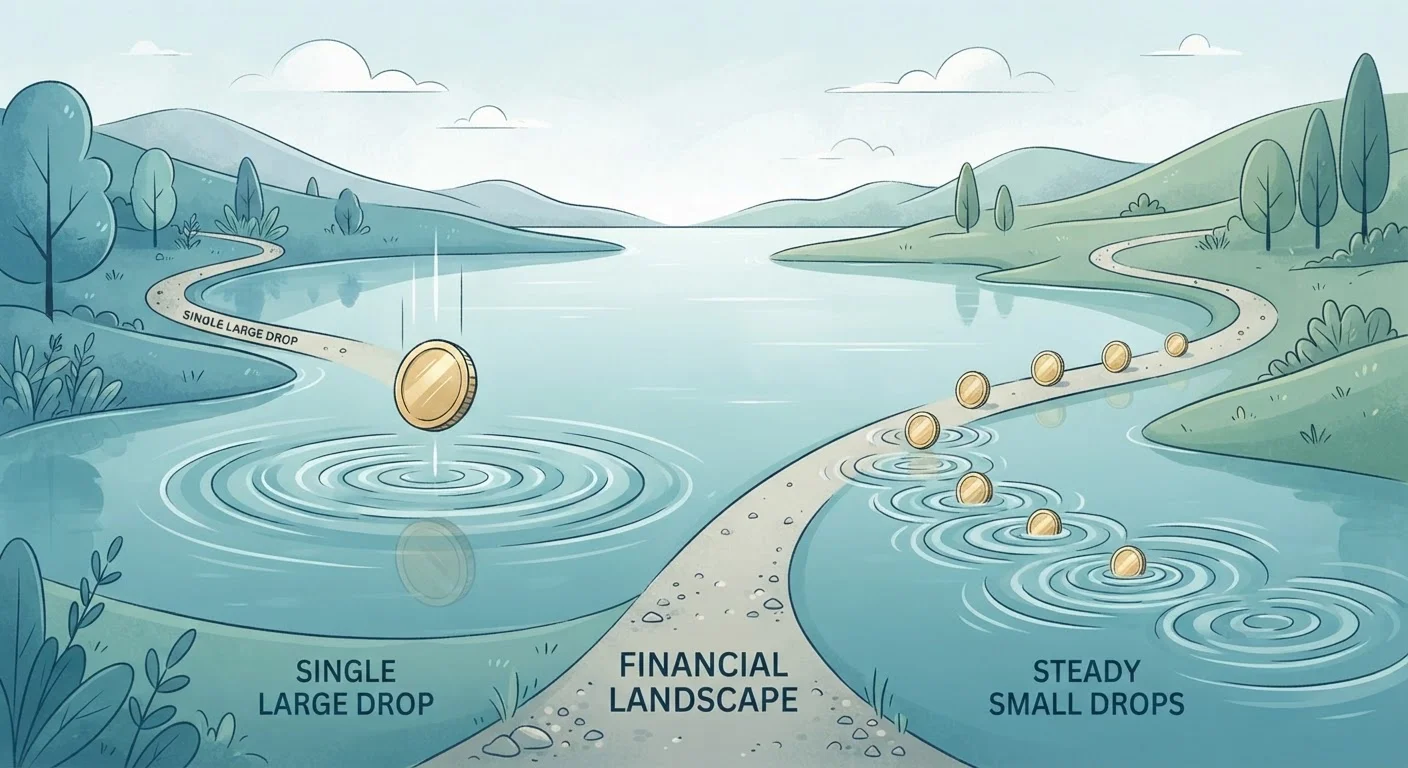
Option A
Lump-Sum Investing
Deploy all available capital at once for maximum market exposure.
Best for: Investors with a windfall or accumulated savings who have a long time horizon and can tolerate short-term volatility.
Option B
Dollar-Cost Averaging (DCA)
Spread investments over time to reduce the impact of market timing.
Best for: Investors who receive income periodically, want to reduce emotional decision-making, or are nervous about deploying a large sum at a market peak.
How Each Strategy Works
Lump-sum investing means putting all available capital into the market in a single transaction. If you have $20,000 to invest, you deploy the entire amount on day one. Your money is immediately exposed to market movements - up or down.
Dollar-cost averaging (DCA) means dividing that same $20,000 into equal installments - say, $2,000 per month over ten months - and investing each portion at regular intervals regardless of market conditions. When prices fall, your fixed dollar amount buys more shares; when prices rise, it buys fewer. Over time, this can lower your average cost per share relative to always buying at a peak.
Both strategies ultimately aim at the same destination: building wealth through market participation. The difference lies in timing, risk exposure, and the psychological experience of investing. Understanding how your asset allocation evolves over time is equally important when using either approach.
What the Research Generally Shows
Multiple studies - including widely cited analysis from Vanguard - have found that lump-sum investing outperforms DCA roughly two-thirds of the time when measured over 10-to-12-month deployment windows across U.S., U.K., and Australian markets. The intuition is straightforward: because markets have historically trended upward over long periods, money invested earlier has more time to compound.
~68%
Rate lump-sum beats DCA historically
Vanguard research analyzing 12-month deployment windows across U.S., U.K., and Australian markets found lump-sum investing outperformed DCA approximately two-thirds of the time.
10+ years
Typical horizon where lump-sum advantage grows
The performance gap between lump-sum and DCA tends to widen with longer holding periods, as more time in the market allows compounding to work more fully.
~50%
Average U.S. equity market decline in major bear markets
Significant market downturns - like the 2000-2002 and 2007-2009 bear markets - highlight why entry timing matters and why some investors prefer DCA's gradual approach.
That said, the one-third of cases where DCA wins matters enormously to real investors. If you happen to deploy a lump sum just before a significant correction - as occurred in early 2000 or late 2007 - the psychological and financial damage can be severe, especially if it prompts panic selling.
It's worth noting that most everyday Americans already practice DCA without realizing it. Contributing a percentage of each paycheck to a 401(k) is dollar-cost averaging by design. The lump-sum vs. DCA debate becomes most relevant when someone suddenly has a larger-than-usual amount to deploy - an inheritance, bonus, or proceeds from selling a home.
This connects to a broader principle explored in understanding opportunity cost: keeping cash on the sidelines during a DCA period isn't free - idle money earns less than invested money historically does over time.
Key Trade-Offs Side by Side
Before choosing an approach, it helps to see the core differences laid out plainly.
| Criterion | Lump-Sum Investing | Dollar-Cost Averaging |
|---|---|---|
| Deployment speed | All at once | Spread over weeks or months |
| Market exposure | Immediate and full | Gradual build-up |
| Historical outperformance | ~2/3 of the time (per Vanguard research) | ~1/3 of the time |
| Timing risk | Higher - vulnerable to buying at a peak | Lower - averages across multiple prices |
| Behavioral complexity | One decision required | Requires ongoing discipline |
| Idle cash drag | None | Uninvested cash earns less over DCA period |
| Best suited to | Windfalls, long horizons, higher risk tolerance | Regular income, anxiety about timing, volatile markets |
One factor the table can't fully capture is behavioral risk. Research in behavioral finance consistently shows that investors who experience sharp early losses are more likely to abandon their strategy altogether. For someone who knows they'll panic-sell after a 20% drop, DCA's smoother entry may actually produce better real-world outcomes than a theoretically superior lump-sum approach.
Risks That Apply to Both Strategies
Neither approach protects you from market risk. Both lump-sum investing and DCA expose your money to potential loss - markets can decline substantially and stay down for extended periods. DCA reduces the risk of poor timing at entry but doesn't eliminate sequence-of-returns risk once you're fully invested.
DCA Doesn't Guarantee a Lower Average Cost
A common misconception is that dollar-cost averaging always results in a lower average purchase price. In a steadily rising market, DCA actually produces a higher average cost than a lump-sum investment made at the start. DCA's advantage materializes primarily in volatile or declining markets where later purchases capture lower prices. Neither outcome is guaranteed.
There's also the risk of over-engineering the decision. Spending months agonizing over which approach to use is itself a form of opportunity cost. If the choice between lump-sum and DCA delays investing altogether, that hesitation may cost more in forgone returns than the difference between the two strategies.
Before making any significant investment decision, consider speaking with a licensed financial adviser who can evaluate your full financial picture - including existing debt, emergency reserves, and tax situation. For context on sequencing financial priorities, see where your next dollar should go and whether to pay off debt or build savings first.
This article is for general informational and educational purposes only and does not constitute personalized financial, investment, tax, or legal advice. Past market performance does not guarantee future results. Consult a qualified, licensed financial professional before making investment decisions.
The content on this site is for informational purposes only and is not a substitute for professional advice. Always consult a qualified professional for guidance specific to your situation.