

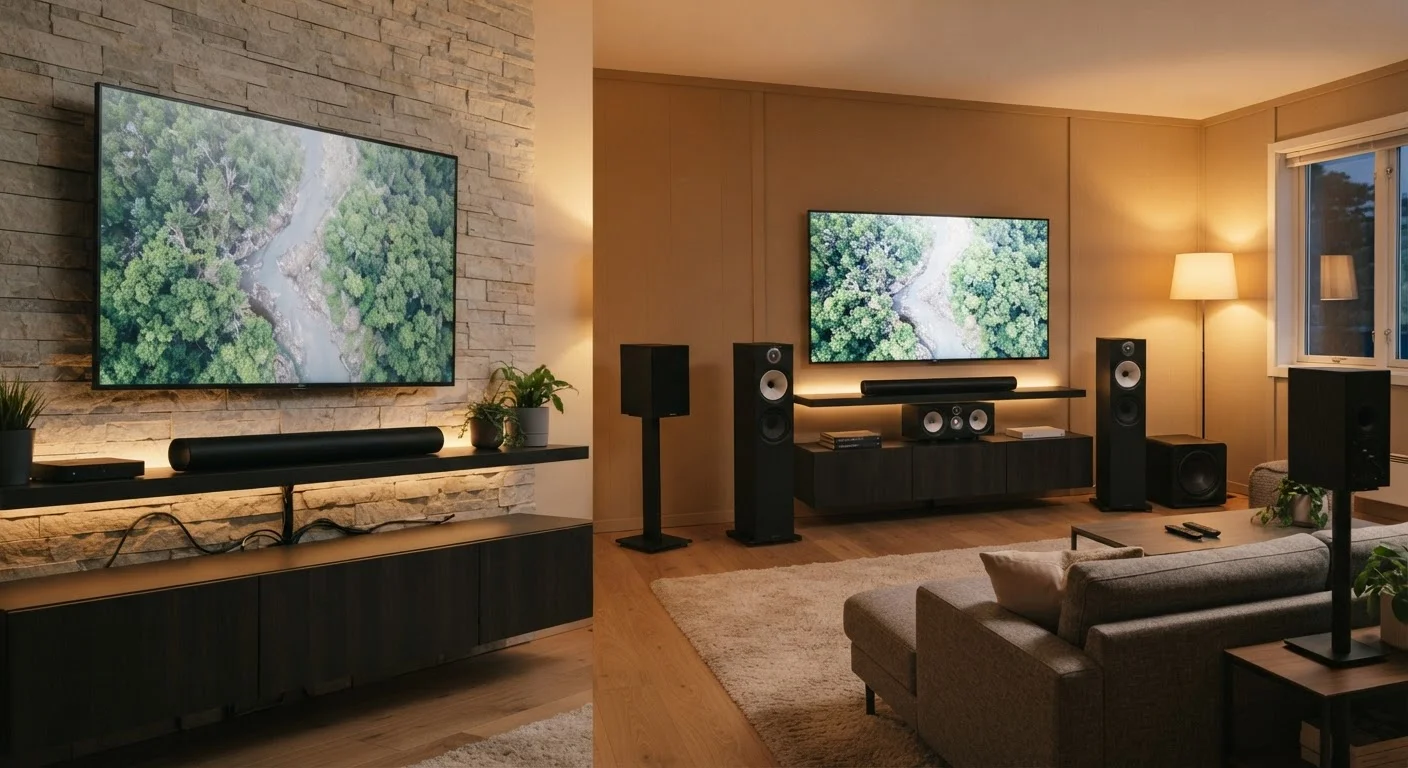
Our Verdict
For casual daily viewing in apartments or smaller living rooms, a well-placed stereo soundbar delivers a meaningful upgrade over built-in TV speakers with minimal hassle. Full surround sound systems earn their complexity in dedicated media rooms or for listeners who prioritize cinematic immersion above all else. Most households fall somewhere in between, making the decision less about audio purity and more about practical fit.
| Best for | Recommended |
|---|---|
| Apartments, smaller rooms, or renters who can't run cables | Stereo Soundbar |
| Dedicated home theater rooms and serious movie enthusiasts | Full Surround Sound System |
| Listeners who want immersive audio without complex installation | Soundbar with Wireless Rear Satellites |
| Those who primarily stream music and casual TV programming | Stereo Soundbar |
What Each Setup Actually Delivers
A stereo soundbar is a single elongated unit that projects audio from two or more internal drivers, typically placed below or above your TV. It creates a left-right stereo field and, in many cases, simulates a wider soundstage using digital processing. Some models include a separate wireless subwoofer for low-frequency reinforcement.
A full surround sound system - most commonly configured as 5.1 - uses dedicated speakers placed at distinct positions around the listener: front left, center, front right, two rear or side surrounds, and a subwoofer. Each channel carries discrete audio information, meaning sound effects and dialogue are physically anchored to specific locations in the room. For a deeper look at how these systems compare at the category level, see how soundbars, bookshelf speakers, and home theater systems differ.
The gap between the two isn't just about speaker count - it's about how sound moves around you versus how well it's projected toward you.
| Stereo Soundbar | Full Surround Sound System | |
|---|---|---|
| Installation effort | Minimal - one cable, no placement decisions | Moderate to high - multiple speakers, wire runs required |
| Surround immersion | Simulated via processing | True discrete rear channels |
| Room size suitability | Best under ~300-400 sq ft | Scales well into larger rooms |
| Dialogue clarity | Strong, especially with dedicated center driver | Excellent with dedicated center channel speaker |
| Cable/clutter impact | Very low | Higher - rear speakers need routing |
| Format support (Atmos, DTS:X) | Limited or virtualized | Full support with compatible receiver |
| Typical complexity | Low - plug and play | Higher - calibration recommended |
Where Soundbars Hold Their Own
For most everyday listening - nightly TV, streaming shows, casual music - a stereo soundbar is genuinely sufficient. It raises dialogue clarity dramatically over built-in TV speakers, adds body to music, and does so without a single wire running across the floor. In rooms under roughly 300 square feet, the stereo image from a quality bar can feel surprisingly full.
Setup simplicity is a real advantage. One HDMI ARC connection (Audio Return Channel - a single cable that carries both audio and control signals between your TV and soundbar) and you're done. There's no receiver to configure, no speaker placement to agonize over, and no arguing about cable runs with your landlord. If you want to go further without adding equipment, optimizing your soundbar's performance through placement and EQ settings can close the gap further.
Placement Makes a Measurable Difference
A soundbar placed directly below the TV at ear level - rather than on a high shelf - delivers noticeably improved stereo separation and dialogue clarity. If a wall mount positions the bar more than a foot above seated ear height, reflected sound can make dialogue feel diffuse. Even small placement adjustments routinely produce more improvement than switching audio modes.
Where Full Surround Sound Wins
Real rear speakers do something no amount of digital processing fully replicates: they place sound behind you. In action sequences, horror films, or immersive nature documentaries, that physical directionality creates a qualitatively different experience - not just louder, but spatially convincing. Soundbars with virtual surround modes can approximate this effect, but the brain distinguishes real versus reflected sound, especially in larger rooms where wall reflections diminish.
Formats like Dolby Atmos and DTS:X add height channels to the equation, and while some soundbars support these formats, the effect scales significantly with dedicated overhead or upward-firing speakers in a proper layout. If you're curious whether Atmos actually matters for your setup, what Dolby Atmos means for living room listening is worth understanding before investing. For those ready to build a full system, setting up a 5.1 system from scratch covers the practical steps.
5.1
Channels in a standard surround system
A 5.1 configuration uses five full-range speakers plus one dedicated subwoofer, giving each audio position a distinct physical source.
~70%
U.S. households that use a soundbar or TV speakers
Consumer Electronics Association research has consistently shown the majority of American households rely on integrated or bar-style audio rather than discrete surround systems.
The Questions That Actually Decide It
Before focusing on specs or formats, a few practical questions clarify the decision faster than any feature list:
- Room size: Larger rooms (over 400 sq ft) tend to make surround systems sound more proportional and immersive. Soundbars can struggle to fill large spaces convincingly.
- Cable tolerance: Surround systems require speaker wire runs to rear positions. Wireless rear satellites exist but add cost. If visible cables or drilling aren't options, a soundbar wins by default.
- Primary content: Sports and news viewers notice far less difference than people who watch action films regularly. Listeners whose primary source is music often find stereo soundbars preferable to poorly calibrated surround setups.
- Listening attention: Background listeners and dedicated viewers have different thresholds. A soundbar rewards casual use; surround rewards active listening.
Working through a pre-purchase checklist before spending anything helps surface which of these factors actually applies to your situation.
Virtual Surround Is Not the Same as Real Surround
Many soundbars advertise 'virtual surround' or '3D audio' modes, which use psychoacoustic processing to simulate the impression of sounds coming from behind you. In treated rooms or under ideal conditions, the effect can be convincing - but it relies heavily on room acoustics and diminishes in larger or acoustically 'dead' spaces. Evaluate virtual surround claims with a listening test in conditions similar to your own room before treating them as equivalent to physical rear speakers.
The content on this site is for informational purposes only and is not a substitute for professional advice. Always consult a qualified professional for guidance specific to your situation.