

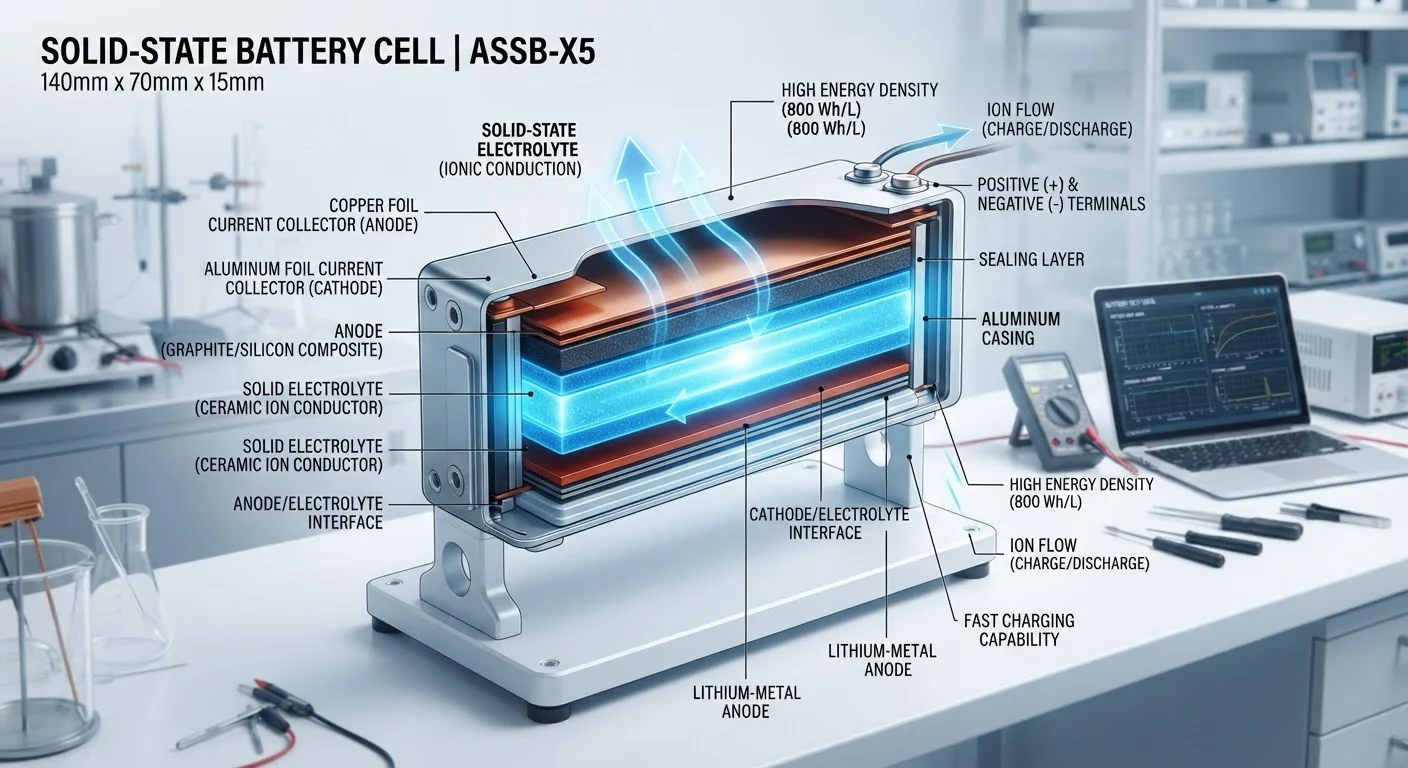
Why the Electrolyte Is the Whole Story
Inside every battery - whether it's in your phone or a 100 kWh EV pack - ions travel between two electrodes: an anode (negative) and a cathode (positive). The electrolyte is the medium that makes that ion movement possible. In the lithium-ion cells that power virtually every current electric vehicle, that electrolyte is a liquid solution. It works well, but it comes with constraints: it's flammable, it requires careful temperature management, and it places physical limits on how the electrodes can be designed.
Replace the liquid with a solid - a ceramic, glass, or polymer material - and several of those constraints change at once. The cell becomes less prone to thermal runaway, the electrodes can potentially be redesigned for higher energy density, and the overall architecture becomes more compact. That's the core promise of solid-state technology, and it explains why both automakers and battery developers have invested heavily in pursuing it.
Solid-State vs. Lithium-Ion: Not a Replacement Yet
Solid-state batteries are often described as a replacement for lithium-ion, but the two categories overlap - many solid-state designs still use lithium chemistry. The meaningful distinction is the electrolyte state (solid vs. liquid), not the ion carrier. This is worth keeping in mind when evaluating news coverage that uses the terms loosely.
The Range Equation: Energy Density Explained
Range anxiety - the concern that an EV won't have enough charge to reach a destination - remains one of the most cited hesitations among potential EV buyers, as noted in consumer research conducted by organizations like J.D. Power and AAA. Solid-state batteries address this partly through improved energy density, which refers to how much energy a battery can store relative to its weight or volume.
Current lithium-ion cells used in EVs have improved dramatically in energy density over the past decade, but they approach physical limits tied to the liquid electrolyte chemistry. Solid-state designs - particularly those using a lithium-metal anode - could achieve energy densities significantly higher than today's cells, which could translate to longer range from a pack of similar size, or equivalent range from a lighter, smaller pack. Both outcomes matter: more range addresses driver concerns, while a lighter pack improves vehicle efficiency and handling.
~500 Wh/kg
Theoretical energy density of lithium-metal solid-state cells
Researchers cite figures in this range as a potential ceiling for advanced solid-state designs, compared to roughly 250-300 Wh/kg in current lithium-ion EV cells.
2-3×
Potential energy density improvement over lithium-ion
Industry analysts and academic researchers have estimated solid-state cells could achieve two to three times the energy density of today's best production cells under ideal conditions.
Late 2020s
Earliest realistic mass-market production window
Multiple automakers and battery suppliers have indicated targeted production timelines in the late 2020s, though these have been revised previously.
For more context on how range fits into the broader EV ownership picture, see common EV assumptions that can mislead buyers.
Where Development Actually Stands
The gap between a working laboratory cell and a mass-produced battery that survives tens of thousands of charge cycles in a real vehicle is enormous. Solid-state batteries have demonstrated strong results at the research scale, but several manufacturing challenges remain unsolved at commercial volumes.
- Interfacial resistance: Where the solid electrolyte contacts the electrode, resistance can build over charge cycles, degrading performance.
- Dendrite growth: In cells using lithium-metal anodes, thin metallic filaments called dendrites can form and eventually pierce the electrolyte, causing a short circuit.
- Brittle materials: Many solid electrolytes are ceramic-based and can crack under the mechanical stress of a battery expanding and contracting during use.
- Manufacturing cost: Producing solid electrolyte layers thin enough and uniform enough for a production battery cell requires processes not yet proven at scale.
Several major automakers and dedicated battery companies have announced pilot programs and target production windows in the late 2020s. Those timelines have shifted in the past and should be understood as goals rather than commitments. Understanding the full EV powertrain spectrum can help drivers contextualize where this technology fits in the broader landscape.
How to Read Battery Breakthrough Headlines
News about battery breakthroughs often describes laboratory results that may be years from production. When evaluating a headline, look for whether the achievement was demonstrated in a full-sized cell or a small research sample, and whether it has been independently verified. Lab-scale results and factory-scale manufacturing are very different milestones.
What This Means for Drivers Today
For drivers currently evaluating an EV purchase, solid-state batteries are not a near-term factor. Today's lithium-ion EVs are mature, well-understood products with established charging infrastructure. The home and public charging options available now are designed around the lithium-ion chemistry that will remain dominant for years to come.
That said, staying broadly informed on solid-state progress is worthwhile, particularly for drivers who plan to buy an EV in the next several years or who are curious about what longer-term resale and technology cycles might look like. Systems like regenerative braking - which already helps extend range in current EVs - reflect the kind of incremental innovation that has defined the EV era so far. Solid-state represents a more fundamental shift, but one that will arrive on an industrial timeline, not a marketing one.
“The transition from liquid to solid electrolytes is not just a materials swap - it's a fundamental reimagining of how a battery cell is built, and that's why it takes time to get right at scale.”
— Yet-Ming Chiang, Professor of Materials Science, Massachusetts Institute of Technology
Frequently Asked Questions
The key difference is the electrolyte. Lithium-ion batteries use a liquid electrolyte to move ions between electrodes; solid-state batteries use a solid material instead. This change can improve energy density and reduce fire risk, since there's no flammable liquid inside the cell.
Potentially, yes. Higher energy density means more energy can be packed into a battery of similar size or weight, which could translate to longer driving range. However, real-world gains will depend on how automakers implement the technology in finished vehicles.
Several automakers and battery developers have announced target timelines in the late 2020s, but those timelines have shifted before. Mass-market solid-state EVs are not yet available, and the technology is still in advanced research and limited pilot production stages.
The elimination of flammable liquid electrolyte is widely considered a safety advantage. Current lithium-ion batteries can undergo thermal runaway - a dangerous self-heating chain reaction - under certain conditions. Solid-state designs are generally expected to reduce this risk, though no battery chemistry is entirely without risk.
Manufacturing at scale is the primary challenge. Producing solid electrolyte materials consistently, bonding them reliably to electrodes, and managing the physical stresses inside the cell during charge cycles are all difficult to achieve cost-effectively in a factory setting.
The content on this site is for informational purposes only and is not a substitute for professional advice. Always consult a qualified professional for guidance specific to your situation.