

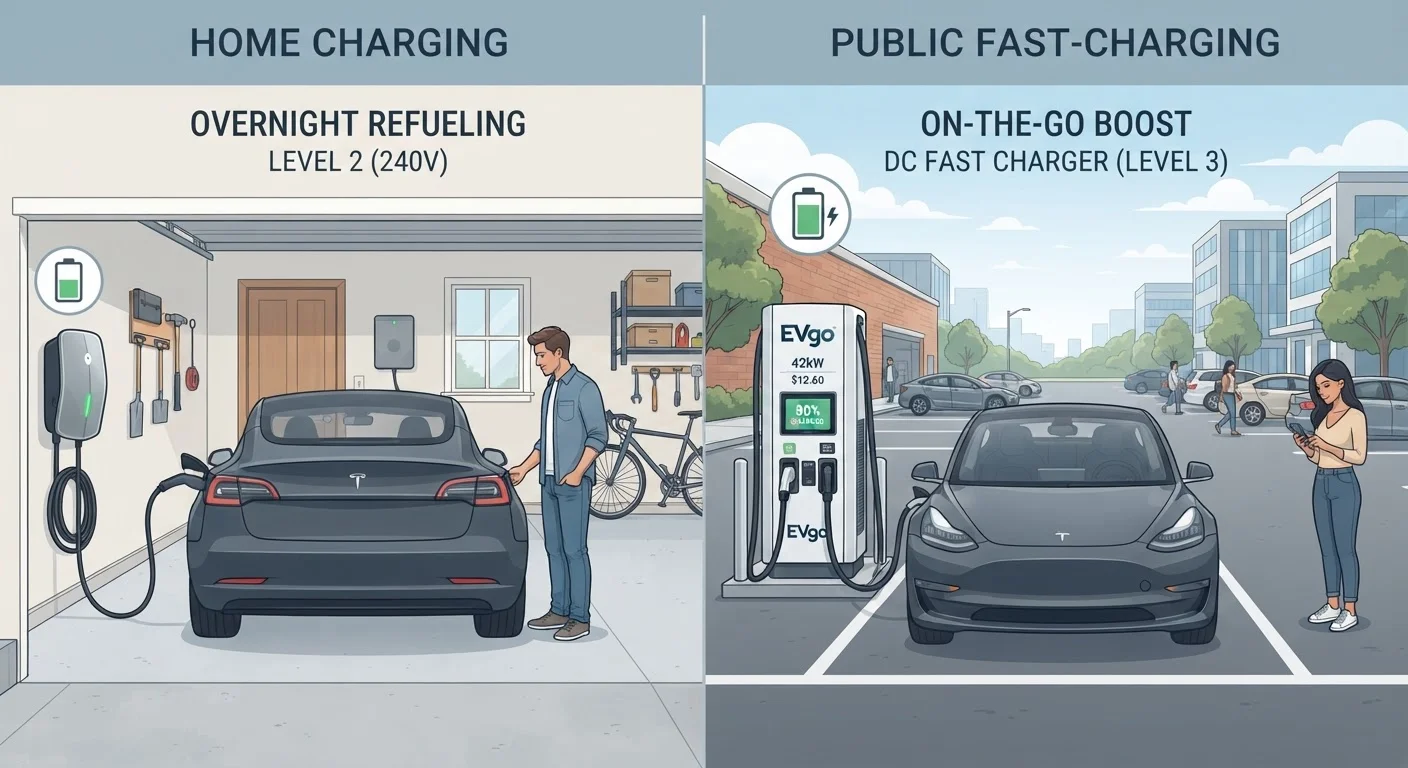
Option A
Home Charging
The convenient, cost-effective daily routine.
Best for: Drivers with a dedicated parking space who want predictable overnight charging at low electricity rates.
Option B
Public Charging Networks
The flexible, on-the-go solution for longer trips.
Best for: EV owners who need rapid mid-trip top-ups, live in apartments, or lack off-street parking.
The Core Difference in How Each Option Works
Home charging and public charging networks both deliver electricity to an EV battery, but they operate in fundamentally different contexts. Home charging - whether a basic Level 1 outlet or an installed Level 2 unit - happens on your schedule, in your space, and draws from your residential electricity account. Public networks are third-party stations located in parking lots, highway rest stops, retail centers, and urban corridors, accessible by any compatible EV driver.
Understanding charging levels is essential here. Level 1 uses a standard 120-volt household outlet and adds roughly 3-5 miles of range per hour - practical only for low-mileage drivers or emergency top-ups. Level 2 runs on 240 volts and can add 20-30 miles per hour, making it the workhorse of home charging. Public DC fast chargers (Level 3) operate at much higher power and can add 100-200 miles in under an hour, though they cost more per session. For a full breakdown, see our guide to charging levels.
| Criterion | Home Charging | Public Charging Networks |
|---|---|---|
| Typical speed | Level 1: 3-5 mi/hr; Level 2: 20-30 mi/hr | Level 2: 20-30 mi/hr; DC Fast: 100-200+ mi/hr |
| Cost per kWh (approx.) | 12-16 cents (residential rate) | 20-60+ cents depending on station type |
| Upfront investment | $800-$2,500+ for Level 2 install | No upfront cost for the driver |
| Availability | Always available at home | Varies by location; may be occupied or offline |
| Long-trip support | Not applicable | Essential for interstate travel |
| Best for apartment dwellers | Generally not accessible | Primary charging option |
Cost: What You Actually Pay Over Time
Cost is where home charging holds its clearest advantage. The average U.S. residential electricity rate hovers around 12-16 cents per kilowatt-hour (kWh), though this varies by state and utility. Public Level 2 stations often charge by the hour or per kWh at rates ranging from 20 to 40 cents per kWh. DC fast chargers can run 40-60 cents per kWh or higher, particularly on premium networks. Over tens of thousands of miles, that difference compounds meaningfully.
The upfront cost equation is reversed, however. Home Level 2 installation - including the charger unit and electrician labor - can run anywhere from $800 to $2,500 or more depending on your panel configuration and local permit requirements. Public charging requires zero upfront investment from the driver. For a fuller picture of what EV ownership costs over time, this breakdown of real EV ownership costs is worth reading.
~80-90%
Share of EV charging done at home
U.S. Department of Energy data consistently shows most EV drivers complete the large majority of their charging at home.
$800-$2,500+
Typical Level 2 home installation cost
Costs vary based on panel capacity, local permits, and labor rates; some utilities offer rebates that reduce out-of-pocket expense.
Convenience, Reliability, and Range Planning
Home charging wins on convenience for daily commuters - you plug in at night and wake up to a full battery without leaving your driveway. Public charging introduces variables: station availability, connector compatibility, network app requirements, and the occasional out-of-service unit. Reliability has improved notably as networks have expanded and utilities have invested in infrastructure, but it remains uneven across regions and providers.
For long-distance travel, public fast-charging networks are simply indispensable. No home charger can address a depleted battery on a 400-mile road trip. The practical reality for most EV owners is a hybrid approach: home charging covers the routine 80-90% of energy needs, while public stations handle road trips and unexpected situations. Drivers without home charging access need to think more carefully about their local network density before purchasing an EV - a point covered in detail in common EV assumptions that lead buyers astray.
A Note on Connector Standards
Connector compatibility is a real-world consideration for public charging. The North American Charging Standard (NACS), originally developed by Tesla, has been adopted by a growing number of automakers, while the Combined Charging System (CCS) remains common on many existing vehicles. Before relying on a specific public network, confirm your vehicle's connector type and whether an adapter is needed. Adapter availability varies by manufacturer and network.
If you're weighing a home charger installation, the right questions to ask before installing a Level 2 charger can help you avoid surprises on permits, panel upgrades, and installation costs.
The content on this site is for informational purposes only and is not a substitute for professional advice. Always consult a qualified professional for guidance specific to your situation.