

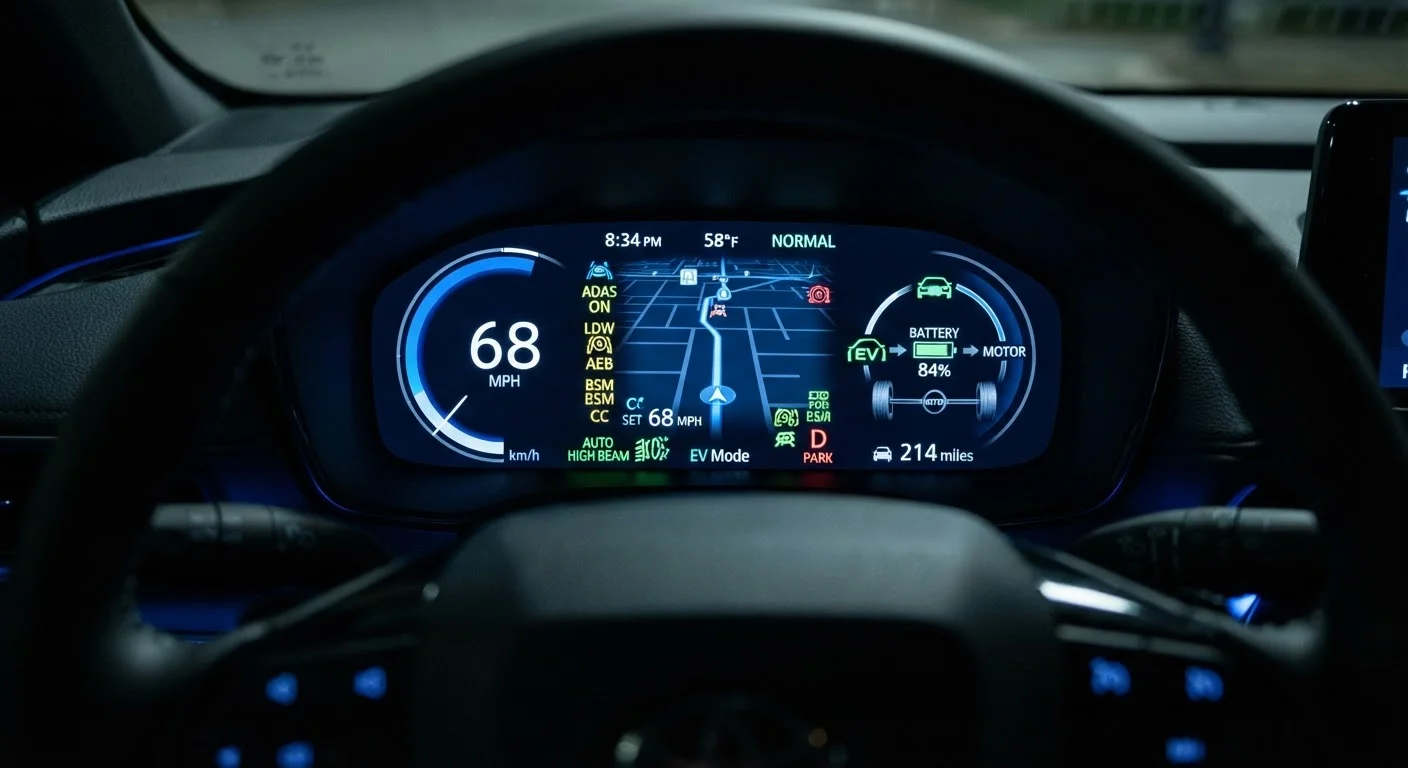
Why the Auto Industry Runs on Abbreviations
Car coverage today reads like an alphabet soup: ADAS, BEV, OTA, V2G, SAE Level 2. Automakers, regulators, and tech journalists lean on acronyms because they're compact shorthand for complex systems - but for everyday drivers, that shorthand often creates more confusion than clarity.
This reference guide decodes the abbreviations appearing most frequently in vehicle reviews, owner's manuals, and dealership conversations. Bookmark it, share it, and come back whenever a new letter combination shows up on your dashboard or in a news headline.
| TPMS federally required since | 2008 (all U.S. passenger vehicles) (NHTSA Federal Motor Vehicle Safety Standard 138) |
| OBD standard port introduced | 1996 (OBD-II) (U.S. EPA mandate) |
| SAE automation levels | 0 through 5 (SAE International J3016 standard) |
| AEB becoming standard | Required on new U.S. light vehicles by 2029 (NHTSA final rule, 2024) |
| EV umbrella covers | BEV, PHEV, FCEV, and HEV (U.S. Department of Energy classification) |
Powertrain Acronyms: HEV, PHEV, BEV, and EV
The electrification spectrum has its own vocabulary, and mixing up these terms leads to real misunderstandings about how a vehicle charges, how far it goes, and what kind of ownership it demands.
- EV (Electric Vehicle) - The broad umbrella. Any vehicle using electric propulsion qualifies, including hybrids.
- HEV (Hybrid Electric Vehicle) - Uses a small battery charged by regenerative braking. Never plugs in. Think of it as a fuel-efficiency upgrade on a conventional car.
- PHEV (Plug-In Hybrid Electric Vehicle) - Larger battery that can be charged externally. Can cover everyday commutes on electricity alone, then switch to gasoline for longer trips.
- BEV (Battery Electric Vehicle) - No combustion engine at all. Range and charging time are the primary ownership considerations.
For a deeper look at how each powertrain works and which driving patterns each suits best, see our powertrain spectrum guide.
Level 2
Most common automation level in new vehicles today
SAE Level 2 means the car can handle steering and speed simultaneously but requires the driver to remain engaged at all times.
2008
Year TPMS became mandatory on all U.S. passenger cars
NHTSA's Federal Motor Vehicle Safety Standard 138 mandated direct or indirect TPMS on all new light vehicles.
~40 miles
Typical all-electric range for a PHEV
According to the U.S. Department of Energy's Alternative Fuels Data Center, most PHEVs offer 20-50 miles of electric-only range before the combustion engine takes over.
Safety and Driver-Assist Acronyms: ADAS, AEB, LiDAR, and SAE Levels
Driver-assistance technology is arguably the fastest-moving segment of the industry, and its abbreviations are everywhere.
- ADAS (Advanced Driver Assistance Systems) - The catch-all term. If a feature uses sensors, cameras, or radar to assist the driver, it's ADAS.
- AEB (Automatic Emergency Braking) - Detects imminent collisions and brakes without driver input. NHTSA finalized a rule in 2024 requiring AEB on new U.S. light vehicles by 2029.
- LiDAR (Light Detection and Ranging) - Laser-based 3D mapping used in advanced automation research and some production vehicles.
- SAE Level - The 0-5 scale defining how much a vehicle can drive itself. Most current new vehicles with driver-assist features sit at Level 2, meaning the car handles steering and speed simultaneously but the driver must stay attentive.
Acronyms vs. Real-World Performance
An acronym tells you what a feature is called, not how well it works in your specific vehicle. ADAS capability, for example, varies significantly between manufacturers and even between trim levels of the same model. Always consult the owner's manual and, where relevant, independent safety ratings to understand exactly what your car's systems can and cannot do.
To understand how specific ADAS features function in daily driving, our driver-assist feature guide walks through each system in plain language. Pairing that knowledge with stronger situational awareness behind the wheel makes driver-assist tech more effective.
Connectivity and Maintenance Acronyms: OBD, OTA, TPMS, and V2G
Beyond drivetrains and safety, a second set of acronyms covers how vehicles communicate - with mechanics, with the cloud, and even with the electrical grid.
- OBD (On-Board Diagnostics) - The standardized port (OBD-II since 1996) that lets scan tools read fault codes. When a check-engine light appears, a mechanic plugs into the OBD port first. Understanding OBD codes is a helpful starting point before any shop visit - see Your Car's Maintenance Schedule, Decoded for context on how diagnostic visits fit into routine upkeep.
- OTA (Over-the-Air) - Software updates pushed wirelessly to vehicle systems. Automakers use OTA to fix bugs, improve features, or address recalls without requiring a dealership trip.
- TPMS (Tire Pressure Monitoring System) - Federally mandated since 2008. A dashboard warning means at least one tire is significantly underinflated - check all four before driving further.
- V2G (Vehicle-to-Grid) - An emerging capability in some EVs that lets the battery supply power back to the home or utility grid, effectively turning the car into a backup power source.
ADAS
Advanced Driver Assistance Systems. An umbrella term for electronic safety and convenience features - such as automatic emergency braking, lane-keeping assist, and adaptive cruise control - that help drivers avoid collisions or reduce workload.
BEV
Battery Electric Vehicle. A car powered entirely by one or more electric motors drawing energy from an onboard battery pack, with no internal combustion engine. It requires external charging to replenish range.
PHEV
Plug-In Hybrid Electric Vehicle. A vehicle that combines a conventional combustion engine with a larger battery than a standard hybrid, allowing it to run on electricity alone for a limited range and be recharged from an external power source.
OBD
On-Board Diagnostics. A standardized system built into vehicles since 1996 that monitors engine and emissions performance, generates fault codes, and allows mechanics (or scan tools) to diagnose problems quickly.
OTA
Over-the-Air update. A software update delivered wirelessly to a vehicle's computer systems - similar to how a smartphone receives app or operating system updates - without requiring a dealership visit.
V2G
Vehicle-to-Grid. A technology that allows a plug-in electric vehicle to send stored battery energy back to the electrical grid or to a home, turning the car into a mobile power source during peak demand or outages.
HEV
Hybrid Electric Vehicle. A vehicle that pairs a combustion engine with a small electric motor and battery that charges through regenerative braking, improving fuel efficiency without ever needing external charging.
TPMS
Tire Pressure Monitoring System. A federally mandated system (required on U.S. passenger vehicles since 2008) that alerts the driver when one or more tires fall significantly below the recommended inflation pressure.
AEB
Automatic Emergency Braking. A safety feature that detects an imminent collision using sensors or cameras and applies the brakes automatically if the driver does not respond in time.
EV
Electric Vehicle. A broad category covering any vehicle propelled primarily or entirely by electric motors, including BEVs, PHEVs, and fuel-cell vehicles.
LiDAR
Light Detection and Ranging. A sensor technology that emits laser pulses to map the vehicle's surroundings in 3D, commonly used in advanced self-driving research and some production vehicles for object detection.
SAE Level
A scale defined by SAE International (formerly the Society of Automotive Engineers) that classifies vehicle automation from Level 0 (no automation) to Level 5 (full self-driving with no human input required under any conditions).
The content on this site is for informational purposes only and is not a substitute for professional advice. Always consult a qualified professional for guidance specific to your situation.