

Why This Distinction Is the Starting Point for Every Budget
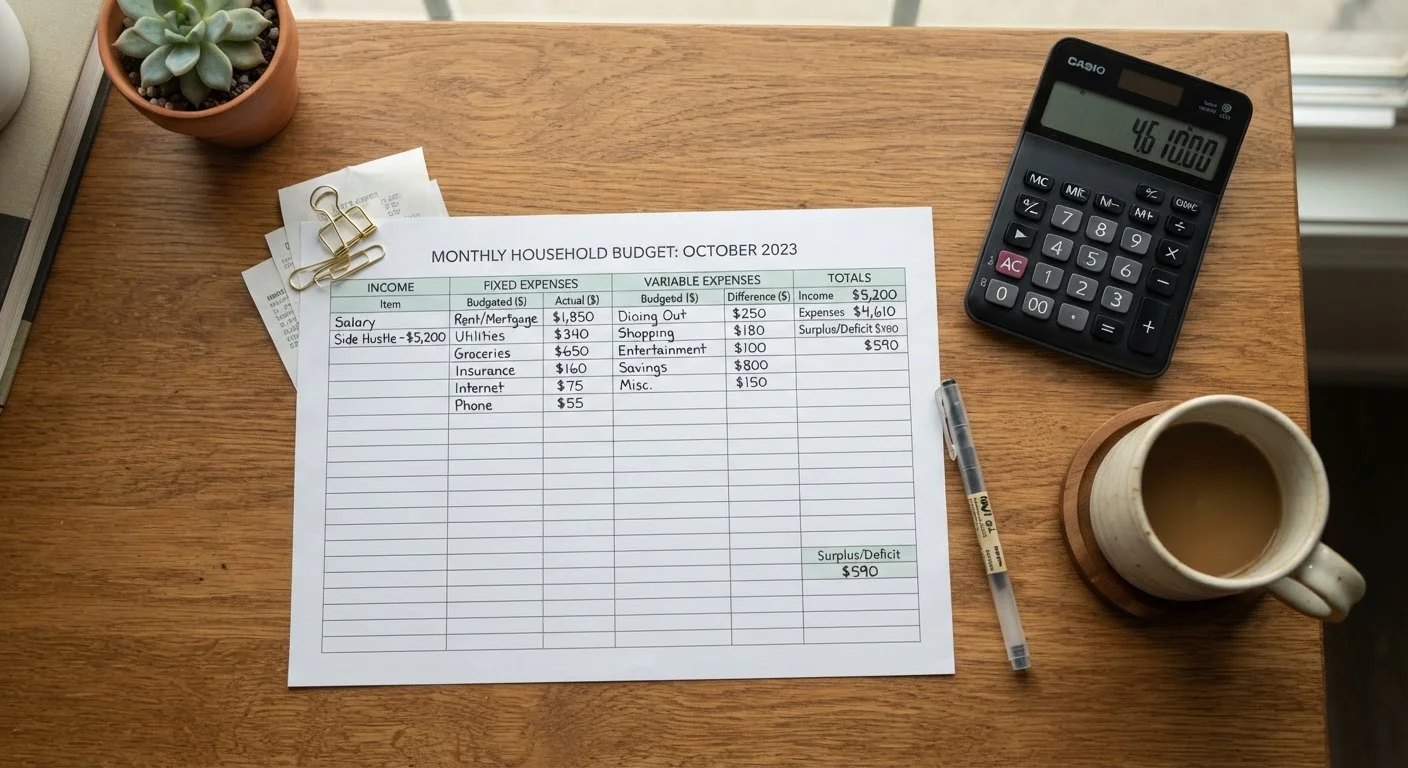
Before you can allocate money wisely, you need to know what you're working with - not just in total, but by type. Lumping all expenses together makes it nearly impossible to identify where you have flexibility and where you don't. That's why splitting costs into fixed and variable categories is the foundation every sound budget is built on.
This isn't abstract financial theory. When a car breaks down or a medical bill arrives, people who know their fixed obligations versus their flexible spending can make a fast, confident decision. Those who don't often turn to credit by default - not because they earned less, but because they lacked a clear picture of their numbers. For a broader look at essential budgeting concepts, see this plain-language glossary.
~33%
Average share of income spent on housing alone
The U.S. Bureau of Labor Statistics Consumer Expenditure Survey consistently finds housing accounts for roughly one-third of average household spending - the single largest fixed expense category.
$227/mo
Average American spending on dining out
Federal Reserve and BLS consumer expenditure data suggest Americans spend meaningfully on food away from home - one of the most common variable categories cited when households try to reduce spending.
Fixed Expenses: The Non-Negotiables in Your Budget
Fixed expenses are costs you've already committed to - contractually or structurally - and that don't change based on how much you use a service. Common examples include:
- Rent or mortgage payment
- Auto loan or lease payments
- Insurance premiums (health, auto, renters, life)
- Minimum debt payments (student loans, personal loans)
- Subscription services billed at a flat monthly rate
The predictability of fixed expenses is both an advantage and a constraint. They're easy to plan around because the number doesn't move. But they're also the hardest to reduce quickly - renegotiating a lease or refinancing a loan takes time, paperwork, and sometimes fees. That said, even small wins here compound significantly: dropping one $80-per-month subscription you never use saves nearly $1,000 over a year without any ongoing willpower required.
Audit Your Fixed Expenses Once a Year
Set a calendar reminder to review every fixed commitment annually - subscriptions, insurance policies, loan rates, and recurring memberships. Many of these can be renegotiated, canceled, or replaced with lower-cost alternatives. A single annual audit often surfaces $50-$150 in monthly savings that had quietly gone unnoticed.
Variable Expenses: Where Your Daily Decisions Live
Variable expenses fluctuate with your choices and circumstances. This category is where most people have the most immediate room to maneuver. Common examples include:
- Groceries and household supplies
- Dining out and coffee
- Gas and transportation costs
- Clothing and personal care
- Entertainment and hobbies
Variable spending isn't inherently bad - it includes genuine necessities like food. But it's also where spending tends to drift unnoticed. A useful habit is to review variable categories weekly rather than monthly; by the time a monthly statement arrives, overspending has already happened.
Once you understand your variable patterns, you're ready to apply a structured method. Zero-based budgeting is particularly effective at reining in variable categories because it forces a deliberate decision about every dollar before the month begins. If you want to compare approaches, this comparison of zero-based budgeting and the envelope method walks through the trade-offs.
Semi-Variable Expenses and How to Handle Them
Not every expense fits neatly into one of two boxes. Utilities - electricity, water, gas - are predictable in that you'll owe something each month, but the amount shifts with usage and season. The same is true of medical copays, childcare overages, and variable-rate loan interest.
A practical approach: pull 12 months of past statements, calculate the monthly average, and budget to that average. In low-cost months, the surplus rolls into a small buffer. In high-cost months, the buffer absorbs the spike. This smoothing technique prevents semi-variable bills from blowing up a budget that otherwise runs on time.
Periodic Expenses Need Their Own Category
Annual or quarterly bills - car registration, insurance lump sums, holiday spending - are predictable but easy to forget when building a monthly budget. Creating a dedicated 'sinking fund' line item for these irregular costs, funded monthly in small increments, prevents them from appearing as emergencies when they arrive.
Once you have all three categories mapped out - fixed, variable, and semi-variable - you have everything you need to build your first complete household budget from scratch.
This article is for general informational and educational purposes only and does not constitute personalized financial advice. Consult a qualified financial professional for guidance specific to your situation.
Frequently Asked Questions
Fixed expenses stay the same each month regardless of your behavior - rent and loan payments are classic examples. Variable expenses change based on usage or choices, such as groceries, gas, or entertainment. Knowing which is which helps you identify where you have control in your budget.
Variable expenses are typically easier to reduce in the short term because they're tied to daily choices. However, eliminating a single fixed expense - like canceling an unused subscription - delivers recurring savings every month without ongoing effort.
Utilities are generally considered semi-variable - you owe something every month, but the amount shifts with usage and season. A common budgeting strategy is to average the past 12 months of utility bills and treat that average as your monthly budget number.
Irregular expenses fit best into a separate 'sinking fund' - a dedicated savings category you contribute to monthly. Divide your expected annual cost by 12 and set that amount aside each month so the money is there when the bill arrives.
Yes. Mapping your fixed costs first shows your true minimum monthly obligation, and anything left from variable categories can be redirected toward debt. This clarity is foundational to strategies like the debt avalanche or debt snowball.
The content on this site is for informational purposes only and is not a substitute for professional advice. Always consult a qualified professional for guidance specific to your situation.