

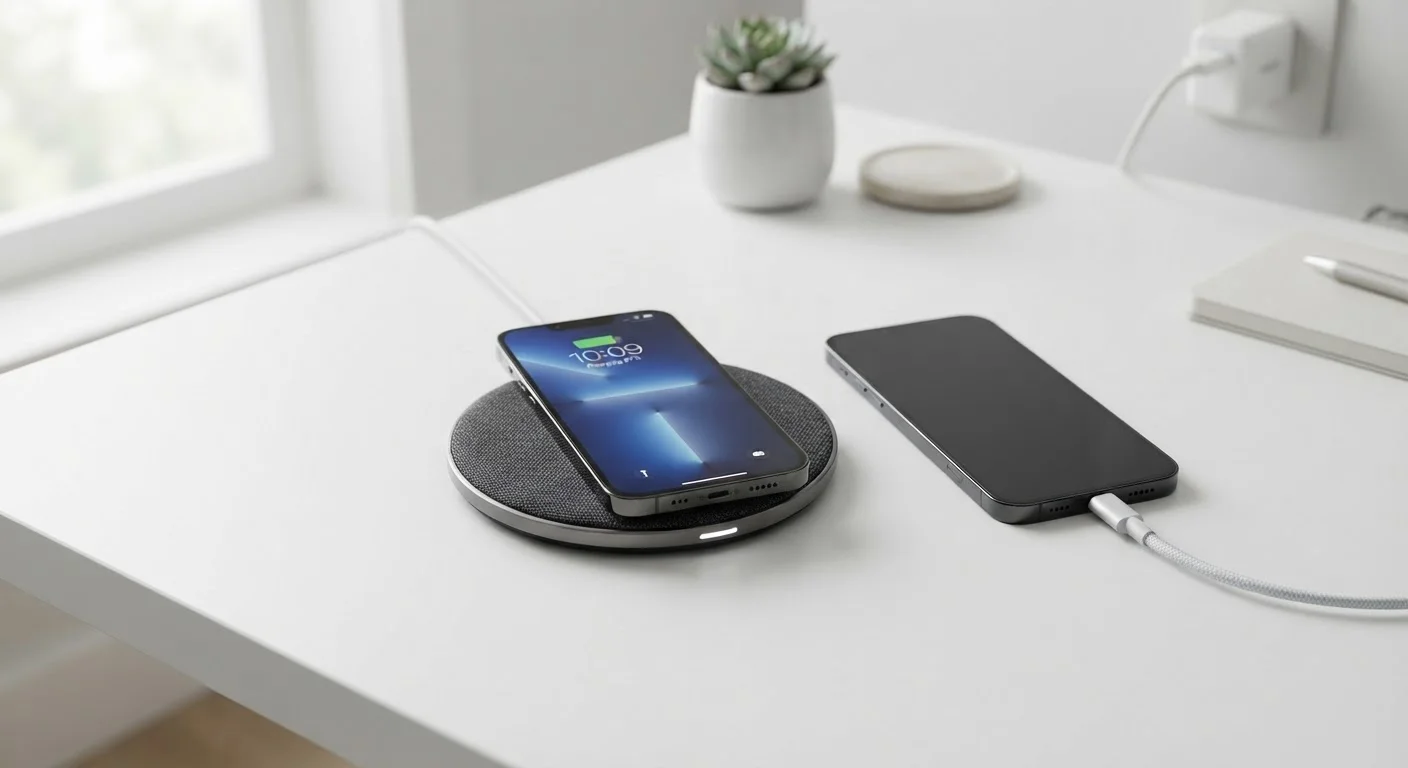
Option A
Wired Charging
The fast, efficient, time-tested standard.
Best for: Anyone who needs a reliable, rapid top-up and wants to minimize long-term battery wear.
Option B
Wireless Charging
The cable-free convenience option.
Best for: Users who prioritize effortless, low-friction charging at a desk or nightstand and can tolerate slower speeds.
The Speed Gap Is Real - But Context Matters
Wired charging moves electricity more directly and efficiently. A USB-C cable connected to a 30W or 65W adapter can dramatically cut charge times compared to a wireless pad rated at 7.5W or 15W. Even the highest-end wireless standards (some reaching 50W in controlled conditions) tend to transfer less usable energy per minute once conversion losses are accounted for.
The real-world gap is less about the technology's theoretical ceiling and more about what ships in the box and what most people actually use. Many wireless pads sold today operate at 5W-15W. A modern phone using a compatible fast-charge wired adapter can far exceed that. If you're regularly charging from 20% to 80% before heading out, wired is the straightforward winner for speed.
| Criterion | Wired Charging | Wireless Charging |
|---|---|---|
| Typical consumer speed | 18W-65W+ common | 7.5W-15W most pads |
| Energy efficiency | Higher (less conversion loss) | Lower (inductive losses) |
| Heat generated at battery | Lower at comparable rates | Higher due to conversion |
| Long-term battery impact | Less thermal stress | More thermal stress over time |
| Convenience | Requires cable connection | Drop-and-charge simplicity |
| Works during active use | Yes, without added heat risk | Generates more heat when combined |
| Device compatibility | Requires matching port/protocol | Requires Qi-compatible device |
Speed also depends heavily on cable quality and charger compatibility. A mismatched cable or a charger that doesn't negotiate the right protocol with your phone can bottleneck a wired connection just as badly as a slow pad. For a broader look at how charging specs translate into practical behavior, small habits around charging can make a measurable difference in daily performance.
Heat: The Hidden Variable in Battery Health
Lithium-ion batteries degrade faster when exposed to elevated temperatures during charging. This is where wireless charging has a genuine disadvantage. Inductive charging - the technology behind wireless pads - works by transferring energy through electromagnetic fields, and that conversion process is inherently less efficient than a direct electrical connection. The energy lost in translation becomes heat, some of which ends up absorbed by the battery.
Wired charging isn't entirely heat-free, especially at very high wattages, but the thermal load at the battery is generally lower for comparable charge rates. Charging a phone while it's sitting in a hot car, tucked under a pillow, or inside a thick case amplifies heat regardless of method.
What 'Battery Health' Actually Means
Most modern smartphones display a battery health percentage that reflects remaining charge capacity relative to original design capacity. A battery at 80% health holds 80% of what it held when new. Heat, frequent full discharges, and very high charge rates all accelerate the decline of this figure. Manufacturers generally consider 80% health after several hundred full charge cycles a normal range - not a defect.
Over two to three years of daily use, the compounding effect of slightly elevated temperatures during wireless charging can contribute to measurable capacity loss - though the magnitude varies by device, pad quality, ambient temperature, and usage patterns. No single charge session causes dramatic harm; it's the aggregate that matters.
Battery health is a broader topic that extends well beyond charging method. If you're curious how this applies to smaller devices, the same principles show up in how earbud battery figures don't tell the whole story.
Practical Trade-Offs for Daily Use
Wireless charging shines in low-friction, habitual scenarios: placing a phone on a pad at a desk or nightstand without thinking about it. There's real value in that convenience, especially for overnight charging where speed is irrelevant. Many people find they top up more consistently with a pad simply because there's no cable to connect.
Wired charging wins on flexibility and reliability. It works with any phone that has a functioning port, requires no alignment, and doesn't leave you wondering whether the phone actually made contact overnight. It also works while actively using the device without the heat buildup that occurs when wireless charging and screen-on use combine.
~80%
Typical wireless charging energy efficiency
Inductive charging systems commonly transfer around 80% of drawn power to the battery; wired systems routinely exceed 90% efficiency under typical conditions.
500-800
Full charge cycles before notable capacity loss
Most lithium-ion phone batteries are designed to retain roughly 80% capacity after this range of full cycles, though heat and partial-charge habits affect actual outcomes.
For context on how wired-versus-wireless trade-offs play out in a different domain, the same tension between convenience and consistency applies to wired vs. wireless smart home devices.
One practical recommendation: use wireless charging for unhurried overnight or desk sessions, and keep a wired charger available for quick top-ups when time is limited. This hybrid approach gets the convenience benefit while limiting wireless heat exposure during the most heat-sensitive charging cycles - partial charges at high rates.
The content on this site is for informational purposes only and is not a substitute for professional advice. Always consult a qualified professional for guidance specific to your situation.