

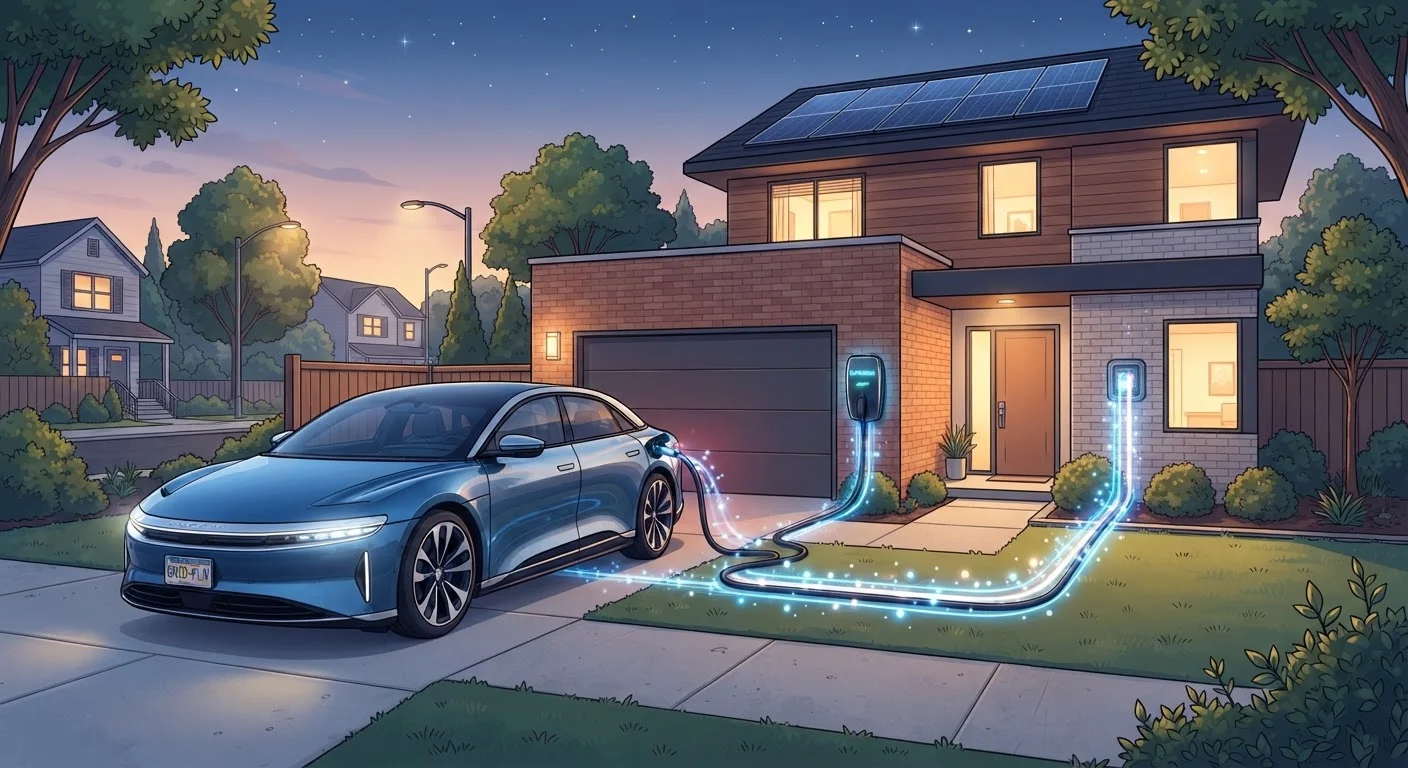
The Basic Idea: Your Car as a Power Source
Most EV owners think of their vehicle as a device that consumes electricity. V2G and V2H flip that model. When your car is parked and plugged in - which, for most drivers, accounts for the majority of its day - its large battery pack could be doing more than just waiting for the next trip.
With Vehicle-to-Home (V2H), stored energy flows from the EV battery through a compatible charger and into your household circuits. With Vehicle-to-Grid (V2G), that energy travels further - out to the broader utility grid, where it can help balance supply and demand in real time.
Think of it as your EV doubling as a rolling power bank - one with a capacity that often rivals or exceeds dedicated home battery storage units. Understanding how these two technologies differ from standard charging is a useful starting point for any EV owner curious about what their vehicle might eventually do beyond transportation. For background on how EVs differ from hybrids and plug-in hybrids at the powertrain level, see our powertrain guide.
~60-100 kWh
Typical EV battery capacity range
Many current long-range EVs carry battery packs in this range, which can represent several days of average U.S. household electricity use under moderate consumption conditions.
29 kWh
Average U.S. daily household electricity use
According to the U.S. Energy Information Administration, the average American home used approximately 29 kWh per day in recent years, highlighting how much a large EV battery could theoretically offset.
What Makes Bidirectional Charging Different
Standard EV charging is a one-way street: AC power from the grid enters your car's onboard charger, gets converted to DC, and charges the battery. Bidirectional charging adds a return lane. The car's system must convert DC battery power back to AC and push it outward through the charging port.
This requires hardware that isn't universal. Not every EV has a bidirectional-capable onboard charger, and even those that do may need a specific type of charging equipment at home - called a bidirectional EVSE (Electric Vehicle Supply Equipment). The communication protocols between the car and the charger also need to match, which is why compatibility checking is essential before assuming any EV can do this.
Check Compatibility Before Assuming Capability
Bidirectional charging is not a feature you can add to an existing EV after purchase - it depends on the vehicle's onboard hardware. If V2G or V2H capability matters to you, verify it explicitly with the manufacturer for any specific model and model year you're considering. Also confirm that the home charging equipment you plan to install supports bidirectional operation.
For homeowners already weighing charger installation decisions, questions to ask before installing a Level 2 charger covers the infrastructure considerations that also apply when planning for bidirectional capability.
Real-World Applications and Current Limitations
V2H's most practical near-term use case is backup power. During a grid outage, a compatible EV with enough charge can power essential home circuits - lights, refrigerator, medical devices - for hours or even days depending on usage and battery capacity. This requires a transfer switch to safely isolate the home from the grid, a job for a licensed electrician.
V2G's potential is larger in scope but harder to access today. Utilities would need to build programs that compensate drivers for contributing to grid stability, and the infrastructure for this remains limited in most U.S. markets. Pilot programs exist in some regions, but widespread adoption is still developing.
There are also open questions about battery longevity. Regularly discharging a vehicle battery deeply for home or grid use adds cycles beyond normal driving. Automakers and independent researchers are actively studying how much real-world impact this has, and some systems set discharge limits to help protect the battery. This uncertainty is worth factoring into any decision. For broader context on EV ownership assumptions, common EV assumptions worth questioning is a useful read.
For drivers thinking about the broader home energy picture, home tech resources explore how connected devices - including EV chargers - fit into a smarter household energy setup. And for those still sorting out the fundamentals of charging at home versus on the road, home charging vs. public charging provides a practical comparison.
Frequently Asked Questions
A growing but still limited number of EVs support bidirectional charging. Some models from Nissan, Ford, Hyundai, Kia, and GM have offered or announced V2H or V2G capability, but compatibility depends on the specific model year and trim. Always verify with the manufacturer and confirm your home equipment supports it.
This is a legitimate concern. Repeated deep discharge cycles can accelerate battery degradation over time. Many automakers and researchers are studying this, and some systems limit discharge depth to protect the battery. Managing how often and how deeply you discharge is advisable.
You typically need a bidirectional EV charger (often called a bidirectional EVSE), a compatible vehicle, and potentially a transfer switch to safely isolate your home from the grid during outages. Installation should be handled by a licensed electrician.
Some utility programs do offer compensation or credits for V2G participation, but availability varies significantly by state and utility provider. Check directly with your local utility to see whether a V2G program exists in your area.
They serve a similar purpose - providing stored energy to your home - but differ in how they work. A dedicated home battery is always stationary and available, while V2H relies on your car being plugged in. V2H can be a cost-effective alternative if you already own a compatible EV.
It can, provided the system includes a transfer switch that disconnects your home from the grid first - a critical safety step. Without this isolation, power exported from your car could endanger utility workers. Never attempt to implement a DIY solution; work with a qualified installer.
The content on this site is for informational purposes only and is not a substitute for professional advice. Always consult a qualified professional for guidance specific to your situation.