

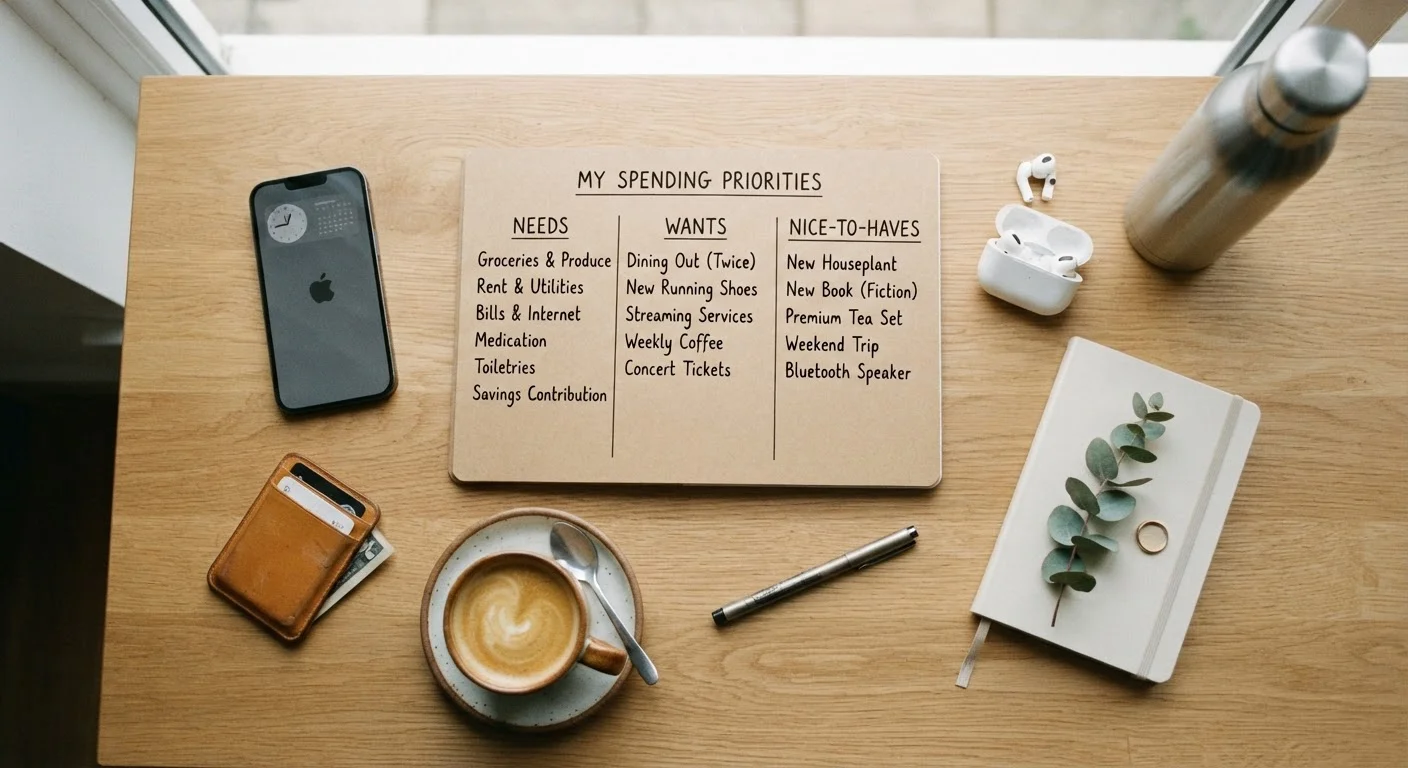
Why Your Cart Needs a Sorting System
Most purchase regret doesn't happen because people buy the wrong thing - it happens because they skip the step of asking why they're buying it at all. Without a sorting system, every product on a shelf or in a browser tab competes equally for your attention and your dollars.
The needs-wants-nice-to-haves framework gives you a fast, repeatable filter. Before you evaluate price, features, or reviews, you first answer one question: which tier does this belong in? That single classification changes how you read every spec sheet and sale tag that follows.
This isn't about restriction. It's about sequencing. When your needs are covered first, wants become guilt-free. And when wants are covered, you can decide clearly whether a nice-to-have is worth the trade-off - rather than discovering that answer after the purchase. For a practical complement to this approach, see how opportunity cost shapes spending priorities.
72%
Shoppers who report buyer's remorse
According to a survey by CreditCards.com, nearly three in four Americans report experiencing buyer's remorse at some point - most commonly after impulse purchases.
47%
Purchases driven by impulse, not planning
A consumer behavior study published by the National Retail Federation found that nearly half of all retail purchases are unplanned at the time of store entry.
Breaking Down the Three Tiers
Needs
A need solves a specific, concrete problem that affects your daily function, safety, or health. Needs have clear failure modes - without them, something important breaks down. A winter coat in a cold climate is a need. Reliable transportation to work is a need. The bar is functional, not aspirational.
Wants
Wants meaningfully improve your quality of life beyond the bare minimum. They're justified upgrades - things that make your day noticeably better in ways you'd genuinely feel if they were absent. A comfortable mattress after years of back pain qualifies as a want with strong justification. A faster laptop for someone who edits video professionally is a want that borders on a need.
Nice-to-Haves
Nice-to-haves are features, upgrades, or items that add appeal without adding proportional value. They're the premium color option, the extended warranty you'll rarely use, the appliance model with a screen when a dial would do the same job. Nice-to-haves aren't bad purchases - they're just lowest priority, and they're where most budget creep originates.
Putting the Framework Into Practice
Before any significant purchase, write down your primary use case in one sentence. Then list the features or specifications that directly serve that use case - those are your needs. Add features that would noticeably improve your experience - those are your wants. Everything else goes in the nice-to-have column.
Now set a budget ceiling that covers your needs fully and your top wants selectively. If a product requires moving into nice-to-have territory to justify its price, that's a signal to either wait or look at alternatives. Setting a firm budget often leads to better purchase outcomes, not just cheaper ones.
Write It Down Before You Shop
The framework works significantly better on paper than in your head. Before browsing, write one sentence describing what problem you're solving, then list your needs and wants separately. Shoppers who externalize this sorting step are less likely to let in-store or online presentation shift nice-to-haves into the wants column. A 90-second exercise can prevent hours of post-purchase second-guessing.
Once you've sorted your tiers, run your shortlisted options through a pre-purchase check. Our pre-purchase checklist helps confirm you're spending with intention before you reach the checkout.
Frequently Asked Questions
Ask yourself: would I still solve my core problem without this feature or item? If yes, it's likely a nice-to-have. Wants tend to meaningfully improve your experience, while nice-to-haves offer marginal or situational gains that rarely justify the extra cost.
Absolutely. A smartphone was once a want; for many people today it functions as a need. Life circumstances - a new job, a health change, a move - regularly reprioritize what belongs in each category. Revisit your framework whenever your situation changes significantly.
Yes, though it's most impactful for purchases above your personal 'pause threshold' - the dollar amount where a wrong decision genuinely stings. For minor purchases, a quick mental check is enough; save the written exercise for bigger decisions.
Test the claim: what specific, concrete problem does this solve? If your answer relies heavily on emotion or social comparison ('everyone has one' or 'I deserve it'), that's a signal you're in want or nice-to-have territory. Needs have clear, functional answers.
Yes - when your needs and core wants are funded and the purchase fits comfortably within your budget without displacement. The framework isn't about denial; it's about sequencing spending intentionally so nice-to-haves don't crowd out necessities.
The content on this site is for informational purposes only and is not a substitute for professional advice. Always consult a qualified professional for guidance specific to your situation.