

How DTI Is Calculated
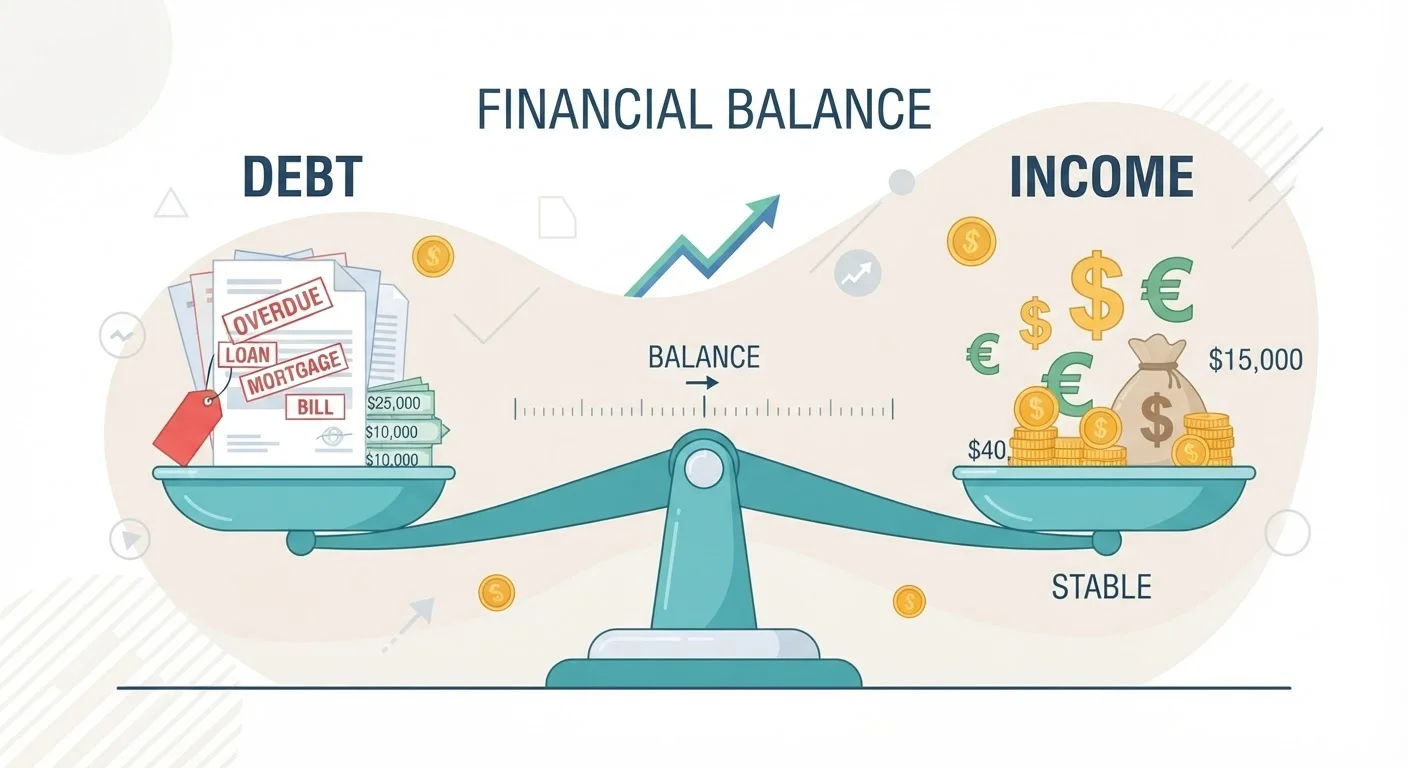
The math is straightforward. Add up all your minimum required monthly debt payments, then divide that total by your gross monthly income. Multiply by 100 to get a percentage.
Example: If your monthly debt obligations total $1,800 - including a car payment, student loan, and minimum credit card payments - and your gross monthly income is $6,000, your DTI is 30% ($1,800 ÷ $6,000 × 100).
What counts as "debt" in this calculation? Recurring, obligated monthly payments: mortgage or rent, auto loans, student loans, credit card minimums, personal loans, and court-ordered payments like alimony or child support. What doesn't count: utilities, groceries, insurance, streaming services, or other variable living expenses.
For a full glossary of the terms that show up in this calculation - like amortization, minimum payment, and gross income - see our personal finance terms reference.
43%
Common maximum back-end DTI for conventional mortgages
The Consumer Financial Protection Bureau (CFPB) identifies 43% as a historically significant DTI threshold in qualified mortgage standards.
36%
DTI level many lenders consider financially healthy
Financial guidance from multiple housing and lending sources cites 36% or below as a generally favorable back-end DTI for borrowers.
28%
Typical front-end DTI ceiling for housing costs
Conventional mortgage guidelines commonly use 28% as the guideline for how much gross income should go toward housing-related payments.
Why Lenders Weight DTI So Heavily
A credit score tells a lender how reliably you've repaid debt in the past. DTI tells them whether you have the current cash flow to take on something new. Both matter, but they answer different questions.
When a lender evaluates a mortgage application, they typically look at two DTI figures: the front-end ratio (just housing costs - principal, interest, taxes, and insurance - as a share of income) and the back-end ratio (all monthly debt obligations combined). Conventional mortgage guidelines commonly target a front-end ratio no higher than 28% and a back-end ratio no higher than 36-43%, though specific thresholds vary by loan type and lender.
The logic is intuitive: if 55 cents of every pre-tax dollar is already committed to debt payments, there's little cushion for an unexpected expense, much less a missed paycheck. Lenders price that risk into their approval decisions - and when they do approve, a high DTI often means less favorable terms.
“Lenders aren't just asking whether you've paid your bills on time - they're asking whether you'll be able to keep paying them if something changes. Debt-to-income ratio is how they answer that second question.”
— Consumer Financial Protection Bureau, U.S. federal agency overseeing consumer financial products and mortgage lending standards
Practical Ways to Improve Your DTI
You have two levers: reduce the numerator (total debt payments) or increase the denominator (gross income). In practice, most households work both simultaneously.
Reduce monthly debt obligations
- Pay down revolving balances: Credit cards don't have fixed terms - eliminating a balance removes the minimum payment from your DTI immediately.
- Avoid new debt before a major application: Every new loan or line adds a payment. Timing matters if you're planning a mortgage application in the next 6-12 months.
- Refinance at a longer term (with caution): Extending a loan term lowers the monthly payment and improves DTI, but increases total interest paid. This trade-off deserves careful thought.
Increase verifiable income
Lenders generally require income to be stable and documentable - typically two years of history for self-employment or variable income. A raise, a part-time role, or rental income can all raise your denominator, but the timing of when lenders will count it matters.
Time Your Applications Strategically
If you're planning a major loan application - especially a mortgage - try to avoid taking on any new debt in the 6-12 months prior. Even a new car loan or credit card, each adding a minimum payment, can push your DTI above a qualifying threshold. Give yourself a window to pay down balances and stabilize your monthly obligations before underwriters review your file.
Deciding whether to aggressively pay down debt or redirect cash toward savings is a closely related question. See our guide on prioritizing debt payoff vs. savings for a framework. And if you're managing these decisions with a partner, coordinating debt paydown as a household adds another layer of strategy worth exploring.
This article is for general informational purposes only and does not constitute personalized financial or lending advice. Consult a licensed financial professional for guidance specific to your situation.
Frequently Asked Questions
Most lenders consider a DTI below 36% healthy, with housing costs ideally under 28% of gross income. A DTI above 43% can make mortgage qualification difficult, though some loan programs allow higher thresholds. The lower your DTI, the more options you generally have.
No - DTI is not a factor in credit score calculations. Credit bureaus don't have visibility into your income, so your score reflects credit behavior only. However, both DTI and credit score are evaluated separately during loan underwriting.
Recurring monthly debt obligations count: mortgage or rent payments, auto loans, student loans, minimum credit card payments, personal loans, and child support or alimony. Utilities, groceries, insurance premiums, and subscriptions are typically excluded.
Paying down existing balances - especially revolving debt like credit cards - reduces your monthly minimum obligations. Avoiding new debt before a loan application also helps. A side income increase takes longer to verify but raises your denominator, improving the ratio.
Lenders use gross income - your earnings before taxes and deductions. This is important because it typically produces a higher base number than take-home pay, which means your DTI percentage will look lower than it might feel in practice when budgeting month-to-month.
The content on this site is for informational purposes only and is not a substitute for professional advice. Always consult a qualified professional for guidance specific to your situation.