

Our Verdict
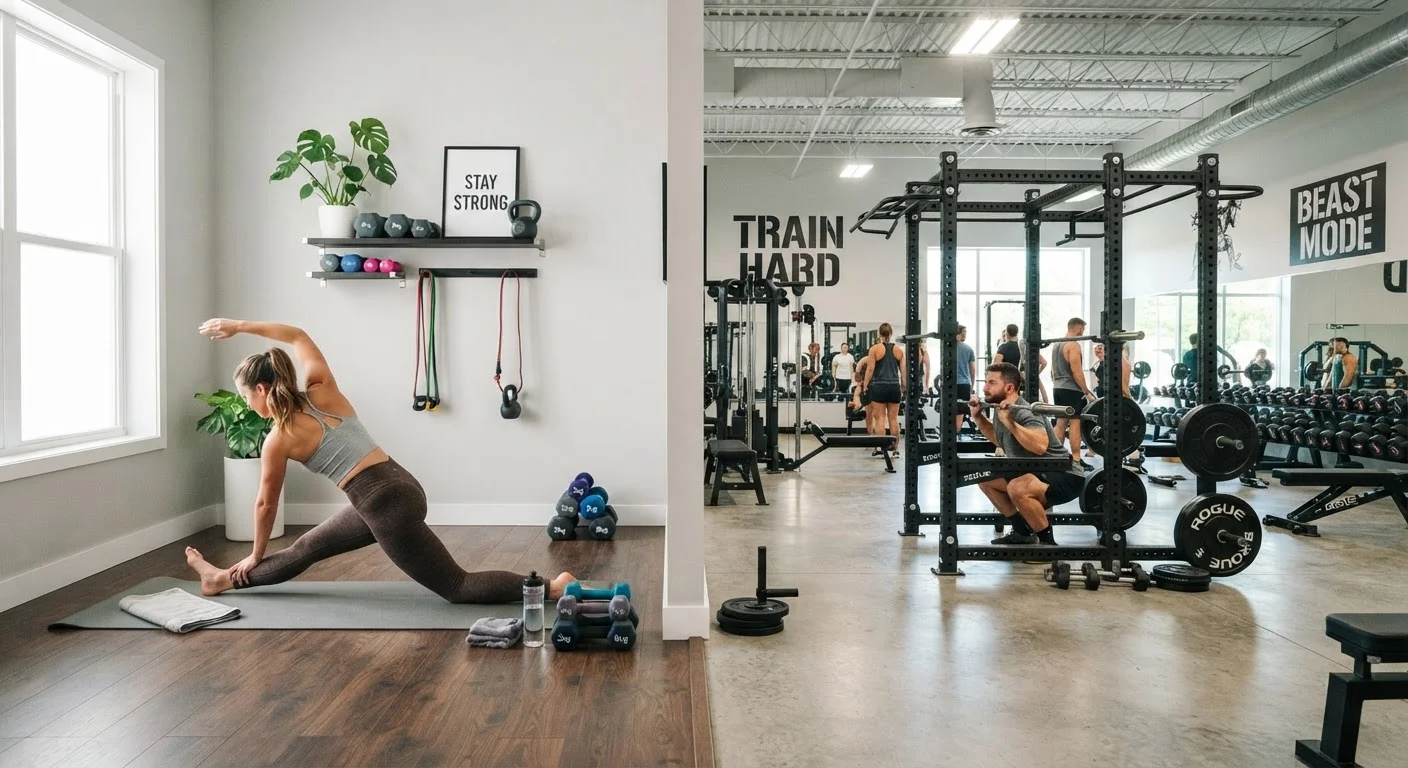
Home and gym training each carry genuine strengths and real limitations. For most people, the deciding factors are consistency, access, and personal motivation style - not which setting is objectively better. Research supports that people who train regularly, regardless of location, achieve meaningful fitness outcomes.
| Best for | Recommended |
|---|---|
| Those with busy schedules or limited commute time | Home Training |
| Those pursuing advanced strength or sport-specific goals | Gym Training |
| Beginners building an exercise habit without high upfront cost | Home Training |
| People who thrive on social environment and coaching access | Gym Training |
What the Research Actually Says About Training Location
A common assumption is that gym training produces superior results because of the equipment available. The evidence is more nuanced. Studies on resistance training consistently show that progressive overload - gradually increasing challenge over time - is the primary driver of strength and muscle adaptation, not the specific tools used to achieve it. Bodyweight progressions, resistance bands, and a modest set of dumbbells can generate that overload effectively for a wide range of fitness goals.
Where setting does matter is in its effect on adherence. A 2019 review published in Health Psychology Review identified convenience and perceived barriers as two of the strongest predictors of whether people maintain an exercise habit long-term. If a 30-minute round-trip to the gym is the difference between working out and skipping, that friction has real consequences over months and years.
For context on how training type interacts with your physiology, see our breakdown of strength training vs. cardio.
The Real Costs: Time, Money, and Space
| Home Training | Gym Training | |
|---|---|---|
| Upfront Cost | Moderate (equipment purchase) | Low (membership only) |
| Ongoing Cost | Minimal after setup | Monthly membership fee |
| Time Efficiency | High - no commute | Lower - travel and wait times |
| Equipment Variety | Limited by space and budget | Extensive, regularly maintained |
| Privacy | Complete | Shared public environment |
| Coaching Access | Self-directed or online only | In-person trainers available |
| Advanced Training Ceiling | Lower for heavy lifting | High across disciplines |
| Consistency Barrier | Low - always available | Higher - requires travel |
Gym memberships in the U.S. typically run anywhere from roughly $10 to over $100 per month, depending on facility type and location. That's a predictable recurring cost with no upfront equipment investment. Home training shifts the model: the initial spend on equipment - even a basic setup of adjustable dumbbells, a mat, and resistance bands - can run several hundred dollars, but there are no ongoing fees once purchased.
Time costs are often underestimated in this comparison. Commuting to and from a gym, dealing with peak-hour wait times for equipment, and changing facilities all add 20-45 minutes to a session. For people with early mornings or lunch-break windows, that overhead can make gym training structurally impractical several days a week.
Space is the home trainer's main constraint. Effective bodyweight and dumbbell training requires surprisingly little floor area - roughly a 6x6 foot clear zone - but heavier barbell work or a full cable setup demands dedicated room that most homes and apartments cannot accommodate.
~$58/mo
Average U.S. gym membership cost
The International Health, Racquet & Sportsclub Association (IHRSA) has reported average monthly gym membership fees in the U.S. consistently fall in the $40-$70 range depending on facility type.
67%
Gym members who rarely attend
Industry analyses have estimated that a substantial majority of gym members use their memberships infrequently, underscoring how paid access does not automatically produce adherence.
Equipment Access and Training Ceiling
Home training has a ceiling that becomes more apparent as fitness levels advance. Progressing on a barbell squat, performing machine-assisted isolation work, or following a periodized powerlifting program typically requires equipment that isn't practical to replicate at home without significant investment. For intermediate and advanced lifters with specific performance goals, the gym's range of resistance levels and modalities is a meaningful advantage.
That said, many people never approach that ceiling. General health, body composition, cardiovascular fitness, and functional strength - the goals most adults actually pursue - are all achievable with moderate home setups. Calisthenics progressions, for instance, can develop substantial upper-body strength without a single piece of weighted equipment. If you incorporate higher-intensity formats, our guide to HIIT's real strengths and limitations is a useful companion read.
Consider a Hybrid Approach
Many people find that combining both settings removes the either/or pressure entirely. Home training on weekday mornings for time efficiency, paired with gym sessions on weekends for heavier lifts or classes, can capture the core advantages of both. Start by identifying which days convenience matters most and build your schedule around those friction points first.
Motivation, Accountability, and Environment
Environment shapes behavior more reliably than willpower. For some people, stepping into a gym signals a mental shift into workout mode - the ambient energy, the social atmosphere, and the presence of other people training all reduce the internal negotiation that often derails home sessions. Access to personal trainers and group classes also provides structured accountability that's hard to replicate independently.
For others, the gym environment creates anxiety, self-consciousness, or a sense of being watched - factors that research identifies as legitimate barriers, particularly for beginners. The privacy of a home workout space removes those pressures entirely and can make it far easier to experiment, make mistakes, and build baseline confidence before considering a gym.
Neither motivation style is superior - they're just different. The honest question is which setting makes you more likely to show up consistently over the next six months, not which one you feel more virtuous choosing.
This article is for general informational and educational purposes only. It is not a substitute for professional medical or fitness advice. Consult a qualified healthcare provider or certified fitness professional before beginning any new exercise program, especially if you have existing health conditions or injuries.
The content on this site is for informational purposes only and is not a substitute for professional advice. Always consult a qualified professional for guidance specific to your situation.