

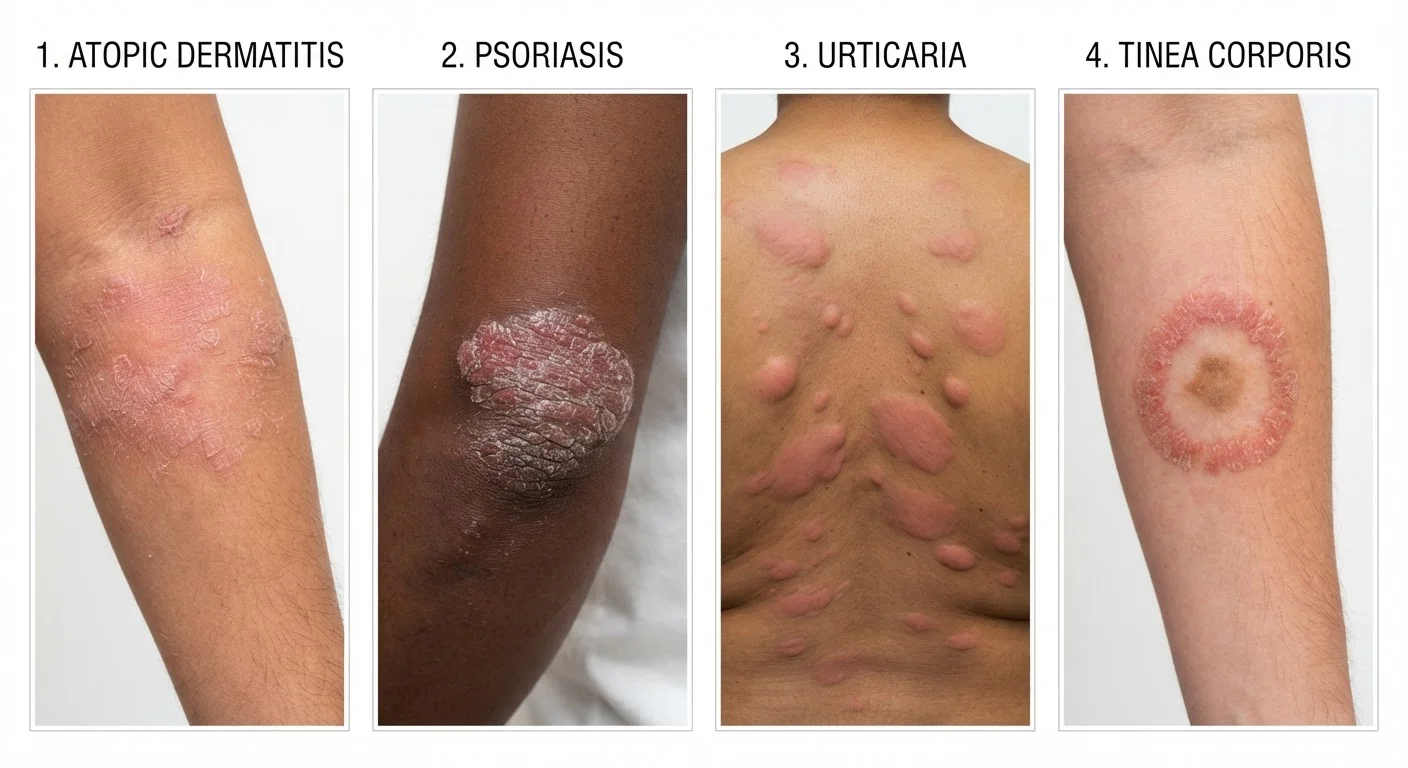
Our Verdict
While these four rashes can look remarkably similar at a glance, each has a distinct pattern of location, texture, trigger, and timeline that helps set it apart. Using those contextual clues - not appearance alone - is the key to telling them apart. Because an incorrect self-diagnosis can lead to treatments that worsen the underlying condition, professional evaluation remains essential.
| Best for | Recommended |
|---|---|
| Chronic, recurring rashes with a family history of asthma or allergies | Evaluation for Eczema |
| Thick, scaling plaques that persist for weeks without an obvious trigger | Evaluation for Psoriasis |
| Rash that appeared after contact with a new product, plant, or material | Evaluation for Contact Dermatitis |
| Raised, itchy welts that shift location within hours after an allergen exposure | Evaluation for Hives (Urticaria) |
Why These Rashes Get Mistaken for Each Other
Redness, itching, and raised or textured skin are features shared by dozens of dermatological conditions. Eczema, psoriasis, contact dermatitis, and hives (urticaria) are among the most prevalent - and the most frequently confused. Each involves skin inflammation, yet the underlying mechanisms, typical locations, and appropriate management strategies differ considerably.
Misidentifying one condition as another isn't just an academic concern. Applying a potent steroid cream to a rash caused by an active infection, for example, can suppress the immune response in a way that allows the infection to worsen. Getting the picture right matters. Just as distinguishing symptom patterns helps clarify other health questions - like those explored in our guide on sorting out overlapping flu-like symptoms - the same principle applies to skin conditions.
| Eczema | Psoriasis | Contact Dermatitis | Hives | |
|---|---|---|---|---|
| Typical appearance | Dry, rough, lichenified patches | Thick silver-scaled plaques | Red, sometimes blistered rash | Raised, pale-centered welts |
| Common locations | Skin folds, hands, face | Scalp, elbows, knees, lower back | Exactly where allergen touched | Anywhere; shifts location |
| Itch level | Intense; itch often precedes rash | Moderate; varies by person | Moderate to intense | Intense, often burning |
| Primary trigger | Environmental factors, stress | Autoimmune; stress, infection | Contact with substance | Allergen, medication, physical stimulus |
| Duration of rash | Chronic with flares/remissions | Chronic; persistent plaques | Resolves when trigger removed | Hours; may recur |
| Age of onset | Often childhood | Often young adulthood | Any age | Any age |
| Associated conditions | Asthma, hay fever | Psoriatic arthritis | Allergic sensitization | Angioedema (in some cases) |
Eczema: The Itch That Rashes
Atopic dermatitis, commonly called eczema, is a chronic inflammatory skin condition with strong ties to the immune system. It tends to run in families alongside asthma and hay fever - a cluster known as the "atopic triad." In children, it characteristically appears in the creases of the elbows and knees; in adults, it often affects the hands, neck, and face.
The texture is the tell: eczema skin tends to be dry, rough, and lichenified (thickened from repeated scratching) during flares. During remission, the skin may look normal. Flares are often triggered by environmental factors - dry air, harsh soaps, sweat, or stress - rather than a single identifiable allergen. The itch typically precedes the rash, which is why eczema is sometimes described as "the itch that rashes."
Keep a Symptom and Trigger Journal
If you experience recurrent rashes, tracking when flares occur alongside potential triggers - products used, foods eaten, stress levels, weather changes - can provide invaluable information for your dermatologist. Even a simple notes app entry with a photo and brief description can help distinguish eczema from other conditions more efficiently than a single office visit.
Psoriasis: Thick Plaques With a Silver Scale
Psoriasis is an autoimmune condition in which skin cells cycle too rapidly, building up into thick, silvery-white plaques on a red or pink base. The most common form - plaque psoriasis - favors the scalp, lower back, elbows, and knees. Unlike eczema, psoriasis plaques have sharply defined edges and a characteristic silvery scale that flakes off when scratched.
Psoriasis is notably less itchy than eczema in many cases, though this varies. It's also associated with systemic inflammation: a meaningful proportion of people with psoriasis develop psoriatic arthritis, which involves joint pain and stiffness. Flares can be triggered by stress, infections (particularly strep throat), certain medications, and skin injury - a phenomenon known as the Koebner response.
Contact Dermatitis: The Rash That Follows a Map
Contact dermatitis is inflammation caused either by direct irritation (irritant contact dermatitis) or an allergic immune response (allergic contact dermatitis). The defining feature is geometric distribution: the rash appears precisely where a substance touched the skin and respects those boundaries almost exactly. Classic examples include a linear rash from brushing against poison ivy, or a rash beneath a watchband or metal earrings.
Allergic contact dermatitis usually develops 24-72 hours after exposure - not immediately - which can make identifying the trigger genuinely difficult. Common culprits include nickel, fragrances, latex, and preservatives in personal care products. Once the offending substance is removed and the skin is treated, the rash generally resolves, though identifying and avoiding the allergen is critical to preventing recurrence. This pattern of cause-and-effect is similar in spirit to how different sore throat causes produce distinct symptoms - context shapes the clinical picture.
Avoid Self-Treating Without a Diagnosis
Over-the-counter hydrocortisone creams can provide temporary relief for inflammatory rashes, but they should not be used long-term or applied to undiagnosed skin conditions. Using topical steroids on a fungal infection, for example, can cause the infection to spread significantly. Always seek a professional diagnosis before committing to a treatment approach, particularly if the rash is worsening, spreading, or accompanied by fever.
Hives: The Rash That Moves
Urticaria, or hives, is uniquely dynamic. Individual wheals - raised, pale-centered, red-bordered welts - typically appear within minutes of an immune trigger and resolve within 24 hours, only to form elsewhere on the body. This migratory quality is the most distinctive feature of hives and sets them apart from every other rash in this comparison.
Triggers are wide-ranging: foods (nuts, shellfish, eggs), medications (especially antibiotics and NSAIDs), insect stings, heat, cold, and pressure can all provoke an episode. When hives are accompanied by swelling of the lips, tongue, or throat - known as angioedema - or by difficulty breathing, this constitutes a medical emergency requiring immediate care. Chronic hives (lasting more than six weeks) often have no identifiable trigger and warrant a thorough evaluation by an allergist or dermatologist.
31.6M
Americans affected by eczema
The National Eczema Association estimates over 31 million Americans live with some form of eczema.
~3%
U.S. adults with psoriasis
The American Academy of Dermatology estimates psoriasis affects roughly 7.5 million American adults, about 3% of the population.
20%
People who experience hives once in their lifetime
Research suggests approximately 1 in 5 people will have at least one episode of urticaria (hives) at some point in their lives.
This article is for general informational and educational purposes only and does not constitute medical advice. If you are experiencing a skin rash, especially one that is severe, spreading rapidly, or accompanied by other symptoms, please consult a qualified healthcare professional for a proper diagnosis and treatment plan.
The content on this site is for informational purposes only and is not a substitute for professional advice. Always consult a qualified professional for guidance specific to your situation.