

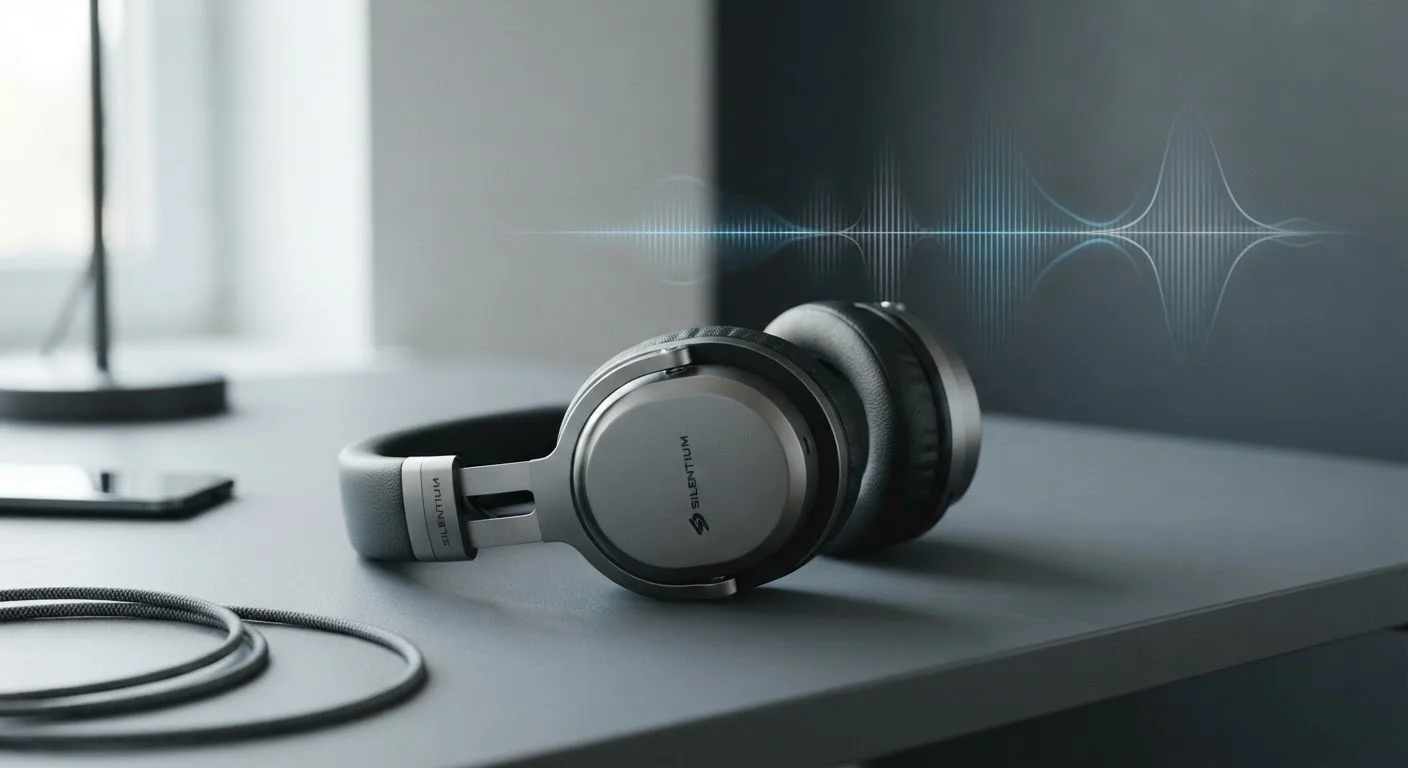
The Physics Behind the Silence
Sound is pressure: waves of compressed and rarefied air traveling through space. When two waves meet with equal amplitude but opposite phase - one pushing where the other pulls - they cancel each other out. This phenomenon is called destructive interference, and it's the foundation of every noise-canceling headphone on the market.
Inside ANC headphones, one or more small microphones (typically positioned on the outer earcup) continuously sample incoming sound. A dedicated processor analyzes that audio signal in real time and generates an inverted copy - a waveform that is mathematically the mirror image of the incoming noise. That anti-noise signal is fed into the headphone driver alongside your audio. When the two signals meet inside the ear cup, they largely cancel. You hear far less of the original ambient sound.
The entire cycle - capture, invert, emit - must happen fast enough to stay in sync with the incoming noise. That latency challenge is why processing power matters, and why cheaper implementations can feel less effective or introduce a faint hissing artifact.
ANC Feels Different from Quiet
Some people find ANC creates a subtle sense of pressure in the ears, even without sound playing. This isn't hearing damage - it's a perceptual effect from the altered acoustic environment inside the ear cup. If you find the sensation uncomfortable, many headphones allow you to reduce ANC intensity or switch it off while keeping passive isolation active.
Why Some Noises Disappear and Others Don't
ANC is genuinely impressive against certain sounds and noticeably limited against others. The difference comes down to predictability and frequency.
Low-frequency, steady sounds - airplane cabin rumble, air conditioning hum, train engines - are the ideal targets. They repeat consistently, giving the processor enough information to build an accurate anti-noise signal. This is where ANC earns its reputation.
Higher-frequency and unpredictable sounds - voices, keyboard clicks, sudden sharp noises - are much harder to cancel. Speech, for example, shifts in pitch and rhythm constantly. By the time the processor has characterized the sound and generated the opposing signal, the source has already changed. The anti-noise is always slightly behind, reducing effectiveness.
~30 dB
Typical low-frequency noise reduction from ANC
Independent acoustic measurements generally show well-implemented ANC reducing low-frequency noise by up to 30 decibels - roughly equivalent to moving from a loud restaurant to a quiet library at those frequencies.
Under 1 ms
Required processing latency for effective ANC
To cancel sound accurately, the ANC processor must analyze and invert the incoming waveform in under one millisecond - a key reason chipset quality directly affects real-world performance.
This is also why "noise-canceling" headphones marketed for open-plan offices may still let coworker conversations bleed through. The marketing isn't necessarily wrong - background HVAC and building noise do get reduced - but don't expect conversations to vanish entirely.
Passive Isolation: The Unsung Partner
ANC doesn't work alone. Every over-ear or in-ear headphone that includes active cancellation also relies on passive noise isolation - the physical barrier created by the earcup seal or ear tip fitting snugly against your ear.
Passive isolation handles mid-to-high frequencies reasonably well on its own. ANC covers the low-frequency range where physical materials are less effective. Together, they complement each other across the full spectrum of noise.
Check Your Ear Tip or Earcup Fit First
Before assuming ANC is underperforming, check your seal. Try a different ear tip size on in-ears, or adjust the headband on over-ears to ensure the earcups sit flush. A proper seal is often the single biggest factor in perceived noise cancellation - more than any spec on the box.
This layered approach also explains why fit matters so much. A loose seal - whether from worn earcup foam, a wrong ear tip size, or simply a headphone design that doesn't match your ear shape - degrades both passive isolation and, indirectly, ANC performance. The system is tuned to work with a specific acoustic environment inside the ear cup; break that seal and the math no longer holds.
If you're curious how audio engineering decisions affect real listening experiences at home, the home audio myths piece covers how similar physical and acoustic factors shape sound in speaker setups too.
Feedforward, Feedback, and Hybrid Systems
Not all ANC implementations are identical. The microphone placement determines the approach:
- Feedforward ANC: Microphone is on the outside of the earcup, sampling noise before it reaches your ear. Reacts quickly but can't correct errors inside the ear cup.
- Feedback ANC: Microphone sits inside the earcup, close to the driver. It hears what you hear, allowing self-correction - but has less time to react to incoming sound.
- Hybrid ANC: Uses both placements simultaneously. The dual-microphone setup combines the early warning of feedforward with the accuracy of feedback, generally delivering the most thorough cancellation.
Hybrid systems require more processing power and more battery - which is part of why headphones that list impressive ANC specs tend to also list higher power consumption. There's no free lunch in signal processing.
For a broader look at how audio engineering choices shape what you hear, the Home Audio hub covers speaker and room acoustics in the same plain-language style.
Frequently Asked Questions
Yes. ANC operates independently of playback - the headphones can reduce ambient sound even in silence mode. Many people use this feature on planes or in loud offices purely for quiet, without listening to anything.
Human speech is highly variable in pitch and timing, making it hard for the ANC processor to create an accurate opposing waveform fast enough. The system works best against steady, predictable low-frequency sounds, not dynamic ones like conversation.
It can introduce a very slight coloration - often described as a subtle pressure sensation or minor tonal shift - though modern processors minimize this. Turning ANC off may reveal a marginally different sound signature, but the difference is small on well-engineered headphones.
Passive isolation is purely physical - the earcup seal blocks sound mechanically, similar to earplugs. ANC is electronic and actively cancels sound waves. Most over-ear headphones combine both for the best overall noise reduction.
Yes. Running ANC requires continuous microphone input and real-time signal processing, which consumes extra power. Most headphones offer an ANC-off mode specifically to extend battery life when you don't need it.
The content on this site is for informational purposes only and is not a substitute for professional advice. Always consult a qualified professional for guidance specific to your situation.